The written works of nature's leading advocates—from Charles Sumner and John Muir to Rachel Carson and President Jimmy Carter, to name a few—have been the subject of many texts, but their speeches remain relatively unknown or unexamined. Green Voices aims to redress this situation. After all, when it comes to the leaders, heroes, and activists of the environmental movement, their speeches formed part of the fertile earth from which uniquely American environmental expectations, assumptions, and norms germinated and grew. Despite having in common a definitively rhetorical focus, the contributions in this book reflect a variety of methods and approaches. Some concentrate on a single speaker and a single speech. Others look at several speeches. Some are historical in orientation, while others are more theoretical. In other words, this collection examines the broad sweep of US environmental history from the perspective of our most famous and influential environmental figures.
eBook - ePub
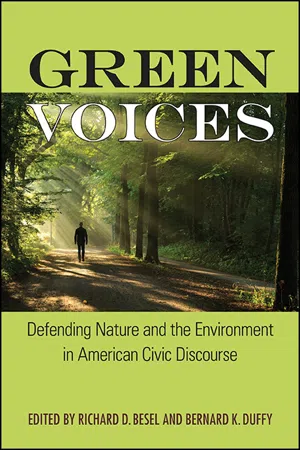
Green Voices
Defending Nature and the Environment in American Civic Discourse
- 414 pages
- English
- ePUB (mobile friendly)
- Available on iOS & Android
eBook - ePub
Green Voices
Defending Nature and the Environment in American Civic Discourse
About this book
Information
ONE
Coming to Grips with the Size of America’s Environment
Charles Sumner Says Farewell to Montesquieu
MICHAEL J. HOSTETLER
Firm like the oak may our blest nation rise,
No less distinguished for its strength than size.
No less distinguished for its strength than size.
—Charles Pinckney Sumner, 1826

Sumner’s three texts are related to the cluster of issues surrounding what George Steiner has called the “American Dimension,” the overwhelming physical environment of North America.2 It is a perspective on the environment largely lost in the twenty-first century. Today, Americans are accustomed to seeing the environment as in need of protection from economic exploitation and population growth. It has not always been so. In the eighteenth century and for much of the nineteenth, it was not that voracious development threatened the environment, but that the environment threatened America’s political economy.3 The particular characteristic of the environment that so threatened the political order was its enormity. The nation’s outrageous size was mind-boggling to Europeans and constituted a quintessential American political dilemma from the time of the founding.4
James Madison had strenuously argued in Federalist No. 14 against Montesquieu’s view that republican governments were impossible in large territories. The practical and theoretical issues of geographical size, however, recurred as the nation grew. The purchase of Louisiana5 and the prolonged national debate over internal improvements6 are just two examples. By the end of the Civil War the country stretched to the Pacific Ocean, but the proposed purchase of Russian America opened up some of the old objections to growth, objections that Sumner countered in his philosophy of continentalism. His philosophy supported a position that lay somewhere between the unbridled boosterism of the early proponents of growth and the more sinister imperialism that was to appear as the twentieth century approached.7 For Sumner, the question of size had moved away from matters such as transportation and communication, argued without resolution in recurring debates about “internal improvements,” back to issues of political philosophy reminiscent of Madison’s quarrel with Montesquieu. Sumner’s pointed reference to Montesquieu in the magazine article he wrote shows that the echo of previous debates about the size of a republic had grown faint but not inaudible. Not surprisingly, the debate tended to be rekindled on the occasion of large acquisitions of territory like the Alaska Purchase. As others who addressed the issue of the nation’s size, Sumner wrestled with the tension between the unity he deemed essential to America’s destiny and the mammoth dimensions of the North American continent, which he saw the United States occupying. Within this tension lay the huge environment’s threat to the Republic. From Sumner’s perspective, the tension is resolved and the threat removed through the extension of what he called “republican institutions.”
Charles Sumner’s discourse provides a distinct example of how Americans sought to come to grips with the size of North America’s environment. A careful reading of the three interrelated texts he produced in 1867 helps explain the intersection of rhetoric and geography in America and reveals, among other things, a perspective, now lost, that viewed the environment as threatening, not threatened. These insights depend on reading the three rhetorical artifacts—speech, essay, and lecture—as closely related parts of a single broader argument regarding national expansion. Based on this reading, Sumner’s rhetoric can be seen as a multitextual example of what rhetorical critics Michael Leff and Andrew Sachs call “rhetorical iconicity,” a quality of discourse in which the form of expression imitates and reinforces the substance of what is expressed.8 In this case, both the unity of Sumner’s discourse and its patient, capacious style mirror his whole idea of continentalism.9 Furthermore, the very means Sumner adopted to propagate his views reflects his underlying philosophy. The effort he expended in publishing his otherwise unavailable Senate speech, the appearance of his essay in a popular magazine, and his personal appearances on a lecture tour all serve to enact his belief that the United States’ continental empire could only be built on republican principles, the most important of which was the consent of the governed. In the end, Sumner’s continentalism offered the promise to tame the threat of the continent’s outsized environment. It achieved this not through the inexorable, naturalistic processes associated with late nineteenth-century imperialism, but by promoting a vision of a unified nation both occupying a huge continent and grounded in republican virtue.
CONTINENTALISM IN THREE PARTS
Charles Sumner’s visionary continentalism is fully expressed in the three major statements he wrote between April and November of 1867. Before looking more closely at these texts, a brief overview of them is in order. First is the speech he gave to the Senate on April 8, in support of the Alaska treaty.10 Sumner spoke for nearly three hours from a single page of notes.11 Since the Senate had met in executive session, the record of the speech was not made public. Therefore, after the debate Sumner felt obliged to prepare a manuscript version of his speech for publication to put his views on the record. “The Cession of Russian America to the United States” was published about six weeks after ratification. The speech is mostly remembered for its lengthy and exhaustive treatment of the natural resources of Alaska. In his Pulitzer Prize–winning biography of Sumner, David Herbert Donald observes that it “was a remarkably accurate and well-informed conspectus of the history and natural resources of the new territory, and it was influential both in shaping public opinion at large and in persuading members of the lower House to appropriate the purchase price specified in the treaty.”12
Following publication of his speech about Russian America, Sumner set to work on an essay about American destiny entitled “Prophetic Voices about America: A Monograph,” which appeared in The Atlantic Monthly in September.13 The article documents the opinions and prognostications of fourteen celebrated individuals, mostly from the eighteenth century, who spoke of the future development of the United States,14 especially in regard to its physical growth. Sumner’s idea of prophecy involves the prescient wisdom of sagacious men more than the transcendent predictions of seers. For example, he cites Sir Thomas Browne, who wrote in the 1680s that “when America shall be so well peopled, civilized, and divided into kingdoms, they are like to have so little regard of their originals as to acknowledge no subjection unto them.”15 Sumner thinks that Browne’s remark was borne out by the American Revolution. He claims that his purpose in collecting such “prophecies” is that, “brought together into one body, on the principle of our national Union, E pluribus unum, they must give new confidence in the destinies of the Republic.”16 The primary destiny Sumner has in mind is continentalism, which he describes as “that coming time when the whole continent, with all its various States, shall be a Plural Unit, with one Constitution, one Liberty, and one Destiny.”17
The last product of Sumner’s rhetorical labor of 1867 is the lecture “Are We a Nation?”18 which he delivered twenty-six times, beginning in Pontiac, Michigan, on October 7, and concluding at New York’s Cooper Union on November 19.19 In it, Sumner argues that the United States is indeed a nation, especially since the defeat in the Civil War of nationalism’s nemesis, states’ rights. Furthermore, American nationalism is grounded in politics “rather than unity of blood or language.”20 Based on the political principles of the Declaration of Independence, Sumner foresees a time when “local jealousies and geographical distinctions will be lost in the attractions of a common country. Then, indeed, there will be no North, no South, no East, no West; but there will be One Nation.”21
As a s...
Table of contents
- Cover
- Title
- Copyright
- Contents
- Foreword
- Acknowledgments
- Introduction: Green Voices in the Swelling Chorus of American Environmental Advocacy
- 1. Coming to Grips with the Size of America’s Environment: Charles Sumner Says Farewell to Montesquieu
- 2. “I had been crying in the wilderness”: John Muir’s Shifting Sublime Response
- 3. Theodore Roosevelt and the Progressive Impulses of Conservation
- 4. See America First! The Aesthetics of Environmental Exceptionalism
- 5. A Call to Partnership, Health, and Pure Fire: A Vital Vision of the Future in Aldo Leopold’s “The Farmer as a Conservationist” Address
- 6. “Conserving not scenery as much as the human spirit itself”: The Environmental Oratory of Sigurd Olson
- 7. “What’s wrong with a little emotion?” Margaret E. Murie’s Wilderness Rhetoric
- 8. Rachel Carson’s War of Words Against Government and Industry: Challenging the Objectivity of American Scientific Discourse
- 9. Mortification and Moral Equivalents: Jimmy Carter’s Energy Jeremiad and the Limits of Civic Sacrifice
- 10. Lois Gibbs’s Rhetoric of Care: Voicing a Relational Ethic of Compassion, Inclusivity, and Community in Response to the Toxic Disaster at Love Canal
- 11. Frank Church’s Natural Place in American Public Address: Light Green Orations That Saved “The River of No Return Wilderness”
- 12. “We will live to piss on their graves”: Edward Abbey, Radical Environmentalism, and the Birth of Earth First!
- 13. “I’m angry both as a citizen and a father”: Robert F. Kennedy Jr.’s Melodramatic Discourse on the Environmental Consequences of “Crony Capitalism”
- 14. Ashley Judd’s Indictment of Mountaintop Removal Coal Mining: A Stain on the Conscience of America
- 15. Environmental Racism and Environmental Justice: Benjamin Chavis Jr. and Issues of Definition and Community
- About the Contributors
- Index
- Back Cover
Trusted by 375,005 students
Access to over 1.5 million titles for a fair monthly price.
Study more efficiently using our study tools.
Frequently asked questions
Yes, you can cancel anytime from the Subscription tab in your account settings on the Perlego website. Your subscription will stay active until the end of your current billing period. Learn how to cancel your subscription
No, books cannot be downloaded as external files, such as PDFs, for use outside of Perlego. However, you can download books within the Perlego app for offline reading on mobile or tablet. Learn how to download books offline
Perlego offers two plans: Essential and Complete
- Essential is ideal for learners and professionals who enjoy exploring a wide range of subjects. Access the Essential Library with 800,000+ trusted titles and best-sellers across business, personal growth, and the humanities. Includes unlimited reading time and Standard Read Aloud voice.
- Complete: Perfect for advanced learners and researchers needing full, unrestricted access. Unlock 1.5M+ books across hundreds of subjects, including academic and specialized titles. The Complete Plan also includes advanced features like Premium Read Aloud and Research Assistant.
We are an online textbook subscription service, where you can get access to an entire online library for less than the price of a single book per month. With over 1.5 million books across 990+ topics, we’ve got you covered! Learn about our mission
Look out for the read-aloud symbol on your next book to see if you can listen to it. The read-aloud tool reads text aloud for you, highlighting the text as it is being read. You can pause it, speed it up and slow it down. Learn more about Read Aloud
Yes! You can use the Perlego app on both iOS and Android devices to read anytime, anywhere — even offline. Perfect for commutes or when you’re on the go.
Please note we cannot support devices running on iOS 13 and Android 7 or earlier. Learn more about using the app
Please note we cannot support devices running on iOS 13 and Android 7 or earlier. Learn more about using the app
Yes, you can access Green Voices by Richard D. Besel, Bernard K. Duffy, Richard D. Besel,Bernard K. Duffy in PDF and/or ePUB format, as well as other popular books in Biological Sciences & North American History. We have over 1.5 million books available in our catalogue for you to explore.