- 281 pages
- English
- PDF
- Available on iOS & Android
About this book
Explores the revolutionary potential of Bruce Lee and hip hop culture in the context of antiglobalization struggles and transnational capitalism.
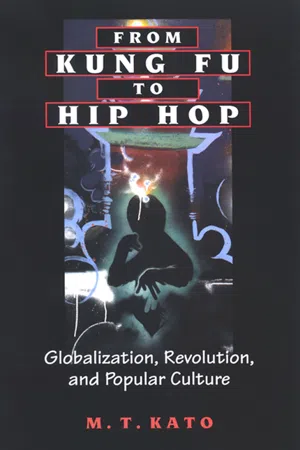
From Kung Fu to Hip Hop looks at the revolutionary potential of popular culture in the sociohistorical context of globalization. Author M. T. Kato examines Bruce Lee's movies, the countercultural aesthetics of Jimi Hendrix, and the autonomy of the hip hop nation to reveal the emerging revolutionary paradigm in popular culture. The analysis is contextualized in a discussion of social movements from the popular struggle against neoimperialism in Asia, to the antiglobalization movements in the Third World, and to the global popular alliances for the reconstruction of an alternative world. Kato presents popular cultural revolution as a mirror image of decolonization struggles in an era of globalization, where progressive artistic expressions are aligned with new modes of subjectivity and collective identity.
Frequently asked questions
- Essential is ideal for learners and professionals who enjoy exploring a wide range of subjects. Access the Essential Library with 800,000+ trusted titles and best-sellers across business, personal growth, and the humanities. Includes unlimited reading time and Standard Read Aloud voice.
- Complete: Perfect for advanced learners and researchers needing full, unrestricted access. Unlock 1.4M+ books across hundreds of subjects, including academic and specialized titles. The Complete Plan also includes advanced features like Premium Read Aloud and Research Assistant.
Please note we cannot support devices running on iOS 13 and Android 7 or earlier. Learn more about using the app.
Information
Table of contents
- From Kung Fu to Hip Hop
- Contents
- Illustrations
- Acknowledgments
- Introduction: On Popular Cultural Revolution
- 1. Kung Fu Cultural Revolution and Japanese Imperialism
- 2. Burning Asia: Bruce Lee’s Kinetic Narrative of Decolonization
- 3. Mutiny in the Global Village
- 4. Enter the Dragon, Power, and Subversion in the World of Transnational Capital
- 5. Game of Death and Hip Hop Aesthetics
- Conclusion: From Possibility to Actualization of Another World
- Notes
- Bibliography
- Index