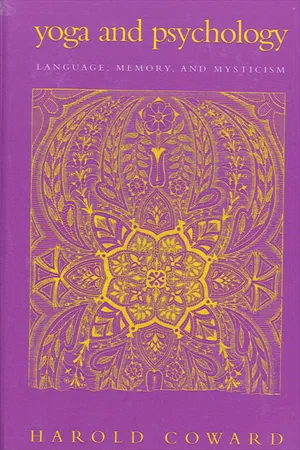
Yoga and Psychology
eBook - PDF

Yoga and Psychology

Language, Memory, and Mysticism

  1. 125 pages
  2. English
  3. PDF
  4. Available on iOS & Android
eBook - PDF

Yoga and Psychology

Language, Memory, and Mysticism

About this book

Explores the influence of yoga in the seminal Indian philosophy of Bhartrhari and in the Western psychology of Freud, Jung, and the transpersonalists, providing unique insights into the differences between Eastern and Western concepts of human nature.

Harold Coward explores how the psychological aspects of Yoga philosophy have been important to intellectual developments both East and West. Foundational for Hindu, Jaina, and Buddhist thought and spiritual practice, Patañjali's Yoga Sutras, the classical statement of Eastern Yoga, are unique in their emphasis on the nature and importance of psychological processes. Yoga's influence is explored in the work of both the seminal Indian thinker Bhartrhari (c. 600 C.E.) and among key figures in Western psychology: founders Freud and Jung, as well as contemporary transpersonalists such as Washburn, Tart, and Ornstein..

Coward shows how the yogic notion of psychological processes makes Bhartrhari's philosophy of language and his theology of revelation possible. He goes on to explore how Western psychology has been influenced by incorporating or rejecting Patañjali's Yoga. The implications of these trends in Western thought for mysticism and memory are examined as well. This analysis results in a notable insight, namely, that there is a crucial difference between Eastern and Western thought with regard to how limited or perfectible human nature is-the West maintaining that we as humans are psychologically, philosophically, and spiritually limited or flawed in nature and thus not perfectible, while Patañjali's Yoga and Eastern thought generally maintain the opposite. Different Western responses to the Eastern position are noted, from complete rejection by Freud, Jung, and Hick, to varying degrees of acceptance by transpersonal thinkers.

Frequently asked questions

Yes, you can cancel anytime from the Subscription tab in your account settings on the Perlego website. Your subscription will stay active until the end of your current billing period. Learn how to cancel your subscription.
At the moment all of our mobile-responsive ePub books are available to download via the app. Most of our PDFs are also available to download and we're working on making the final remaining ones downloadable now. Learn more here.
Perlego offers two plans: Essential and Complete
  • Essential is ideal for learners and professionals who enjoy exploring a wide range of subjects. Access the Essential Library with 800,000+ trusted titles and best-sellers across business, personal growth, and the humanities. Includes unlimited reading time and Standard Read Aloud voice.
  • Complete: Perfect for advanced learners and researchers needing full, unrestricted access. Unlock 1.4M+ books across hundreds of subjects, including academic and specialized titles. The Complete Plan also includes advanced features like Premium Read Aloud and Research Assistant.
Both plans are available with monthly, semester, or annual billing cycles.
We are an online textbook subscription service, where you can get access to an entire online library for less than the price of a single book per month. With over 1 million books across 1000+ topics, we’ve got you covered! Learn more here.
Look out for the read-aloud symbol on your next book to see if you can listen to it. The read-aloud tool reads text aloud for you, highlighting the text as it is being read. You can pause it, speed it up and slow it down. Learn more here.
Yes! You can use the Perlego app on both iOS or Android devices to read anytime, anywhere — even offline. Perfect for commutes or when you’re on the go.
Please note we cannot support devices running on iOS 13 and Android 7 or earlier. Learn more about using the app.
Yes, you can access Yoga and Psychology by Harold Coward in PDF and/or ePUB format, as well as other popular books in Theology & Religion & Eastern Philosophy. We have over one million books available in our catalogue for you to explore.

Table of contents

  1. Yoga and Psychology
  2. Contents
  3. Preface
  4. 1. Introduction
  5. Part I: Yoga and Language
  6. Part II: Yoga and Western Psychology
  7. Notes
  8. Glossary of Sanskrit Terms
  9. Index