![]()
1
The Framework
Only the genuine Buddhists (those who have Dhamma and know the Buddha) can conserve Nature, while those who are Buddhists in name alone cannot do it. True Buddhists are able to conserve the deeper Nature, that is, the mental Nature. Non-genuine Buddhists can't conserve Nature, even the material kind. When the mental Nature is well conserved, the outer material Nature will be able to conserve itself.
—Buddhadasa Bhikkhu1
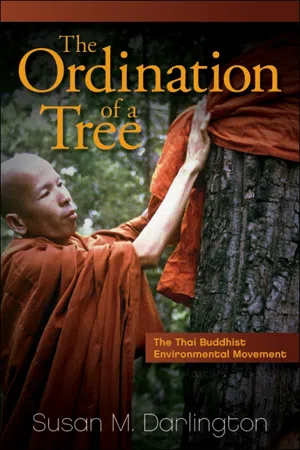
THE IMAGE of ordaining a tree sparks strong reactions. A scholarly debate surrounds the degree to which Buddhism is inherently environmental, but that debate remains primarily abstract: whether the Buddha raised concerns for the suffering of the natural world or focused primarily on humans; whether Buddhist scriptures encompass an environmental ethics; and what Buddhist concepts of nature are (Harris 1991; Holder 2007; Schmithausen 1997). The idea of wrapping a tree in a monk's orange robes in order to preserve the forest goes beyond these debates. The question of whether a tree can even be ordained because that status is reserved solely for humans aside (see Blum 2009; Darlington 2009), the act raises issues of politics, economics, inequalities, and power. What can religion offer these situations? In Thailand, Buddhism is a lived religion, one that responds to ever-changing circumstances and a variety of agendas. How it is interpreted and acted upon impacts not only how people perceive the world and their place within it, but their social responsibilities as well. Ordaining a tree is a radical, provocative, and controversial act that challenges people to take responsibility—for themselves, the society, and the natural environment.
Environmentalism captured the Thai imagination in the latter half of the twentieth century. While the issues involved ranged from urban pollution to hydroelectric dams to resource depletion, nothing seemed to occupy the growing environmental movement more than deforestation. What happens to trees is part of a much larger, complex problem, but trees matter.2 They are tangible reminders of the power of the natural world, homes for not only birds, monkeys, and tigers, but, in the Thai world, spirits as well. And they symbolize the predominant religion in the country, Buddhism, because of the Buddha's intimate relationship with trees: He was born in Lumbini grove, enlightened under a bodhi tree, and physically passed (parinibbana, Pali) under a grove of sal trees. Not all trees are sacred, but they have come to embody the debates, struggles, successes, and failures of environmentalism in Thailand, particularly the efforts of a small number of Buddhist monks engaged in conserving forests, protecting wildlife, and changing the imbalance of negative effects of resource degradation and livelihood choices.
Five images of sacred trees encapsulate the evolution of what has become a Buddhist environmental movement in Thailand. The first is of the numerous trees with colorful cloths tied around their trunks (Plate 1). They are usually found in temple compounds but exist quietly in other auspicious sites across the country. Little notice is taken of them as Thai Buddhists proceed about their daily lives. They are just there.
The second image occurs in a dark forest (Plate 2). A Buddhist monk reaches around a moderately sized tree, tying an old orange robe with no fanfare. He utters a quiet incantation, but not loud enough for observers to hear. Nearby a small number of lay villagers do the same, marking trees throughout the forest as valuable to someone.
Far more conscious and conspicuous is the image of twenty monks seated near a large tree in the mountains of Nan Province. The monks chant, connected with each other and the tree by a white thread that conveys sanctity from the words to the tree. Shortly thereafter two monks wrap a tightly twisted orange robe around the wide circumference of the tree (Plate 3). The act is documented by multiple photographers, and witnessed by more than two hundred people—villagers, nongovernmental workers, and academics. A sign nailed to the tree reads, “Tham lai pa khue tham lai chat,” which can be translated as “To harm the forest is to harm life,” or alternatively, “To harm the forest is to harm one's future lives,” or “the nation” (Darlington 1998, 10).
Henry Delcore provides the fourth image through his description below, the setting of a tree ordination performed in 1996:
The focus of the ritual space was the altar at the front of the clearing, a tiered structure of carved wood tables four feet wide and five feet tall, the lower levels occupied by candles, flowers and incense, the top level by a foot-tall Buddha image. To the right of the altar stood an easel with a photo portrait of the King, set about level with the Buddha image. To the left of the altar was a folding table with the microphone for the public address system, where speakers stood to address the crowd later in the day. Directly to the right of the altar were chairs for the monks, who had not yet arrived. Eventually, another cluster of chairs formed near the monk section and would be occupied by the local officials and other honored guests in attendance; the villagers sat on mats on the ground…. Each ordination made use of a primary cloth marked by the kanchana-phisek symbol [the seal of the current Chakri Dynasty], which was tied to the “mother tree,” the largest tree in the area. A large number of smaller, unmarked cloths, all the saffron color of monks' robes, were also tied by participants to trees in the area. A saay sin—a white string used in many Thai rituals to symbolically bind together the khwan—had been tied to the Buddha image on the altar, and ran around the entire clearing area, encompassing the participants. (Khwan is a kind of soul stuff possessed by both animate and inanimate entities.) Over the altar, a twenty foot long banner announced the formal title of the forest ordination program: “Program for the Community Forest Ordination of 50 Million Trees in Honor of the King's Golden Jubilee.” (Delcore 2004b, 11–12)
The last image is the most recent, although forms of all the others continue to this day. Three beautiful, young Thai women pose holding a monk's robe around a large tree (Plate 4). Behind them a few other wrapped trees can be seen, but no other context identifies the place or the smiling women. The caption of this newspaper photograph reveals the women as contestants in the 2010 Miss Thailand Universe contest in Kamphaeng Phet Province (“Beauty Contestants Ordain Tree” 2010).3
All five images represent tree ordinations in Thailand. All but the first occurred since the late 1980s. The tree ordination—the ritual described in all but the first image—is the quintessential symbol of the Thai Buddhist environmental movement. Since the late 1980s a small number of monks have performed these rituals in which they consecrate a tree and the surrounding forest to bring attention to environmental problems, especially concerning the forests and water, that make life difficult for Thai villagers, and by implication, for the nation as a whole. The rituals and the trees wrapped in orange robes remind villagers of their dependence on the forest for their livelihoods—food, materials for daily life, and water. As monks depend on the laity for their material needs, so too the forest depends on the people who live around it for preservation. People can either protect the forest or cut it down. Monks concerned with the consequences of the latter use the image of ordained trees to encourage people to do the former.
The movement is not about trees per se, but the monks and the people with whom they live and work who must deal with the direct consequences of environmental destruction. In fact, the monk credited with performing the first tree ordination did not intend to ordain a tree. He performed a ritual to consecrate a forest and seedlings for reforestation to raise awareness of people's dependence on them and to object to deforestation occurring due to logging. The villagers who participated referred to the seedlings as “ordained trees” (ton mai buat), thereby coining the term that has come to identify a broader movement. Buddhist environmentalism is only one aspect of a larger, vibrant environmental movement in Thailand comprised of many interpretations and goals, a movement that Hirsch (1996, 15–16) describes as “a multi-faceted discourse that deals with key social, economic and political issues, including questions of control over resources by empowered and disempowered groups.”
The different manifestations of the “ordained tree” in the images above represent change in the forms, meanings, and control of the Buddhist environmental movement. They illustrate a general progression from an understated belief in spirits and honoring of the Buddha to ritual and symbolic invocation of the Buddha's teachings to protect the forest and the humans who depend on its resources, often in a manner that criticizes the direction of state-led economic development. The ritual eventually became associated with the king and the state, and even incorporated within popular culture, limiting the sanctity of the ritual in some cases while claiming its moral implications. At the same time, environmental monks continued to perform tree ordinations for their own, non-state projects. Some incorporated new approaches or shifted their focus to a more local rather than national level, countering the appropriation of their symbolic action. Behind these images lies a set of interrelated and contested discourses: of how Buddhism can and should be used in the modern, social world; of the goals of environmentalism and the relationship between humans and the natural world; of the meaning of “development,” and the related tensions between material growth and spiritual progress as measures of improving the lives of Thai citizens;4 of concepts of power and knowledge, and the construction and appropriation of new forms of knowledge, including interpretations of Buddhism itself.
This book is the story of the Thai Buddhist environmental movement, the monks involved, and the debated meanings underlying their actions. I look at the movement historically to place it into its larger context of socially engaged Buddhism in Thailand as monks responded to social, political, and economic changes that impacted people's perceptions and practice of the religion. Socially engaged Buddhism, a phrase coined by the Vietnamese monk Thich Nhat Hanh, refers to the active use of the religion and its teachings to address social issues, such as violence and war, economic development and inequalities, gender issues, and environmental degradation. I witnessed the rise of environmental Buddhism in Thailand in connection with other forms of socially engaged Buddhism.
Although a few monks first explicitly engaged in environmental issues in the 1980s, monks have been involved in social and political issues in diverse ways throughout Thai history. The sangha (the order of monks) formed one-third of the triad of Buddhist society—the sangha, the monarchy, and the laity. In Theravada Buddhist societies in particular the sangha and the monarchy supported and legitimated each other. Some monks challenged this system, either by removing themselves from the influence and control of the king to practice an austere lifestyle in remote forests, or, in the case of a small number of millenarian monks in Northeast Thailand and Burma, leading unsuccessful uprisings against the state (Ishii 1975; Keyes 1977). Other monks have been used by the state to promote its agendas, such as the forest monks in the early twentieth century who enabled the central state in Bangkok to expand its influence into peripheral regions, especially in the North-east (Tambiah 1996, 1984; Kamala 1997; J. Taylor 1993a). In the 1960s, Field Marshall Sarit Thanarat created Buddhist community development and missionary programs, Thammathud and Thammacharik, to push his economic development ideas and concepts of national identity into remote and border regions through the participation of monks (Ishii 1986, 115).
The monks with whom I am concerned here fall into another category of social activism. They do not support the state's objectives, and usually criticize the negative impacts of many state policies on rural people.5 In particular, as I conducted my initial research on the rural development work of a high-ranking monk in northern Thailand in the mid-1980s, I realized the links between independent “development monks” (phra nak phatthana) and the criticisms of state-led development and modernization that these monks articulated, with the “environmental monks” (phra nak anuraksa thamachat), those monks who focused on the effects of environmental changes (human-made) on people's lives. Both groups—even as the label “group” may be a misnomer because of the fluidity of these movements—took on political issues surrounding the direction of Thai society and economy. They did not aim to engage in politics directly, with a couple of exceptions, but through their interpretations of the causes of suffering faced by the lay people they served they saw it as their responsibility as monks to raise questions and challenge the power of political and business interests. They struggled against the power of greed, anger, and ignorance (the root evils in Buddhist teachings), but also the dominant social views and agendas (i.e., concepts of consumption and accumulation) grounded in those attitudes. Ultimately, development and environmental monks use and reframe religious practice and interpretations to legitimate not the government, but local people—those who usually have no power.
Engaged Buddhism and the Environment
The main goal of Buddhism is to relieve suffering. Suffering (dukkha, Pali) has a specific meaning in Buddhism. The leading Thai scholar monk, P. A. Payutto, defines dukkha as “suffering; misery; woe; pain; ill; sorrow; trouble; discomfort; unsatisfactoriness; problematic situation; stress; conflict” (1985, 380–81). The concept lies at the heart of the Four Noble Truths, a central set of Buddhist principles: There is suffering; There is a cause of suffering; There is a cessation of suffering; The path to the cessation of suffering is the Eight-fold Path (Payutto 1985, 181).6 The philosophical concept involves mental dissatisfaction as much as physical pain and the attachment to a concept of self. The distinctions between philosophical Buddhism and socially engaged Buddhism lie in how suffering is interpreted and the actions taken to relieve it. Buddhists have always addressed suffering as a philosophical, spiritual, and metaphysical state of being; socially engaged Buddhists add to this list social, political, and economic forms of suffering. In addition to the philosophical extinction of suffering (nibbana, Pali, or “enlightenment”), engaged Buddhists work to end suffering in the here and now, targeting the social, political factors that affect people's lives, especially those who have little or no power in society. They see social justice as crucial to being Buddhists.7
The term engaged Buddhism is attributed to Thich Nhat Hanh. During the war in Vietnam in the 1960s, he used Buddhist principles to work for social justice and peace. The concept of engaged Buddhism as a means of responding to modern social problems emerged concurrently in many Buddhist societies in the mid-twentieth century. Initially, activists who took a Buddhist approach focused on local issues and communities. Globalization not only brought capitalism and multinational business to Buddhist countries but also introduced alternative ideas intended to help people oppose dominant concepts of large-scale economic development and rapid growth. Buddhists concerned with social issues in different nations began to support each other as part of this process. In 1989, the Thai social activist Sulak Sivaraksa founded the International Network of Engaged Buddhists (INEB), a nonprofit organization that brings together Buddhists from around the world concerned with social justice. Information and ideas exchanged at INEB conferences and through the journal, Seeds of Peace, sparked new actions on local levels. The actions of engaged Buddhists, whose work is grounded in Buddhist philosophy, are contributing to a rethinking of the application of Buddhism in the modern world.
Among the many foci of engaged Buddhists is concern for the natural environment and the impact of its destruction on all forms of life. Thai environmental monks did not invent the idea of using Buddhism to deal with environmental issues. Buddhists across Asia and America point to scriptures that document reverence for nature and ground ecological activism in Buddhist teachings. His Holiness the Dalai Lama included environmental issues in his call to make Tibet a zone of peace; the Korean nun Jiyul Sunim fought the destruction of a sacred mountain to build a railway tunnel; and American Buddhists draw from different forms of Buddhism to express concerns about, and responsibility for, nuclear waste, deforestation, and water usage, to name only a few cases (for more examples, see Kaza and Kraft 2000; Tucker and Williams 1997). Beyond the Buddhist world, a movement linking religions of all kinds with ecology has been growing worldwide over the past several decades.8
Most of the literature on Buddhism and environmentalism focuses on the philosophical issues underlying this relationship. Some of it criticizes any claims to authenticity in the Buddhist scriptures or early Buddhism (Harris 1991, 1994, 1995, 1997; Schmithausen 1997). Others counter these critics through close documentation of the philosophical underpinnings of environmental concepts in Buddhism (Holder 2007; Swearer 1997). The irony is that most of this literature remains abstract. Socially engaged Buddhism is ultimate...