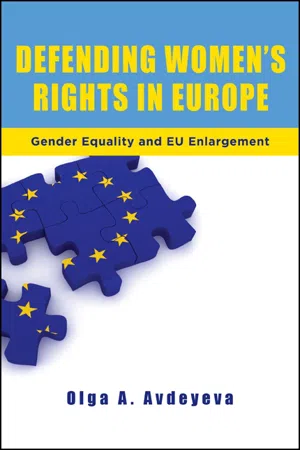
Between 2004 and 2007, ten post-communist Eastern European states became members of the European Union (EU). To do so, these nations had to meet certain EU accession requirements, including antidiscrimination reforms. While attaining EU membership was an incredible achievement, many scholars and experts doubted the sustainability of accession-linked reforms. Would these nations comply with EU directives on gender equality? To explore this question, Defending Women's Rights in Europe presents a unique analysis of detailed original comparative data on state compliance with EU gender equality requirements. It features a comprehensive quantitative analysis combined with rigorous insightful case studies of reforms in Poland, the Czech Republic, and Lithuania. Olga A. Avdeyeva reveals that policy and institutional reforms developed furthest in those states where women's advocacy NGOs managed to form coalitions with governing political parties. After becoming members of the EU, the governments did not abolish these policies and institutions despite the costs and lack of popular support. Reputational concerns prevented state elites from policy dismantling, but gender equality policies and institutions became marginalized on the state agenda after accession. This book is freely available in an open access edition thanks to Knowledge Unlatched—an initiative that provides libraries and institutions with a centralized platform to support OA collections and from leading publishing houses and OA initiatives. Learn more at the Knowledge Unlatched website at: https://www.knowledgeunlatched.org/, and access the book online at the SUNY Open Access Repository at http://hdl.handle.net/20.500.12648/1710.
- 286 pages
- English
- ePUB (mobile friendly)
- Available on iOS & Android
eBook - ePub
About this book
Trusted by 375,005 students
Access to over 1.5 million titles for a fair monthly price.
Study more efficiently using our study tools.
Information
I
EU Enlargement, Accession Conditionality, and Gender Equality
Theoretical Departures and Research Design
1
Introduction
On May 1, 2004, eight countries of the former communist bloc entered the European Union (EU) after almost a decade of accession negotiations and considerable reforms to their domestic institutions and legal codes.1 Two and a half years later on January 1, 2007, two other post-communist countries, Romania and Bulgaria, joined the European Union. These long-awaited events marked a historic moment and “a decisive phase” in eliminating “divisive structures in Europe” (Polish Government Delegation 1998).2 They also demonstrated a remarkable commitment by candidate states to transform their domestic policies, institutions, and practices, in order to fulfill accession requirements imposed by the European Commission (EC). In total, candidate states had to comply with thirty-five chapters of the European Community Law, also known as Aquis Communautaire. These documents comprise the primary and secondary legislation, objectives, substantive rules, policies, and case law which form the legal order of the European Union in social, political, economic, and legal affairs.
After the collapse of communism across Central and Eastern Europe (CEE) in 1989, the prospect of EU membership became a strong incentive for newly independent states to comply with EU accession requirements. They fervently sought membership in the European Union despite the potential high costs of domestic reforms and legal transformation. EU membership implied unprecedented support in the development of a market economy and the strengthening of democratic political institutions from Brussels, full integration with the EU economic and financial institutions, free movement of labor and goods, substantial investment in states’ infrastructures, and finally, but very importantly, acceptance and recognition of these states as members of the European community.
Each accession agreement, overseen by the European Commission, included a Social Chapter which encompassed ten directives on gender equality in the workplace and in social security calculation. Candidate states were required both to transpose these legal prescriptions into national law as well as to establish government institutions capable of enforcing these new codes at the national and local levels. While gender equality laws were not of prime importance to most of the governments in the post-communist Enlargement states, the European Commission emphasized the significance of gender equality directives by making them an indispensable part of membership conditionality.3 Regardless of the strong incentives to comply, the commentators of EU accession noted substantial variation in states’ commitment to transposing and enforcing gender equality directives (Avdeyeva 2009, 2010; Sedelmeyer 2009, 2012; Sloat 2004b; Watson and Lindenberg 2002). Lithuania and Slovenia were the frontrunners of state compliance with EU requirements on gender equality. Bulgaria, Estonia, Latvia, and Romania were reform laggards, only meeting the accession requirements shortly before the accession deadline. Poland, Hungary, and Slovakia saw periods of progressive reforms and dramatic reversals on gender equality while the neighboring Czech Republic made very modest steps in complying with minimum requirements. Until today, Latvia continues to lag behind in policy and institutional adjustment. What explains these puzzling variations in levels of state compliance with EU accession requirements on gender equality? To answer this question, I examine how domestic state and non-state political actors—women’s groups, political parties, opposition groups, and women politicians—influence national policy and policy enforcement.
The domestic dimension of compliance, however, is refracted by the international dimension, or the status of EU Enlargement states as regards to the European Union. The status of these states changed from aspirants seeking EU candidacy to EU candidate states, and finally, to EU member states. Each of these periods was characterized by a particular set of instruments used by the European Union to influence the behavior of Enlargement states. I identify three distinct mechanisms of EU influence, which I collectively call international pressures: conditionality, normative pressures, and social pressures. I explore the role of these mechanisms in the process of EU accession and their ability to produce a sustained change in state behavior. By normative pressures, or socialization, I mean EU strategies to influence normative positions of elites and public in EU Enlargement states. Such strategies are based on persuasion and include the following: recommendations for government policy, policy advice, and “policy teaching,” including soft law, training, conferences, and dissemination of educational policy materials. Importantly, these measures offer no reward or punishment for compliant or non-compliant behavior. The goal of these strategies is to produce congruence in values, beliefs, and policy positions on gender equality amongst the elites and public in EU Enlargement states, which I refer to as “normative congruence” throughout this book.
By social pressures or social influence, I mean a self-imposed and/or a group-imposed pressure to conform to practices and behaviors shared by other group members. The main assumptions for describing this mechanism of social influence are derived from social psychology and are based on the argument that actors’ environment influences their behavior (Aronson, Wilson, and Akert 2002). Social environment and actors that constitute it can alter the behavior of group members by emphasizing the role of social and cognitive costs (such as shaming, exclusion, and shunning) and social benefits (including praise, prestige, reputation, and recognition by others). Political scientists investigated the role of social pressures for explaining state behavior and found empirical support for the theory of social influence as applied to states (Johnston 2001, 2005; Kelley and Simmons 2012; Hafner-Burton and Tsutsui 2005). This mechanism of influence is distinctively different from normative pressures, where behavior of actors is explained by the degree of their normative fit or congruence (the more similar beliefs they hold, the more likely they are to act similarly). It is also very different from rationalist-, interest-, and preference-based explanations of behavior: actors are driven by social and cognitive benefits, such as group recognition and prestige, rather than by purely material interests. Another distinctive feature of social influence is in the degree of compliance with group expectations. In response to social pressures, actors demonstrate to other group members their respect and recognition of group practices and values even if they do not whole-heartedly embrace these values. Their goal is to assimilate others in the group and signal conformity with group values. The conformal behavior, however, does not necessarily produce changes in actors’ normative positions (change in deep-seated beliefs and values) and often result in formal superficial compliance with group norms. The conformal behavior, therefore, produces poor compliance with international requirements.
Finally, by conditional pressures, or conditionality, I mean the explicit connection between material incentives and compliant behavior. The extension of EU membership to candidate states is conditioned on their compliance with EU accession requirements. The transfer of conditional laws and institutions is often described as a coercive imposition of EU policy and institutional models on candidate states. During the accession process, the European Commission (EC) received unprecedented powers to review and evaluate the degree of state compliance with EU requirements and had powers to put accession negotiations at a halt in case of candidate state noncompliance. It is widely acknowledged that EU conditionality significantly altered the incentive structure for candidate states and enabled the EU to impose laws and institutions which these states would not have adopted otherwise (Grabbe 2006; Schimmelfennig and Sedelmeier 2005a,b; Vachudova 2005). The EC powers to punish states decreased significantly after states gained membership in the European Union, because it becomes costly and procedurally difficult to expel states from EU for noncompliance. This fact changes government calculation about the costs and benefits of compliance with EU requirements, especially if policy changes are costly and unpopular at home. While in some policy areas the European Commission continues to maintain similar conditional powers toward the member states (such as agricultural and competition policy areas), for most other policy areas the European Union relies on state voluntary observance of EU Directives. The European Commission does not have the same monitoring and enforcement capacity in member and candidate states. The monitoring process in a member state is not so rigorous and often relies on the third-party monitoring (such as interest groups and the public). The European Commission can initiate the infringement procedures against noncomplying states, but in the area of social policy in general, and gender equality in particular, the cases of infringement procedures are limited to legal violations of EU Directives (e.g., policy incongruence in member states with EU Directives). The powers of the Commission to monitor the enforcement of new policies are very limited. For instance, there are no cases of infringement procedures initiated against new member states which do not enforce adopted gender equality laws. For this reason, some commentators feared that conditional imposition of EU laws could regress upon states’ accession to the European Union; that is, once conditional requirements were removed, the states would no longer have any incentive to comply with Commission-imposed requirements, leading to institutional and policy reversals (Epstein and Sedelmeier 2008). But findings from various policy areas, including gender equality in the workplace, demonstrate the opposite: the EU Enlargement states strengthened their compliance with EU laws upon the accession and in a number of cases outperformed EU-15 states in levels of compliance with EU regulations (Blauberger 2009; Faulkner, Treib and Holzleithner 2008a,b; Grabbe 2005; Sedelmeier 2008; Toshkov 2008). What explains the stability of these reforms following accession? I offer several theoretical explanations to the question of compliance in the pre- and post-accession periods and explore the mechanisms of conditionality, normative congruence, and social pressures in shaping states’ compliance with international laws.
Argument
In my evaluation of international influences on state compliance, I find that EU conditionality based on the credible promise of membership had a large effect on (a) the adoption of policies and (b) the enforcement capacities of institutions regarding gender equality in the EU accession states. A detailed analysis reveals that candidate states significantly changed their domestic policies and established government institutions on gender equality to comply with EU accession requirements. Upon accession, new member states generally maintained those same high levels of reform and showed no signs of dramatically dismantling the policies or the institutions meant to support gender equality. This study speaks to the debate about the respective role of norms, social pressures, and incentives in explaining state compliance with international requirements. I emphasize the importance of membership conditionality, perceived and real incentives or benefits derived from compliance, and considerations of costs at the initial stages of inducing state compliance with EU accession requirements. Once granted membership, however, states become responsive to social pressures generated by the expectations of the European Commission and self-imposed by new member states of the Union. Such social pressures include the states’ desire to act in congruence with their formal commitments to the Union, thus signaling to all other parties that they are not deviant actors and that they can keep their promise to fulfill the obligations associated with membership. We observe that social pressures prevent the reversal of reforms upon state accession to European Union; however, they do not guarantee that compliance will continue to strengthen rapidly following their membership. Instead, we observe state conformity with EU requirements on gender equality that prevents dramatic reversals of policies or discontinuation of institutions, on the one hand, but which does not result in a strong state commitment to reforms, on the other hand. Rapid reforms during the accession period, therefore, lead to conformity with EU requirements after accession and result in superficial formalistic enforcement of new laws.
To explore the variations in state compliance with EU gender equality requirements, I test several hypotheses about the importance of domestic political actors and the levels of their mobilization in support of, or in opposition to, gender equality requirements. Specifically, I demonstrate that certain configurations of domestic political actors who support policies and institutions on gender equality significantly strengthened state compliance with EU requirements before and after accession to the European Union. In particular, I find that state compliance with gender equality directives was highest in times when a left-wing majority in national parliaments coincided with active advocacy from non-governmental organizations (NGOs) specializing in gender equality. These two actors produce a joint effect that is important for explaining the difference in state commitment to gender equality policies. I observe that left-wing governments, while on average more responsive to gender equality demands than right-wing governments, did not reach the highest levels of compliance without pressure from women’s NGOs. Active advocacy women’s NGOs often coul...
Table of contents
- Cover
- Title
- Copyright
- Dedication
- Contents
- List of Illustrations
- Acknowledgments
- Part I. Eu enlargement, Accession Conditionality, and Gender Equality: Theoretical Departures and Research Design
- Part II. Case Studies: International and Domestic Dimensions
- Appendix I
- Appendix II
- Appendix III
- Appendix IV
- Notes
- Personal Interviews
- References
- Index
- Back Cover
Frequently asked questions
Yes, you can cancel anytime from the Subscription tab in your account settings on the Perlego website. Your subscription will stay active until the end of your current billing period. Learn how to cancel your subscription
No, books cannot be downloaded as external files, such as PDFs, for use outside of Perlego. However, you can download books within the Perlego app for offline reading on mobile or tablet. Learn how to download books offline
We are an online textbook subscription service, where you can get access to an entire online library for less than the price of a single book per month. With over 1.5 million books across 990+ topics, we’ve got you covered! Learn about our mission
Look out for the read-aloud symbol on your next book to see if you can listen to it. The read-aloud tool reads text aloud for you, highlighting the text as it is being read. You can pause it, speed it up and slow it down. Learn more about Read Aloud
Yes! You can use the Perlego app on both iOS and Android devices to read anytime, anywhere — even offline. Perfect for commutes or when you’re on the go.
Please note we cannot support devices running on iOS 13 and Android 7 or earlier. Learn more about using the app
Please note we cannot support devices running on iOS 13 and Android 7 or earlier. Learn more about using the app
Yes, you can access Defending Women's Rights in Europe by Olga A. Avdeyeva in PDF and/or ePUB format, as well as other popular books in Politics & International Relations & 21st Century History. We have over 1.5 million books available in our catalogue for you to explore.