![]()
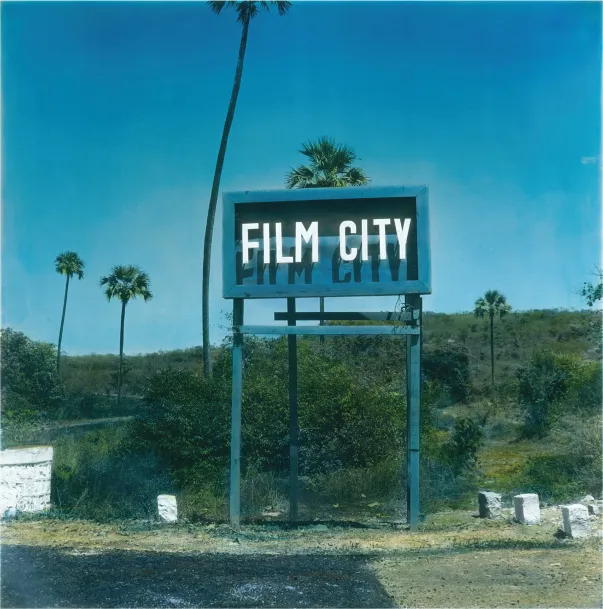
Film City, original hand-coloured photograph. © Olivier Richon.
Reproduced by permission of Olivier Richon.
one
Bombay before Bollywood
Film City Fantasies
When I first arrived in autumn 1979 at the modest bungalow in the leafy outskirts of Pune that housed the National Film Archive of India (NFAI), eager to see their paperwork collections, I was directed to one dusty cupboard in the corner of the small library. Inside, higgledy-piggledy, was a random collection of posters and film stills from the ‘new’ or ‘art’ cinema, alongside some stills from Hindi and Marathi classics of the 1950s and earlier. Once I had explained—to the consternation and bemusement of the library staff—that I was interested in the contemporary popular or mainstream Hindi cinema, a script of Vijay Anand’s 1965 film Guide was reluctantly retrieved for me. As it had been nominated for an Academy Award, I was assured that it was a ‘good’ mainstream film—a film of a better kind. I spent a few weeks dutifully working my way through this script and usefully improving my Hindi. But little more was on offer, although it is now clear that their vaults must have held much other uncatalogued material, albeit little of the then recent popular.
I soon gave up and made my way down to Bombay where I started to build my own collection of fan postcards and calendars of stars, film song-books and dialogue cassettes from the ubiquitous pavement vendors and small street stalls. I found a film-crazy college student as my unofficial tutor, visited the cinema with her twice or thrice a week, watched Doordarshan’s Sunday night movie and its film song show Chitrahaar with determined regularity and gradually, pincer-movement, made my way into the industry, watching first-hand how films were made. After a confusing twenty months in which I met almost all the Bombay cinema ‘greats’ alive in that era, I returned to London to attempt to make sense of it all, with no more than a handful of other scholarly works or databases to refer to. It was a daunting task. When I had first suggested this doctoral project to my social anthropology department, I was firmly discouraged on the grounds that ‘cinema isn’t culture’. When I presented a paper on Manmohan Desai’s films at a Pesaro conference in 1985, I was slow-clapped by the entire contingent of Cahiers du Cinema critics aligned along the front row. Today the situation for any researcher of Indian cinema has changed beyond all recognition, both at the National Film Archive in Pune and elsewhere. Part of the journey of this book is also the journey of this transformation.
THE CHALLENGE
Now that Indian cinema is at least a hundred years old—and possibly a decade older than that—it is time to take stock. Indian cinema studies has, largely over the past decade, become an established academic discipline with a fast-growing community of scholars based around the world. Much has been achieved since Barnouw and Krishnaswamy’s groundbreaking Indian Film of 1963, which had been my bible in the early 1980s.1 We have two scholarly encyclopaedias, a burgeoning body of academic and journalistic books and articles, at least three peer-reviewed journals in the field, digitised archives at NFAI, any number of films and film clips online—many with subtitles—and a mushrooming of databases, including collections of visual ephemera and songs, as well as a pioneering online encyclopaedia wiki project.2 It has never been easier to find material.
But, with this plenitude comes a danger: as academic and journalistic projects accumulate, certain versions of Indian cinema history are becoming fossilised and assumptions and assertions about the form are being uncritically recycled, as I will discuss. While there is an abundance of online and other information, the resources for critical evaluation of this material are more limited. Moreover, the archives of early Indian cinema, both films and documents, are notoriously scanty in comparison with film industries elsewhere in the world, a point to which I will return.
The current book is both an intervention and itself an archival repository of sorts. By way of intervention, I will be arguing that, now that the discipline has reached critical mass and is ready for take-off, it is urgent that we encourage more stories to be told about Indian cinema and that we reassess some of the myths and hazy generalisations that have grown up around its history. This includes building—and stressing—a more nuanced picture of India’s earliest films and film-makers that, among other things, represents the true balance between mythologicals, stunts, fantasies and other genres within that early history, as well as the dominance of American and European films in that era.3 This process should also include a reassessment of the significance of the B- and C-circuits throughout Indian cinema history and recognition of the dangers of carving this history into monolithic eras.4 While some scholarly works—notably Ashish Rajadhyaksha and Paul Willemen’s Encyclopaedia of Indian Cinema, together with groundbreaking studies of the silent era by Kaushik Bhaumik and Virchand Dharamsey (on Bombay) and Stephen Hughes (on Madras)—have long been clear about this, their findings do not always get through to the accounts that flourish in the mainstream.5 Although the more journalistic histories are rarely completely wrong, their emphases can be decidedly misleading. But now that scholarship is growing and Indian cinema history can afford to become more complex and less pat, it is time for orthodoxies to be challenged.
Alongside this polemical thrust, the impetus for the current book stems from the recognition that I have myself accumulated a body of writing and research material over the past thirty years and it is time to reassess my own collection and to see what patterns emerge. The chapters that follow track a broadly chronological path, from the silent era to 1994, with a brief coda bringing us up to 2013. However, this is in no conventional sense a history of Bombay cinema. Instead, the book draws eclectically on diverse cinematic tropes and film artefacts across two key eras, pre-independence and the early 1980s. From these ‘clues and myths’, for the most part serendipitously found and intuitively followed, a map emerges that opens up alternative historical narratives and debates to shed new light on the films, their industry and their circulation.6 Thus, for example, two chapters in part one take ephemeral visual artefacts as their starting point (lobby cards, film stills, posters), while the chapters of part two are substantially based around ethnographic fieldwork. Although the book builds on discrete essays researched and written at different points in time and within varying conceptual frameworks, its overarching themes and arguments emerged as the chapters spoke to each other across three decades of Indian cinema scholarship.
BOMBAY BEFORE BOLLYWOOD
My title is a knowingly controversial one. At its simplest, Bombay Before Bollywood signals no more than that the book’s content focuses on mainstream Hindi cinema in the years before 1995—before the Shiv Sena renamed Bombay as Mumbai and before the moniker ‘Bollywood’ gained international currency as changes began to take root within India’s film industry in the wake of economic liberalisation. But the title also points up conundrums around two equally—if differently—contentious and slippery terms. The use or refusal of both has become significant in the modern world: while both ‘Mumbai’ and ‘Bollywood’ had been in use for many years before the mid-1990s, both terms are today crucially marked by who speaks them and from where.
For many Marathi and Gujarati speakers of Mumbai/Bombay, their home city has always been ‘Mumbai’ in their vernacular languages. Moreover, for many people outside India, both diasporic Asian and non-Asian, as well as for others within India, there is a compelling case for refusing the term Bombay, given its colonialist history and connotations. The city’s official name has been Mumbai since November 1995. On the other hand, many of the city’s inhabitants of all backgrounds, brought up within a proudly cosmopolitan metropolis, have always called their home Bombay and continue to assert their right to do so or to slip between Mumbai and Bombay, often within the same sentence.7 The term, for them, signals a celebration of the secular, multi-faith city with which they identify. In this book I have chosen to use the term Bombay to refer to the city and its film industry as I knew—and lived with—them before 1995 and the term Mumbai to refer to the city after that point.
The term ‘Bollywood’ is more subtly—and less politically—complicated. A well-rehearsed debate on what, exactly, Bollywood means, how it evolved and how it should—or should not—be used is still unresolved. As with all good histories there are contested myths of origin, with several people claiming to have invented the term.8 In fact, as Madhava Prasad points out, the term ‘Tollywood’ had existed since the 1930s to refer to films made in Tollygunge, Calcutta.9 The follow-on coinage of the term ‘Bollywood’ is likely to have arisen in a number of places independently. This matter is of little importance. For what it is worth, while I do remember the term’s occasional usage within Bombay film circles in the early 1980s, it had little wider currency at the time and was a flippant, slightly derogatory term that expressed the ambivalence of educated English-speaking middle-class Indians towards their own popular cinema.
The debate about the term ‘Bollywood’ today revolves around three issues: what it means, who uses it, and where. Crucially, the term is not unanimously used within the Mumbai industry, although it is becoming increasingly common among the younger generation. But many film-makers are openly hostile to the term—although they will happily tolerate it in the context of the global success of their own films. ‘Bollywood’ is of course widely used outside India, by both diasporic South Asians and non-Asians, and Rajinder Dudrah has argued for its special importance within this context.10 While Dudrah uses the term carefully and consistently, many others do not.11 To be fair, its meaning is extraordinarily elastic: most usually it refers to films made in Mumbai/Bombay within the populist conventions of spectacle and action, song and dance, music and stars. At times ‘Bollywood’ refers to those conventions themselves. Sometimes the term is used only of films made in Mumbai since the mid-1990s with a targeted appeal to the non-resident Indian (NRI) market; at other times, in popular parlance, Bollywood refers to all Indian films of all eras, or even to all films made by people of Indian origin anywhere in the world. The term may also refer, more broadly, to the contemporary Mumbai film industry, while more nuanced arguments building on a key intervention by Ashish Rajadhyaksha use it to refer to the agglomeration of cultural and entertainment industries that revolve around Hindi/Mumbai/Bombay/Indian cinema, in which the films themselves play a comparatively minor role.12 Whether the term refers to a set of conventions, a body of films or an industry, ‘Bollywood’ is a brand that sells everything from face cream to barbers’ stalls; from fashion to food; from dance classes to academic books. Crucially, as Ravi Vasudevan notes, it is a brand that sells India to the world.13 But, as Prasad and others point out, the effect of the term ‘Bolly...