- 206 pages
- English
- ePUB (mobile friendly)
- Available on iOS & Android
About this book
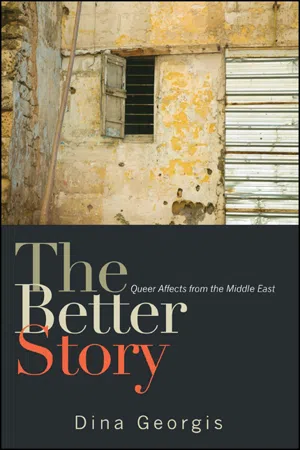
Finalist for the 2014 Next Generation Indie Book Awards in the GLBT category With a focus on aesthetic texts that narrate stories about or from the Middle East, The Better Story offers fresh insights into political conflict. Dina Georgis argues that narrative is an emotional resource for learning and for generating better political futures. This book suggests that narrative not only gives us insight into social constructs, but also leads us into understanding the enigmatic processes by which we become and give our "selfs" over to collective memories, histories, and identities. Stories link us to queer "forgotten" spaces that official history has discarded. The Better Story argues that feminist, queer, and postcolonial studies have not helped us think about lives that do not neatly fit into the valorized logic of resistance and emancipation.
Frequently asked questions
- Essential is ideal for learners and professionals who enjoy exploring a wide range of subjects. Access the Essential Library with 800,000+ trusted titles and best-sellers across business, personal growth, and the humanities. Includes unlimited reading time and Standard Read Aloud voice.
- Complete: Perfect for advanced learners and researchers needing full, unrestricted access. Unlock 1.4M+ books across hundreds of subjects, including academic and specialized titles. The Complete Plan also includes advanced features like Premium Read Aloud and Research Assistant.
Please note we cannot support devices running on iOS 13 and Android 7 or earlier. Learn more about using the app.
Information
Table of contents
- Title Page
- Preface: A Family Portrait
- Acknowledgments
- Introduction: What's in a Better Story, or Listening Queerly
- 1. Two Stories in One
- 2. When the Subaltern Speaks and Speaking of a Suicide
- 3. Terrorism and the Aesthetics of Love
- 4. Postcolonial Revolt: An Antihero in Search of Self
- 5. Discarded Histories and the Adjectives of Queer Pain
- Epilogue: The Story Never Ends
- Notes
- Bibliography