![]()
// 1 //
Early Baggage
Filmic Experimentation and Televisuality Retrieved as “Carry-On” Language
RYAN TRECARTIN CREATED Early Baggage (2001–03) during his tenure as an art student at Rhode Island School of Design. The series consists of four individual short videos: Valentine’s Day Girl (2001), Yo! A Romantic Comedy (2002), What’s the Love Making Babies For (2003), and Wayne’s World (2003), which are thematically and stylistically fully characteristic of his cinematic language. Viewers can already identify many of the defining formal elements that would firmly establish the artist’s style—fast-paced editing, superimposition, oblique camera angles, repetition, fragmented shots, and discontinuity. Early Baggage also introduces us to Trecartin’s recurring preoccupation with queerness, camp, the carnivalesque, and the grotesque and abject body. These early, pre-YouTube era videos clearly show that rather than gradually developing a visual vocabulary over time, he had already established a unique style at the outset of his career.
This is not to say that Early Baggage reveals all we mean when we speak of Trecartin’s work. While it encompasses some of his formal approach, it does not contain many of the motifs the artist has explored and developed in the course of his career to date. He initially established his language by merging, inverting, blending shots, and utilizing postproduction tools, while breaking basic rules of filmmaking: 180-degree rule, rule of thirds, and leading-line composition. He borrows a myriad of stylistic references and techniques from experimental filmmaking and television for his arsenal of unlimited effects. He draws influence from a trajectory of avant-garde films, which concerned themselves with the formal manipulation of the moving image, often utilizing manual alternative processes. Through his use of Apple iMovie postproduction software with its multitude of special effects such as overlay to achieve a superimposition effect, reverse function that inverts images, and instant replay to repeat shots, he pays homage to a long-standing tradition of experimental filmmaking.
While Trecartin’s digitally manipulated work may appear at first as a conglomeration of random software commands, these carefully selected effects play essential roles in inciting emotional responses from viewers. As I will be demonstrating throughout the body of this book, his aim is for his movies not to be simply watched but to be experienced. Trecartin’s work enacts the manic and overwhelming experiential stimulus of virtual technology through fast-paced editing and an overload of images, computer-generated special effects, and iconography directly inspired by contemporary modes of communication.
In addition to new technology and experimental filmmaking, television plays a major part in shaping Trecartin’s early work. The influence of TV and its effect on viewers is notable in Early Baggage, which is rich in pop culture references taken directly from television tropes such as the music video, commercial, soap opera, reality TV, and talk show, which he typically displays in rapidly expelled imagery and media sound bites.
Trecartin’s first series of videos demonstrates an acute awareness of the ways mass media impacts youth culture by examining how young people readily identify with consumer culture and create and perform their identity(ies) around it. The four-part series begins with Valentine’s Day Girl, a fantasy narrative about a teen girl, played by his friend and collaborator Lizzie Fitch, who has fallen victim to a holiday shopping obsession. Yo! A Romantic Comedy follows, featuring white suburban teenagers appropriating the vocabulary, body language, and street fashions characteristic of hip-hop culture. The low-tech creatures in What’s the Love Making Babies For then communicate through a dynamic instant text messaging dialect about gender and reproduction. Finally, in Wayne’s World, Trecartin ponders the significance of the content generated by mainstream forms of youth entertainment, by referencing MTV’s music videos, reality programs such as The Real World, and homespun community cable programming. Valentine’s Day Girl and Wayne’s World make for particularly interesting close readings, as both not only comment on the effects of media on youth culture but also demonstrate the direct correlation that exists early on in Trecartin’s art with avant-garde cinema and television.
Valentine’s Day Girl opens with a black screen. No image appears within the first thirty seconds, yet the manic soundtrack playing in the background foreshadows the frantic action that is about to unfold. Although Trecartin’s work is primarily visual in nature, he “intends his viewers to be listeners as well.” Linda Norden comments, “The best way to gain conversance in Trecartin’s work is to watch it—and listen to it—repeatedly.” Indeed, the tumultuous opening soundtrack meshes well with its fast-paced in-your-face visuals. The brief silence at the commencement of the opening scene is shattered by a digital cacophony that takes the viewer by surprise as a loud discordant mixture of electronic sounds, including video game buzz and computer system crash warning signals, sound off at full blast. Although the relentless noise is at first unpleasant, if one listens to it repeatedly, a certain rhythm is identifiable, in which sounds are repeated in a sequential order that progressively accelerate until each note and vibration converge to create a sort of techno-clash melody. This overwhelming symphonic expulsion actually prepares us for full immersion into Trecartin’s saturated visual style.
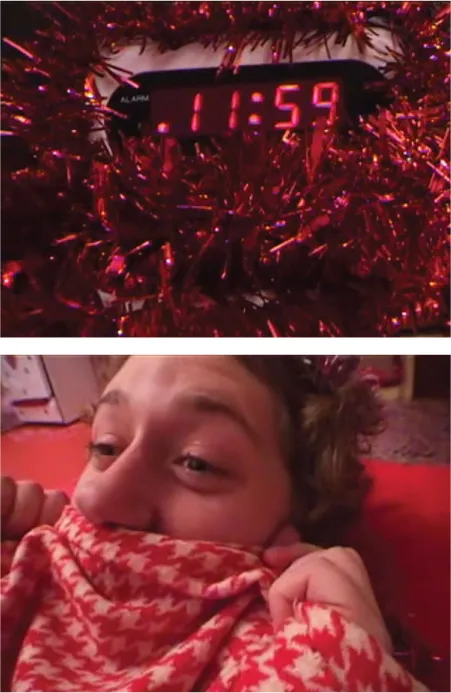
Figures 1.1 and 1.2 Valentine’s Day Girl (2001)
An abrupt cut to a close-up of an LCD alarm clock swathed in a sparkly red garland is our entry point. The clock radio reads “11:59.” Loud shrieks of excitement can be overheard in the background. Trecartin jump-cuts to a close-up of the protagonist’s feet stomping on red linoleum flooring. The opening sequence is structured as a set of increasingly rapid crosscuts between close-ups of the alarm clock and an array of shots of Lizzie Fitch impatiently waiting for the clock to strike 12:00 midnight. Trecartin’s stylistic decisions convey how the protagonist experiences the quickly shifting succession of moods. The artist translates a range of emotions that include anticipation, impatience, and finally euphoria. He accomplishes these fluctuations by employing rapid editing and artful cinematography that includes tilted camera angles, jump cuts, and claustrophobic close-ups. The video appears to be in a perpetual state of motion, as no shot lasts longer than three seconds. Flux is, in fact, a defining characteristic of all his work.
After jumping out of bed, Valentine’s Day Girl’s heroine stretches her arms wide open as if waking up from an extended hibernation and exclaims, “I don’t like Frederick. Boys are gross! Boys are gross!” Lizzie is then framed through an overhead shot as she casually explains, “I think I like girls this year.” The high-angle prevents us from seeing her face. We do not know at this point if this sudden shift in her romantic preference is willed, or if it is a change that she has discovered after the fact, something that has happened to her spontaneously, without her consciously willing it. The unsettling background soundtrack comes to a sudden standstill and a close-up of the heroine fills the screen. The protagonist casts her eyes upward and for a moment of stasis appears to be wallowing in a state of ecstasy. She recovers and utters the name of her new love interest, “Ashley,” in an exaggerated sensual voice. It is at this instance that we come to the conclusion that she is open to change; she accepts this shift and indeed embraces it. The lengthy five-second close-up reveals to us that the protagonist’s switch is not involuntary. She then proceeds to erase Frederick’s name from a long list of male and female contenders scribbled on a heart-shaped card she keeps tucked underneath her sweater, which further emphasizes Valentine’s Day girl’s fickleness. When asked to comment on the identity(ies) of the characters in his videos, Trecartin replied that he looks forward to the time when “we [can] reach a point where personality defines you more than your gender, sexuality, or career because nothing is fixed.”
Trecartin’s understanding of “personality” as nonfixed aligns itself with Doty’s definition of queerness, as mentioned in the introduction. In the close-up described above, the protagonist not only expresses her choice but also affirms her queerness. Valentine’s Day girl becomes a prototype for many of Trecartin’s later subjects. It is important to understand that it is not because Ryan Trecartin and his characters do not set parameters for categorizing themselves that they are queer. It is because the artist and characters actively label themselves as individuals who cannot be labeled, that I understand them—and they understand themselves—to be queer. It is in this proactive labeling that they play a subversive role in the affirmation of their queer identity(ies). His characters are anything but passive; they seek “personal agency […] in an age of infinite optionality.”
Trecartin frames his protagonists through partial views and tight close-ups that only reveal portions of their faces or bodies. In one close-up, for instance, the camera focuses on the protagonist’s thighs as she sits on top of her kitchen table making her body appear truncated. She is overheard exclaiming, “I wish I had a penis!” The artist employs this fractional shot, as if it were a piece of a puzzle he is assembling. These in turn stand as symbols of the multidimensionality of his characters, made up of various options that he reconfigures, merges, or does away with. Valentine’s Day girl may eventually decide that she will be a pansexual femme or a transsexual butch queen; either way, she, like all the other Trecartin protagonists who will come after her, occupies a queer space that is not contained within or described by a fixed gender/identity.
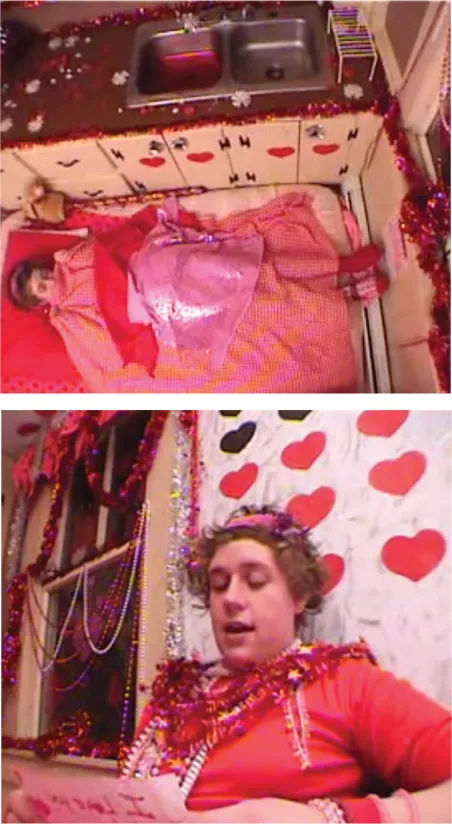
Figures 1.3 and 1.4 Valentine’s Day Girl (2001)
As the scene unfolds, Trecartin provides wide-angle shots of the apartment’s gaudy decor. Every nook and cranny in the low-budget set is replete with heart-shaped or cupid-inspired decorations and iconography. The over-the-top, campy mise-en-scène is strewn with carefully selected red, pink, and white party props, tinsel garland, and love-themed patterned fabrics. In her pivotal essay “Notes on Camp,” Susan Sontag writes, “To emphasize style is to slight content, or to introduce an attitude which is neutral with respect to content. It goes without saying that the Camp sensibility is disengaged, depoliticized—or at least apolitical.” While Trecartin’s campiness is playful, it is in no way disengaged. The oversaturation of sanguine colors and abundance of mass-manufactured plastic Valentine’s Day tchotchkes point to the subversive nature of his commentary on the material culture of holiday commercialism. In addition, the protagonist’s fanatical excitement is never justified, as she is never shown actually celebrating with anyone but herself. This facet of Fitch’s character represents young consumers influenced by the media to anticipate and take...