1.
THE MOHAWK SQUATTED on the padded seat of the open coach, his sinewy arms dangling between his knees, like a wolf, and waited for something to speak to him.
Hendrick, the English called him. To his own people he was Forked Paths, a war captain of the Wolf Clan who moved against his enemies in the way of the forest, where nothing is straight. But the crooked streets of London, still new to him, held traps and deceptions as deep as any Hendrick Forked Paths had laid.
He was not attending to the round, sucking mouth of the Englishman who sat facing him, with gold galloon on his courtier's coat and a great bush of powdered hair that was not his own, or the halting gutturals of the Dutch interpreter at his side, or the creak of the carriage wheels, or the squall of the lewd, strapping doxies who flounced about at the foot of the Haymarket, or the scrape of a busker's fiddle, or the scuttle of rats along the open sewers, or the screech of the gulls—salt birds, bitter birds—though the Mohawk could distinguish all these sounds, and a hundred more. To his wolf ears, the roar of the city was not a sea, or a wall; it was a forest where every bush had a name, every leaf stood apart, though in this cramped world of the Sunrise People so many were pressed together.
Hendrick was listening and looking for a guide, something that knew him, a cousin from the world of the Onkwehonwe, the Real People, on the farther shore of the ocean sea he had crossed in the white men's floating castle—for the raven that shows the path of the deer, for the wren that warns of witchcraft, for the hawk that sees beyond forests and mountains. Hendrick found only the gulls and the fat, waddling pigeons, tamer even than the flocks of passenger pigeons that came with the spring melt into the Real World, so many and so helpless that a child could bat them off the branches with a stick or catch them in her bare hands. London pigeons reminded the Mohawk of the swag-bellied Englishman who sat opposite, his buttery face half choked by his neckcloth. Londoners smelled alike to Hendrick. They stank of meat that was born dead, of four-leggeds that lived to be butchered, not hunted, and therefore—alone among animals—had no home in the spirit world. Beneath clouds of claret and gin, civet and cologne, the courtier in the carriage reeked of dead meat and cow's milk, which was worse than poison to the Real People. Hendrick had once been persuaded to drink cow's milk in a Dutchman's house at Albany. It had made his ears ache and his nose bleed.
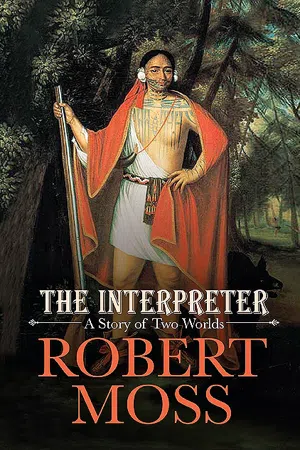
The war captain's clothes were new. He wore a flowing scarlet mantle trimmed with gold and a shirt of finest cambric over a long black waistcoat with matching breeches and stockings—black because the Court was still in mourning for the Prince of Denmark, the Queen's late husband. All four of the Indian ambassadors wore similar clothes. Their outfits were gifts of the Crown. Puzzled as to how Indian chiefs should be attired for a call upon Her Majesty, the Queen's advisers had sent them to a playhouse tailor who dressed the kings of the stage. The Indian ambassadors had improved the costumier's designs with touches of their own. Hendrick wore the kahstowa, the feathered headdress of his people, crowned with a shower of white feathers and bright turkey down. He carried a heavy, ball-headed war club weighted for his hand, carved and notched to recall the scalps he had taken from the French and the Bark Eaters, their native allies. He wore three pairs of earrings, posted in the holes drilled in his ears when he was still an infant on the cradleboard. His pipe-bag was slung from his broad shoulder, because man rides to the skies on a cloud of tobacco. Tied to his waist by a rattlesnake belt was the otterskin bundle that held the power to bind souls and to kill from afar, and the vocabulary of his dreams.
Londoners surged around the two coaches, goggling at the visitors from America. Some had seen Indians before—wild men exhibited in cages as circus novelties—or heard tales of Pocahontas. But London had never played host to Indian royalty until now. The fact that there were no titles of kingship in Mohawk country, and that the four Indians in the two coaches were not even traditional chiefs, was a detail omitted by the hack authors of broadsheets and ballads celebrating the visit. The illustrations that embellished these publications showed the Indian Kings in the raiment of medieval monarchs, with beards and crowns, or in the robes of the Magi, bearing gifts in gold coffers.
What most impressed the crowd was how unlike the pictures the Queen's visitors had turned out to be. They were awed by Hendrick's sheer physical presence. He was a giant by English standards, a tower of hard muscle rising nearly seven feet high. The Londoners were fascinated by the tattoos of his companions. Nicholas Etakoam, the Mahican, had a flight of thunderbirds engraved across his temple. John Laughing, a Mohawk from the Upper Castle at Canajoharie, was adorned with curving lines that resembled both the phases of the moon and the raking clawmarks of a bear. Brant Vanishing Smoke—who belonged to the Bear Clan—wore tattoos of huge, stylized claws on his wrists and forearms, as if the paws of his totem animal were resting over his own.
A wit in the street hailed Vanishing Smoke as the Illustrated Man. Prints copied from his official portrait by Verelst, the Court painter, would soon be used as advertisments for London tattoo parlors. The phases of the moon were incised in exquisite detail across his forehead. His features were fine and regular, but the dark bars across his lower face suggested the predator, as the wolf's markings blacken its jaws and draw its prey to the terrible, steady eyes that read whether the quarry is ripe for the harvest. Lunar disks or gorgets were tattooed between Vanishing Smoke's collarbones. His chest bristled with spearpoints and arrowheads. Strangest of all was the thing that seemed to be scaling his sternum. It looked like an armored aquatic bug, ancient and utterly alien.
The warriors of Kush had worn pendants carved in the shape of flies, modeling themselves on the kind of biting fly that would not leave off an attack until it was dead. What kind of warrior—what sort of King—sported a tattoo of an insect from an ancient era?
The coachmen pulled on their reins and swore at their horses. Hendrick rose from his heels.
“This is the longhouse of the English Queen,” Abraham Schuyler informed the Mohawks in their own language.
Vanishing Smoke studied St. James's Palace. The building was the color of black river mud. He saw horse warriors in breastplates of bright metal, and helmets plumed with horsehair, which made them one with their mounts. He recognized something he knew, and smiled on them.
The Indians were escorted by three white men who had sailed from the New World with them. They were Colonel Peter Schuyler, his brother Captain Abraham Schuyler, and Colonel Sir Francis Nicholson. In an age of war—the current one sparked by a dispute over the Spanish succession—everyone wanted a military title; Nicholson liked to be addressed as general. Peter Schuyler, the first mayor of Albany, was the cleverest of the three. He had made a fortune in the fur trade and used his money to buy influence among the Indians. The Mohawks called him by his first name, but rendered it as Quider, because it was hard for them to get their tongues round the letter P. Abraham Schuyler had learned native languages the old-fashioned way, by sleeping with the women. As Albany Dutchmen, stirred by profit, not flags, the Schuylers were not automatic enthusiasts for the war policy that had brought the Indian Kings to London, but would move with the prevailing wind.
Colonel Nicholson and his Scottish associate Samuel Vetch (who had stayed behind in Boston) were the moving spirits behind this expedition. Nicholson was an empire-builder who planned to deliver a series of blows to the French that would knock them out of North America. He knew that no European army could win battles in the forests of North America without native allies. He hoped to achieve two objectives in London. First, to convince the League of Five Nations (to which the Mohawks belonged), via the stories the Four Kings would take home, that the might of Britain was invincible and that the Confederacy should scrap its official policy of neutrality in white men's wars and commit its warriors to Britain's cause. Second, he hoped to inspire Queen Anne and her ministers to stop dallying and despatch a fleet of warships and a redcoat army to expel the French from Canada. Francis Nicholson had brought the Four Kings to London to arrange a war.
His Grace the Duke of Shrewsbury, the Lord Chamberlain, hooked his richly upholstered arm over Peter Schuyler's.
“I trust you explained to them about the chairs.”
For an instant, Schuyler appeared at a loss. His mouth opened and closed like a fish out of water.
“In case Her Majesty does the honor of asking them to sit,” His Grace prodded the Dutchman.
“Ah, the chairs.” Schuyler took it in. “They are perfect gentlemen, you know,” he added evasively. “I have entertained them in my own house many times.”
He did not comment on what much of London had observed: that the Four Kings from America shared a violent and inscrutable aversion to all modes of seating suited to an Englishman's rump. Whether lolling at ease in their lodgings in Covent garden, or on public display with the Lord Mayor or the Astronomer Royal, they went to any lengths to avoid arranging their hindquarters in the prescribed style. They sat on their heels, hugged their haunches, or sprawled full-length on backs or bellies.
In the audience chamber, Hendrick took the plump hand Her Majesty extended to him, palm down, and squeezed it experimentally. He still found it strange that the English greeted each other by touching fingertips. Real People took you by the upper arm, closer to the heart.
The elderly Stuart sovereign was small, round and heavy, sheathed in black cloth. Hendrick smelled powder, musk and thick red wine, sluggish as congealing blood. And the stale, cold stench of meat buried the whole winter in a cache beneath the snow, stored against the Starving Time before the birds fly back from the south. Hendrick smelled her dead womb, that had delivered only still-births, and babies born to die.
The Queen's lips fluttered. It would please her for the Four Kings to be seated.
Hendrick watched his companions bend backwards and part their meat on the chairs that had been placed before the throne. This was necessary, Quider had explained to them; if they sat on the floor in the way warriors are meant to sit, Her Majesty would mistake this for an insult. Hendrick compromised by staying on his feet. He was the Word Carrier for this delegation, the one charged to speak for all. He could stand without giving offence.
He addressed the Queen, in his own language, as his elder sister.
“Aktsia, what is now spoken by one mouth is shared by every heart. We are grateful we have come safely across the Great Water, which our grandfathers have never done. We have come to condole you for the loss of your husband, who walks the path of strawberries.
“With this belt—” he held up a string of wampum beads, which was accepted, on Quider's nod, by a Royal equerry “—we wipe the tears from your eyes, that you may see clearly.
“We remove the blockage from your ears, so you may hear clearly.
“We open your mouth, so you may speak clearly.
“And we open the passage from your heart to your mouth, so that henceforth you will speak only from the heart.”
The Mohawk's cadences were waves, rolling one on top of the other, each extending the range of the one before. At his last words, Brant Vanishing Smoke and the other Indians gave a sharp, sudden yelp of confirmation. When Abraham Schuyler translated the words of condolence, the Queen put a hand to her heart.
The Lord Chamberlain looked daggers at Schuyler. This episode was not on the program. The exchange with the Queen was supposed to be confined to the reading of an agreed text, drafted by Schuyler and Nicholson, and responses to any questions Her Majesty might be pleased to ask.
Now Hendrick held up a belt that reached from his shoulder to his waist: eleven rows of white and purple beads, strung on strips of rawhide. Without wampum—the sacred shells of life—a man's speech is empty or (worse) a deception. The Lord Chamberlain intervened to claim possession of this curiosity. The Queen, motioning for him to give her a closer look, puzzled over the belt as if trying to determine where it might fit in her wardrobe.
The Lord Chamberlain scowled at Major Pigeon, the court soldier who had been charged with reading the prepared text of Hendrick's speech.
“Great Queen!” Major Pigeon piped, the queue of his tie-wig bobbing behind him. “We have undertaken a long and tedious voyage, that we might see our Great Queen.”
“Aktsia,” Hendrick resumed. “Our path is thick with blood and betrayals.”
In his own tongue, Hendrick always referred to the Queen as his big sister. There was no servility in his speech, nothing of the subject. He spoke as a younger man to a slightly older female relative.
Hendrick made the promise Colonel Nicholson had schemed and dreamed for. He would recruit the Mohawks and their sister-nations to march with the English against the French. But he warned that there must be an honest exchange of services. The Queen must leash the sharpers who were thieving Indian land with fraudulent deeds, issued by cheating governors.
“Your traders are snakes who poison us with rum. If the beaver pelts we have brought them were piled one on top of the other they would touch the sky. Yet all we receive are a few rags that leave our backsides bare, and trinkets our women a...