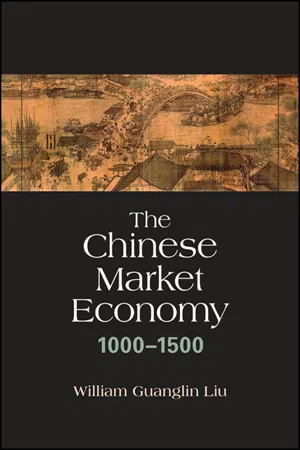
The Chinese Market Economy, 1000–1500
eBook - ePub

The Chinese Market Economy, 1000–1500

  1. 394 pages
  2. English
  3. ePUB (mobile friendly)
  4. Available on iOS & Android
eBook - ePub

The Chinese Market Economy, 1000–1500

About this book

Since the economic liberalization of the 1980s, the Chinese economy has boomed and is poised to become the world's largest market economy, a position traditional China held a millennium ago. William Guanglin Liu's bold and fascinating book is the first to rely on quantitative methods to investigate the early market economy that existed in China, making use of rare market and population data produced by the Song dynasty in the eleventh century. A counterexample comes from the century around 1400 when the early Ming court deliberately turned agrarian society into a command economy system. This radical change not only shrank markets, but also caused a sharp decline in the living standards of common people. Liu's landmark study of the rise and fall of a market economy highlights important issues for contemporary China at both the empirical and theoretical levels.

Frequently asked questions

Yes, you can cancel anytime from the Subscription tab in your account settings on the Perlego website. Your subscription will stay active until the end of your current billing period. Learn how to cancel your subscription.
No, books cannot be downloaded as external files, such as PDFs, for use outside of Perlego. However, you can download books within the Perlego app for offline reading on mobile or tablet. Learn more here.
Perlego offers two plans: Essential and Complete
  • Essential is ideal for learners and professionals who enjoy exploring a wide range of subjects. Access the Essential Library with 800,000+ trusted titles and best-sellers across business, personal growth, and the humanities. Includes unlimited reading time and Standard Read Aloud voice.
  • Complete: Perfect for advanced learners and researchers needing full, unrestricted access. Unlock 1.4M+ books across hundreds of subjects, including academic and specialized titles. The Complete Plan also includes advanced features like Premium Read Aloud and Research Assistant.
Both plans are available with monthly, semester, or annual billing cycles.
We are an online textbook subscription service, where you can get access to an entire online library for less than the price of a single book per month. With over 1 million books across 1000+ topics, we’ve got you covered! Learn more here.
Look out for the read-aloud symbol on your next book to see if you can listen to it. The read-aloud tool reads text aloud for you, highlighting the text as it is being read. You can pause it, speed it up and slow it down. Learn more here.
Yes! You can use the Perlego app on both iOS or Android devices to read anytime, anywhere β€” even offline. Perfect for commutes or when you’re on the go.
Please note we cannot support devices running on iOS 13 and Android 7 or earlier. Learn more about using the app.
Yes, you can access The Chinese Market Economy, 1000–1500 by William Guanglin Liu in PDF and/or ePUB format, as well as other popular books in History & Economic History. We have over one million books available in our catalogue for you to explore.

Information

Table of contents

  1. Cover
  2. Title
  3. Copyright
  4. Contents
  5. List of Illustrations
  6. Acknowledgments
  7. Dynasties, Events, and Equivalents
  8. Introduction
  9. Part I. The Market Economy in Late Imperial China
  10. Part II. The Song Era
  11. Part III. The Ming Era
  12. Part IV. Agriculture
  13. Conclusion
  14. A General Guide to Chinese Economic Data Sources in the Song and Ming Eras
  15. Appendix A. Chinese Population Data
  16. Appendix B. Long-Term Changes in Prices and the Money Stock
  17. Appendix C. Waterway Networks in the Eleventh Century
  18. Appendix D. Chinese Acreage, 900–1600
  19. Appendix E. Long-Term Changes in Real Wages
  20. Appendix F. Estimates of National Incomes
  21. Appendix G. Major Commodities in the Domestic Market
  22. Appendix H. Military Farms, Involuntary Migrations, and Extensive Agriculture
  23. Notes
  24. Bibliography
  25. Index
  26. Back Cover