MAINSTREAM REPRESENTATIONS
OF SOCIALLY INVISIBLE WOMEN
Prisons, by their very nature, conceal the people who live and work inside them. Those who attempt to gain access to prisons for the purposes of research, activism, family visitation, or even governmental evaluation see and hear little more than what prison officials wish to show to the world. Even those who reside within the prisons walls, and many of those who are employed there, will likely never have a full picture of what takes place day to day in the prison as a whole. Prisoners are often grouped together, packed into tight spaces, and forced to cohabitate with more of their colleagues than the prison was designed to hold, yet they are also isolated from other populations within the prison and can live for years without seeing certain others confined within the same border of fences and razor wire. The systematic obfuscation of knowledge about prisons and prisoners makes it challenging to piece together a realistic depiction of how people experience incarceration.
Perhaps it is this mystery that enshrouds the carceral that fuels the desire for outsiders to create representations of those inside prisons. This statement may be particularly true for incarcerated women, who continue to represent a smaller proportion of the prison population (just 7 percent) and seem to perplex society because they do not fit the traditional mold of what a prisoner is “supposed” to be: male and, in contemporary society, of color. Throughout history, organizations, medical professionals, and the media have rushed to explain what “causes” female criminality and, in so doing, have manufactured representations of women behind bars that are not necessarily congruous with how imprisoned women may frame and understand themselves, their lives, and their experiences with incarceration.
In some ways, society has been preoccupied with representing incarcerated women. In the nineteenth century, women who engaged—or perhaps indulged—in “pleasures of the body” such as drinking in public, having sex outside of marriage, or committing adultery crossed the dividing line between femininity and masculinity and could find themselves serving prison sentences. These women were termed “fallen women” by society and were represented as beyond redemption (Freedman 1981). Gender expectations and a strong double standard meant that men could more freely engage in the same behaviors that led to the social control and punishment of women. It was not until women prison reformers organized to improve prison conditions and establish separate reformatories for “fallen women” that women came to be seen as having potential for rehabilitation (Freedman 1981). This rehabilitation was really a mandate to accept traditional, middle-class gender norms that stressed the maternal role of women in the family; only when a “fallen woman” accepted these values would it be deemed appropriate to release her from prison. Of course, this reform work was focused almost exclusively on white women; incarcerated women of color were overlooked by reformers and remained in separate wings of men's custodial institutions (Rafter 1990). A representation of the “deserving” female prisoner therefore developed, and this image was of a white, young woman who was in desperate need of guidance and reform.
By the midtwentieth century, Hollywood began to represent incarcerated women. Films like I Want to Live (1958) and Caged (1950) were melodramatic depictions of prison life. I Want to Live is based on the story of Barbara Graham, who was executed at thirty-two years of age in California for a murder in which she was allegedly involved with two other men. Nicknamed “Bloody Babs” by the media, the film describes the media frenzy around her case and its representation of Graham as a “bad girl” or “party girl” because she was involved in prostitution, gambling, and drugs. Such representations clearly depict a gender double standard: men can indulge in gambling and drugs, for example, but women who do so, and women who engage in prostitution, have crossed the line between “pure” and “licentious” and are conceptualized, to use Karlene Faith's (1993) term, as “unruly.” These representations also remove Graham from the social context of her life and fail to capture the complexity of her time both before and during prison.
On the other hand, the academy award–nominated Caged tells the story of a young woman hardened by the prison environment. This film interestingly suggests that healthcare was inadequate in women's prisons in 1950 (a problem that continues today) and shows a well-meaning warden, who champions rehabilitation efforts, in a power struggle with a correctional officer who thinks women inside should be treated like “animals.” But it again does little to interrogate the larger social forces that contribute to one's incarceration and fails to capture the complexity of prison life for women behind bars; it also depicts women in prison as desperately needing guidance and charitable help. Moreover, both films overwhelmingly represent white women prisoners; one wonders where all of the incarcerated women of color were.
More contemporary representations of women in prison are obsessed with the idea of incarcerated women as “hardened criminals.” The E! Network, for example, currently runs a special entitled, Women Who Kill, which chronicles high-profile cases of disproportionately white women who have killed their husbands. This special creates a flat and simplistic picture of the lives of such women, sensationalizes crime and incarceration, and suggests, albeit implicitly, that women behind bars are all crazed killers who are to be feared. Larger processes of racism, classism, and sexism, which contribute to the present-day incarceration of a disproportionate number of women in prison, are not discussed or interrogated, nor is it brought to the viewer's attention that most women in prison are not doing time for violent crimes.
To be sure, sensationalized accounts and portrayals of incarcerated women and their crimes could not be further from the truth. Unlike films, television programs, and even nineteenth-century reformers who turned their attention toward white prisoners, incarcerated women are disproportionately of color and poor: close to 70 percent of these women are black, Latina, First Nation, or Asian (Díaz-Cotto 2006; James 2005; Johnson 2003), and most are poor or working class. A growing percentage of women prisoners are migrant women, overwhelmingly from Mexico.
At least 57 percent of women incarcerated in state prisons report that they have experienced sexual and/or physical violence prior to their confinement; about one-third of imprisoned women report having been raped prior to their incarceration (Lawston 2008; Mauer, Potler, and Wolf 1999). Moreover, incarcerated women are more likely than their male counterparts to be addicted to drugs or to report a drug problem at the time of arrest (Pollock 2002; Owen 1998), more often than not because they are trying to lessen the pain that results from the violence they have suffered. Despite mainstream media portrayals of women in prison as “violent” and “hardened,” the majority of incarcerated women do their time for nonviolent drug or property offenses, with drug offenses—largely due to changes in drug laws—being the largest source of growth for the women's prison and jail population (see Lawston 2008; Schlesinger 2008; Reynolds 2008; Díaz-Cotto 2007; Johnson 2003; Mauer, Potler, and Wolf 1999). Additionally, at least two-thirds of incarcerated women are mothers to children under eighteen years of age (Mumola 2000). Although imprisoned women experience incarceration directly, then, their children, families, communities, friends, and other loved ones also suffer from their confinement in myriad and no less painful ways.
A major problem with both current and past mainstream media representations of incarcerated women is that the material presented tells us little about how these women represent themselves, how they conceptualize and process imprisonment and the separation from their communities and families, and how they express dissent and fight for their voices to be heard by those on the outside of prison walls, which as Vonda suggests at the beginning of this chapter is an important goal for many contemporary imprisoned women. Most media representations fail to show the complexity of prisoners' lives, allowing women's crimes and the stigma of criminality to overshadow, and act as a master status to, all other aspects of their identities. These media representations fail to contextualize women's imprisonment within a social system that relies on racism, economic discrimination, and sexism to lock up marginalized groups of women who are our mothers, sisters, wives, partners, and friends. Like all of us, the women that the United States targets for incarceration are infinitely more multifaceted than the simplistic representations that have historically dominated society, and their voices are no less important than any of ours on the outside of prison walls.
CHALLENGING MAINSTREAM REPRESENTATIONS OF
INCARCERATED WOMEN:
PRISONERS, SCHOLARS, ACTIVISTS, AND ARTISTS
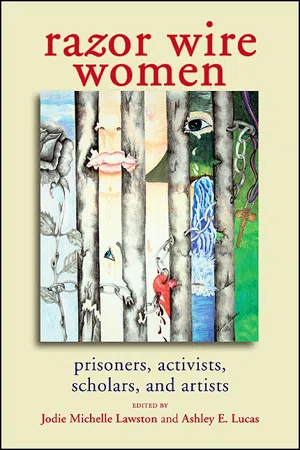
While mass media outlets and traditional reform groups like those found in the nineteenth century attempted (and continue to attempt) to represent women who are confined behind steal doors and razor wire, prisoners, activists, scholars, and artists have nevertheless managed to contribute their varied forms of discourse to the historical record of women's incarceration in the United States. Autobiographical accounts of women's imprisonment in this country date back at least as far as the 1860s, when a number of privileged Southern women were jailed as Confederate spies (Boyd 1865; Robinson 1864). These early accounts are few and far between and describe only the experiences of those literate enough to write their own stories. Although the women's prison reform movement of the nineteenth century is brilliantly documented by several scholars (Freedman 1981; Rafter 1990; Dodge 2006), the literature available suggests that the voices of women in reformatories and custodial institutions were muted by activists who were concerned with reforming women who “stepped out of line.” More recent literature, such as Wally Lamb's popular anthologies Couldn't Keep It To Myself: Testimonies from Our Imprisoned Sisters (2004) and I'll Fly Away: Further Testimonies from the Women of York Prison (2007), as well as numerous scholarly articles, books, and volumes, including but not limited to those edited by Solinger, Johnson, Raimon, Reynolds, and Tapia (2009), Sudbury (2005), Hardon and Hill (1998), Boudin (1998), Girshick (1999), Owen (1998), and Richie (1996) have been more successful at highlighting the voices, knowledge, and testimonies of women in prison.
Activism around women's confinement has also served to contest mainstream understandings of incarceration. Nineteenth-century reformers challenged the idea that criminalized women could not be “rehabilitated” (Freedman 1981) but operated under the assumption that “rehabilitation” is congruous with acceptance of traditional gender expectations. In contrast, more contemporary progressive activism, from the 1970s to today, has not only underscored the importance of women prisoners speaking for themselves, but in some cases has begun to question incarceration in its entirety.
Women activists in the 1970s fell on a continuum: some groups advocated for the reform of prisons (such as through improvement of prison conditions and rehabilitative programs), while others advocated for alternatives to incarceration (such as through the channeling of resources such as education, housing, and jobs in an equitable manner to all communities) (Resources for Community Change 1975). Like many of the men in the radical men's prison movement (Cummins 1994), incarcerated and formerly incarcerated women were an integral and powerful part of this movement, which helped to reframe understandings of imprisonment.
Activists today still fall on a continuum: some organizations primarily strive for prison reform, while others fight for systemic social change and alternatives to incarceration. Many organizations, though, inhabit the liminal space between reform and abolition of prisons; these groups incorporate prisoner support work into their missions while adhering to a vision of a world without prisons. Organizations that fight for prison abolition—such as Critical Resistance—provide public education on the economic, social, and political roots of the U.S. prison regime, its effects on all of our lives, and community alternatives to imprisonment. Incite! focuses specifically on the effects of violence and incarceration on women and also offers suggestions for beginning to move away from a system that relies on violence and punishment to ensure safety. Such organizations are powerful engines for social change that have the potential to radically alter how the United States conceptualizes and approaches “crime.”
Art has also been a provocative way to reconceptualize manufactured representations of incarcerated women. Imprisoned women have likely produced creative writing and artwork of some kind throughout U.S. history, but artists' contributions, for the most part, went undocumented until the midtwentieth century. Though it is difficult to document the work of most individual prison artists, a small handful of incarcerated writers, visual artists, musicians, dancers, and theater practitioners have received recognition outside prison walls. Of this select group of published and celebrated prison artists, very few are women, and their work tends to be significantly less well known than the male prisoners working in the same artistic genre.
More organized and larger-scale efforts to promote creative expression in prison began when activist, educational, and artistic organizations made major in-roads into both women's and men's facilities from the 1980s to the present. Performer Rhodessa Jones and her collaborators began creating theater with the women of the San Francisco County Jail in 1989 and subsequently formed the Medea Project, a theater collective of incarcerated and nonincarcerated women. In 1990, Buzz Alexander, an English professor at the University of Michigan, began teaching a theater class in a women's prison and founded the Prison Creative Arts Project, which now facilitates arts workshops in prisons, juvenile detention centers, and urban high schools throughout Michigan. Women on the Rise! a program based out of Miami's Museum of Contemporary Art since 2004, enables professional women artists to collaborate on art projects with girls in the Miami-Dade County Juvenile Detention Center. All three of these organizations are discussed in subsequent chapters of this book.
Arts programs are crucial in that they give participants a creative mode in which to think critically about their lives in relation to the performative and performed power structures of the prison. Incarcerated women's voices and visions, in artistic form, are as essential to struggles for equality and justice as are those of nonincarcerated people, scholars, and activists. The symbols of incarcerated women's fights are embedded in the words and images created by prisoner artists.
Artists from outside prisons also raise awareness and generate dialogue about issues surrounding the carceral by helping unmask the everyday implications of prisons in average citizens' lives.
Particularly unique ways of presenting prisoners' voices and a more complex representation of incarceration can also be found on websites such as Women in Prison: A Site for Resistance, run by Beyondmedia Education in Chicago, which includes articles, artwork, poetry, and other creative work by prisoners, scholars, activists, and the families, friends, and children of prisoners. Such work has been critical to challenging archetypical images surrounding incarceration.