![]()
1
Hunting for Easter Eggs in Rosetta and L’humanité
A
DOOR SLAMS. A
YOUNG woman agitatedly walks down a corridor, the handheld camera on her heels. She’s wearing a white overcoat and a hair net. We don’t see her face. She turns right, right, left. A second door.
Slam! She moves down the stairs into a factory hall, which remains blurry as the camera maintains focus on her back. We hear the noise of machines. “Entrez dans mon bureau!” [Come back to my office!] calls a man, in shirt and tie, as he obstructs her way, “Entrez dans mon bureau, je vous dis!” She evades him and slides underneath the assembly line, while the camera struggles to keep up with her and to keep her in focus. “C’est vrai que t’as dit que je suis souvent en retard!?” [Is it true you’ve said I’m often late!?], she asks angrily, out of breath, to a female coworker. She has been fired, we realize.
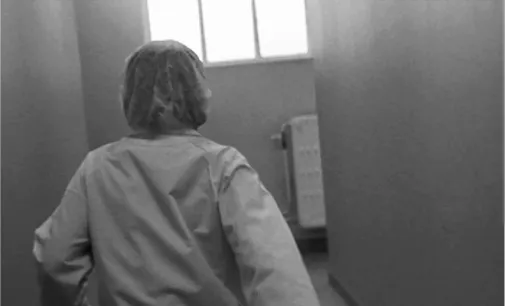
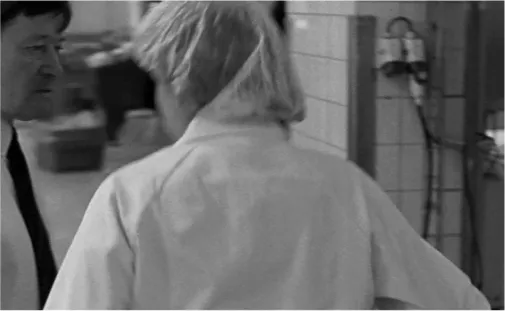
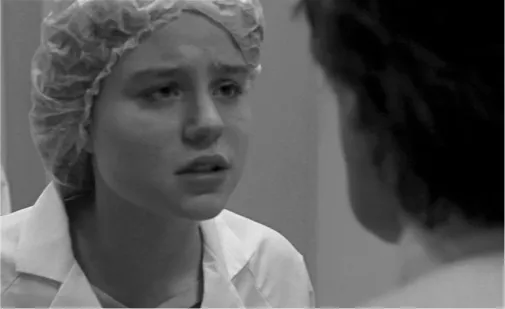
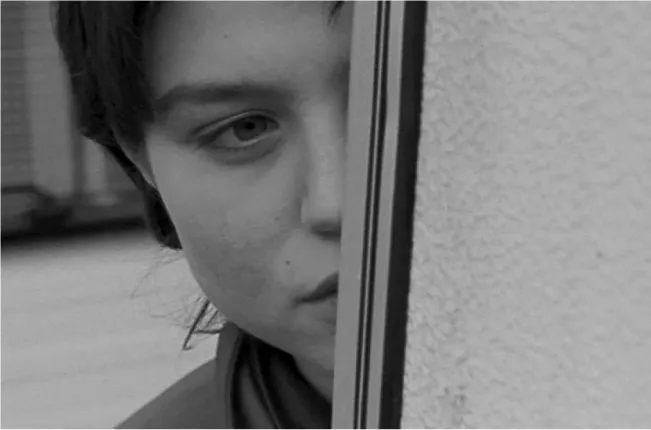
Inevitably, this transcription of the opening scene of Jean-Pierre Dardenne and Luc Dardenne’s Rosetta (1999) remains insufficiently expressive, of the film’s texture, of its color, and of its rapid pace. Figures 1.1–1.3 capture the close range at which the camera follows Rosetta (Émilie Dequenne), the film’s seventeen-year-old protagonist. The scene is characteristic of the Dardennes’ realism: the protagonist’s obstinacy, the close-up shots of the back of her head, the direct sound, the elliptical editing, and the camera’s refusal to leave her alone. The camera is determined to follow Rosetta and to make felt her struggle for a human life, her small war.
Figures 1.1–1.3. The opening scene of Rosetta (Jean-Pierre Dardenne and Luc Dardenne, 1999).
Other than Rosetta, the film that stands central in this chapter is L’humanité by Bruno Dumont, also from 1999, and which like Rosetta is a story rooted in the French-Walloon Nord. The question that guides my argument is the same Rancière asks in his Cahiers du cinéma essay about these two films: “What unites Rosetta and L’humanité?” As stated in the introduction, one of the parallels Rancière leaves unmentioned is that both Rosetta and L’humanité are variations on films by Robert Bresson, namely, Mouchette (1967) and Journal d’un curé de champagne (1951), stories Bresson in turn adapted from novels by Georges Bernanos. L’humanité cites, moreover, Maurice Pialat’s film Sous le soleil de Satan (1987), another Bernanos adaptation and like L’humanité a film set and shot in the French North. Like Bresson, the Dardennes and Dumont create moral tales for a world abandoned by God and lacking in solidarity. Unlike, or at least much more openly than Bresson, the Dardennes and Dumont also flirt with a belief in an innate human essence. I do not share this minimal humanism, at least not in the form it presents itself in these films. However self-conscious Rosetta and L’humanité may show themselves in their play with dominant understandings of sexuality, gender, race, and class, ultimately they model their notion of “human” on a male, heterosexual, white subject position. At the same time, these films are also smart, teasing their viewer into spiritual mind games from which there seems to be no way out. Upon very close analysis Rosetta and L’humanité turn out to share a hieroglyphic double nature, in that their seemingly straightforward quest stories are encrypted with the spirit, hiding in plain sight, like an Easter egg painted in the colors of the field.
But let me not reveal too much at this point. Inasmuch as this chapter is an argument about and critique of Rosetta and L’humanité, it is also a reenactment, in writing, of my comparative analysis of these two films, playing, pausing, and replaying them over and again, while piecing together their secret codes. To fast-forward to the end of this chapter to find out whodunit would really spoil the analysis.
A Normal Life
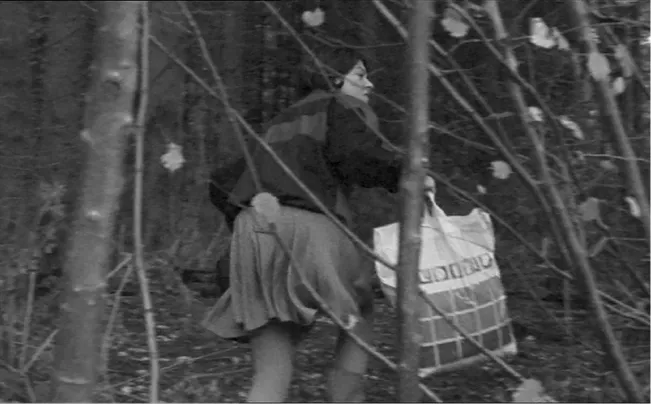
Let’s press play again. Following the opening scene, which ends with the police dragging Rosetta out of the factory, we see her eating a waffle. The camera then follows Rosetta—on the bus, through a wooden gate the viewer infers she’s not supposed to use (fig. 1.4), across a busy road, down the road’s shoulder, through the forest, underneath a fence—to her home at the “Grand Canyon,” the trailer park where she lives with her alcoholic mother (Anne Yernaux). By trailing Rosetta’s trespasses and shortcuts, the camera maps her small world at the margins of society. As Luc Dardenne observes, Rosetta “is in a state of war.” Her radius of action is small: other than the forest and the trailer park, the main hubs in her life are the thrift store to which she sells the clothes mended by her and her mother, the apartment of her new friend Riquet (Fabrizio Rongione), and the waffle stand where Riquet works until Rosetta denounces him to get his job. As she travels between these places, in scenes that are very similar to one another in terms of framing and editing, the film familiarizes the viewer with her habits and hiding spots, including the drainpipe in which she keeps her rubber boots. Having exchanged her shoes for her boots, Rosetta, carrying a heavy plastic bag and with the camera in close pursuit, once again finds her way through the forest, changes into her shoes, and disappears underneath the fence that encloses the trailer park (fig. 1.5).
Figure 1.4. Through a wooden gate she’s not supposed to use.
Figure 1.5. Rosetta, carrying a heavy plastic bag, once again finds her way through the woods.
The Dardennes shot Rosetta in Seraing near Liège. Liège is the largest metropolitan area in Wallonia, which at the turn of the millennium had unemployment rates among the highest in Europe. The film engages this crisis through Rosetta’s desperate quest for a job. Rosetta expresses her desire to become a member of the working class and to belong in a more general sense; at the end of the day, after her painstaking efforts have finally paid off: she has found a job. Lying in bed in Riquet’s apartment, Rosetta assures herself of her normalcy:
Tu t’appelles Rosetta. Je m’appelle Rosetta. Tu as trouvé un travail. J’ai trouvé un travail. Tu as trouvé un ami. J’ai trouvé un ami. T’as une vie normale. J’ai une vie normale. Tu ne tomberas pas dans le trou. Je ne tomberai pas dans le trou. Bonne nuit. Bonne nuit. (Your name is Rosetta. My name is Rosetta. You’ve found a job. I’ve found a job. You’ve found a friend. I’ve found a friend. You have a normal life. I have a normal life. You won’t fall in a rut. I won’t fall in a rut. Good night. Good night.)
The day following this self-subjectifying prayer, however, Rosetta is laid off again and finds herself back at square one of her flight forward.
Rosetta’s pursuit of a normal human life is characteristic of the Dardennes’ practice and philosophy, which can be situated in a broader wave of new realism, especially in northwestern European cinema that expresses life in a postindustrial society. As Philip Mosley writes, the Dardennes share with other filmmakers from Wallonia (Lucas Belvaux, Benoît Mariage) as well as neighboring regions in France (e.g., Laurent Cantet, Dumont) and the United Kingdom (Mike Leigh, Ken Loach) “a preoccupation with the lives of working-class individuals struggling to survive with a measure of dignity.” Mosley refers to the Dardennes’ practice as a “responsible realism” that displays an “acute awareness of a need for both individual and collective responsibility in human relations.” To this one can add that the Dardennes’ films are moral tales that test their protagonists’ “humanity.” At first sight the Dardennes’ universe appears strictly immanent, yet all of the Dardennes’ films disallow the viewer to understand character action as being fully motivated by the precarious material conditions these protagonists often find themselves in. From La Promesse / The Promise (1996), via L’Enfant / The Child (2005), to Deux jours, une nuit / Two Days, One Night (2014), ultimately plot progression also transcends the material dimension of the quest for a “normal” life, as that quest is connected to a moral stake (while in their most recent films La Fille inconnue / The Unknown Girl [2016] and Le Jeune Ahmed / Young Ahmed [2019] the economic dimension has moved to the background altogether). Also Rosetta connects its protagonist’s quest to a moral struggle, leaving space for a minimum of agency on the young woman’s part to do the right thing despite everything. How far will Rosetta go to pursue her modest dreams? Is she willing to sacrifice her humanity? This testing of her moral character becomes most explicit in the scene in which Rosetta stands by passively for forty seconds after Riquet, the waffle maker, has fallen into a muddy stream. Only after a sustained inner debate does Rosetta grab a stick to pull her friend out of the water, even though she wants his job.
What are we to make of this spark of compassion that interrupts Rosetta’s painfully long moral struggle? Does it demonstrate “the possibility of human agency in a time when we have lost faith in that possibility,” as Thorn Andersen argues in relation to the Dardennes’ Le silence de Lorna (2008)? Andersen distinguishes Lorna (Arta Dobroshi) from the wandering protagonists of Italian neorealist cinema. “[Lorna’s] perceptions,” he writes, “lead immediately to actions, there is no dissociation between them. Against the tide of neorealism, the Dardennes continue to insist that action is character.” Like nearly all of their protagonists, Lorna and Rosetta are always moving. They are always acting, and in that respect they differ from the neorealist wanderer. But when perceptions immediately lead to actions and are inseparable from the actions they trigger, what is the role of agency, if agency is understood as the locus of indeterminacy between perception and action? If Rosetta acts, it is because she is acted upon—she is acted upon by a society that chases, confines, excludes, exploits, and dehumanizes her. Most of the time, she’s depicted as acting out of instinct, the near elimination of the interval between perception and action, rather than agency. The forest Rosetta cuts through and where she fishes, for food rather than fun, is an urban wilderness where she needs to be continuously on her guard, especially for the park manager. If she does not wander, it is not because she is less desperate than her neorealist predecessors. She simply does not have time to wander.
To understand the temporal structure of Rosetta’s subjectivity, it is instructive to compare her to another Dardennes protagonist, Bruno (Jérémie Renier) from L’Enfant. Slightly older than Rosetta, Bruno is the leader of a small gang of petty thieves. Assuring himself that he will always “find” money, he is only interested in the current rate at which things are going, from a stolen camera and the hat that looks so good on him (and that gives him the air of a French New Wave hero) to his own child, whom he sells to a black market adoption ring for some quick cash. He lives strictly in the present, which makes him seem somewhat psychotic. Rosetta, in contrast, refuses a reality without future orientation. She struggles to survive, but she also has her pride and persistence, her humanity. Whereas Bruno seems to have accepted his life at the margins and survives day to day until reality decides otherwise, Rosetta wants a normal life, starting with a job. Unlike Bruno, she is obsessed with her future, with making a quantum leap into normalcy, a desire for which she’s willing to sacrifice the present. She rejects Riquet’s offer to assist him in swindling his boss by selling his own homemade waffles at the stand because she wants “un vrai travail,” a real job. Rosetta refuses to dehumanize herself in the face of a dehumanizing society. That’s why she throws out the salmon her mother has been given for free: “On n’est pas des mendiants” (We’re not beggars). Rosetta catches her own fish with her own homemade traps. And that’s why she pulls out the plants her mother has planted near the trailer because she refuses to accept the trailer as her home: “Pourquoi tu plantes tous ces trucs? On va pas quand-même rester ici hein?” (Why are you planting all these? We will not stay here anyway?). But Rosetta is also ashamed of her current situation, which leads her to lie that she’s living at a “manège” (a horse-riding school) to a social security officer. She wants a job, but, more than that, she wants to be normal and human, in her own eyes and those of society, whose gaze she ventriloquizes before going to sleep: “Tu t’appelle Rosetta” (Your name is Rosetta).
Rosetta’s fight to integrate herself into a fraying postindustrial social tissue attests to the waning of parochial power structures—including the nuclear family, the church, trade unions, and the welfare state—that seek to define a “normal,” “human” life, attaching people to a stable set of subject positions from cradle to grave. In his late essay “The Subject and Power” (1982), Michel Foucault describes parochial power as a form of power, or a “power technique,” that originated in Christian institutions and subsequently became integrated into the modern Western state. Christianity, Foucault explains, introduced a code of ethics that spread new power relations throughout the ancient world. By organizing itself as a church, Christianity postulated “in principle that certain individuals can, by their relig...