![]()
Chapter 1
Civilizing Nature in Twain’s Adventures of Huckleberry Finn
In “The Boy and the River,” his introduction to a 1950 edition of Adventures of Huckleberry Finn, T. S. Eliot praised Twain’s depiction of the Mississippi River. Declaring the novel a “masterpiece,” Eliot insisted that “the River makes the book a great book. As with Conrad, we are continually reminded of the power and terror of Nature, and the isolation and feebleness of Man. … Mark Twain is a native, and the River God is his God” (285, 287). Eliot’s reference to the River God is an allusion to his own “The Dry Salvages” (1941), which begins with a tribute to the Mississippi:
I do not know much about gods; but I think that the river
Is a strong brown god—sullen, untamed and intractable,
Patient to some degree, at first recognised as a frontier;
Useful, untrustworthy, as a conveyor of commerce;
Then only a problem confronting the builder of bridges.
The problem once solved, the brown god is almost forgotten
By the dwellers in cities—ever, however, implacable,
Keeping his seasons and rages, destroyer, reminder
Of what men choose to forget. Unhonoured, unpropitiated
By worshippers of the machine, but waiting, watching and waiting. (1–10)
In both the introduction and the poem, Eliot represents the Mississippi, which he knew from his childhood in St. Louis, as a powerful force that cannot be tamed by humans. Furthermore, by depicting the river as a forgotten “brown god” that threatens to vent his rage upon the urban worshippers of technology, Eliot seems to link the threat of an uncontrollable nature with Western nightmares of the pent fury of subjugated races.1
Recent ecocritics have had little to say about Huckleberry Finn, which is somewhat surprising since earlier critics celebrated Twain’s representation of nature in a manner consistent with the resistance narrative. Leo Marx notes that after the “idyll” of Jackson’s Island, Huck and Jim “continue to enjoy many of the delights they had known earlier, above all a sense of the bounty, beauty, and harmony made possible by an accommodation to nature” (Machine 327). Similarly, Robert Schulman argues that “in the great, idyllic moments on the river, Huck fully if briefly realizes his individuality in the context of a human community with Jim and a natural community with the surrounding world” (33). However, other critics have complicated this reading. Sacvan Bercovitch points out that the lyrical description of the river occupies “less than one percent of the book,” and he challenges the sentimentalism of the positive reading, noting that “the river is the source of storms and water snakes, it calls up the fog that keeps Huck and Jim from reaching Cairo; it is ‘dangersome’ to those on it and those who live near it” (111, 110). Likewise, Jocelyn Chadwick-Joshua rejects Eliot’s claim that the river is what makes the novel great; instead, it is an “ambiguous symbol” that is both “a source of tremendous upheaval” and the “quiet center” where Huck is enlightened (90).
Placing Huckleberry Finn in the context of environmental history reveals the ambivalence of nineteenth-century Americans who hoped to reconcile their concerns about a threatened nature with their fears of a powerful nature that resists domination. The novel is set in the 1840s, when attempts were being made to bring the Mississippi under control, a process that had reached a critical moment by 1885, when the novel was published. Furthermore, Twain began writing Huckleberry Finn in 1876, at a time when Americans had begun to realize the damage to the natural world caused by a century of efforts to dominate nature. Twain’s novel traces the late-nineteenth-century environmental crisis to its roots in the American frontier experience, but it also grapples with the potentially unmanageable nature represented by African Americans. Ultimately, these anxieties are reconciled by commodifying the disappearing natural world as wilderness nostalgia.
In 1936, President Franklin Roosevelt dedicated the Mark Twain Memorial Bridge in Hannibal, noting that “Mark Twain and his tales live, though the years have passed and time has wrought its changes on the Mississippi” (qtd. in Hearn cxxxviii). Those changes to the Mississippi River valley had already begun in Twain’s lifetime. One of the earliest transformations was the system of levees that was constructed to limit the damage caused by flooding. In 1870, Louisiana senator John S. Harris called for new levees to change “a watery waste into a smiling expanse of cultivated lands unequaled in fertility” (qtd. in C. Morris 153). Christopher Morris points out that between 1840 and 1944, a series of flood-control acts shifted responsibility for levee construction and maintenance from the individual states to the federal Army Corps of Engineers (140–68). Much of this legislation was in response to particularly severe floods that occurred in 1874 and 1882, bracketing the composition of Huckleberry Finn. In fact, two of the four appendices in Twain’s Life on the Mississippi (1883) deal with the destructive effects of the 1882 flood and the need for federal involvement in levy construction.
In addition to flood control, attempts were made to harness the power of the river. As late as 1907, the progressive hydrologist W. J. McGee saw the river “as lawless as a monster of the jungle and not yet brought under human control” (qtd. in Scarpino 63). Philip Scarpino points out that in the nineteenth century, the white pine industry, which required an unobstructed river to transport lumber, dominated the economies of river towns such as Twain’s Hannibal (19–22, 36). But. after the decline of lumbering in the 1890s, industrial development demanded that the unpredictable river be made navigable. Channels were improved, meandering loops were straightened, and locks and dams were built to regulate the flow of the river and to produce hydroelectric power for industry. Scarpino notes that by the turn of the century, the river was forced to submit to “industrial discipline”; he quotes a journalist who boasts that the 1913 completion of the dam at Keokuk, Iowa, meant that “the mighty Mississippi River has been hitched to the machinery and devices of civilization” (7, 12). By the 1920s, these improvements had become so extensive that they were being contested by groups such as the Izaak Walton League and the Bureau of Fisheries. Scarpino reprints a 1923 cartoon supporting a proposed upper Mississippi wildlife refuge: as the ghosts of Huck and Tom look at a sad modern boy, Tom says, “Say Huck! Ain’t you glad we lived before the country began to be civilized all out of shape?” (145).
In 1882, as he was struggling to complete Huckleberry Finn, Twain took a month-long trip on the Mississippi. His subsequent book, Life on the Mississippi, compares the river that Twain saw in 1882 with the one he remembered from the 1850s when he was a steamboat pilot. Reflecting on his training, Twain depicts the “science” of piloting as a difficult book that he eventually mastered, but at the cost of losing “the grace, the beauty, the poetry” of the river (286, 284). He contrasts his memory of a beautiful sunset with his perception of the same sunset after he had developed a pilot’s perspective: “All the value any feature of it had for me now was the amount of usefulness it could furnish toward compassing the safe piloting of a steamboat” (285). But, on the 1882 trip, Twain realized that the navigational improvements made by the government had rendered much of this knowledge obsolete. He admits that artificial lighting, snag removal, and charts have reduced the dangers of the river, but he complains that they have “knocked the romance out of piloting” (397). He scorns the efforts by the engineers of the US River Commission to remake the Mississippi through dams, dikes, and other improvements, pointing out that the “abstruse science” of engineers “cannot tame that lawless stream, cannot curb it or confine it, cannot say to it, Go here, or Go there, and make it obey” (398). The untamable power of the river could be seen in the lingering effects of the most recent flood, which inundated the valley just a few months before Twain’s trip. He describes the “flood-wasted land” with its “signs, all about, of men’s hard work gone to ruin” (414, 413).
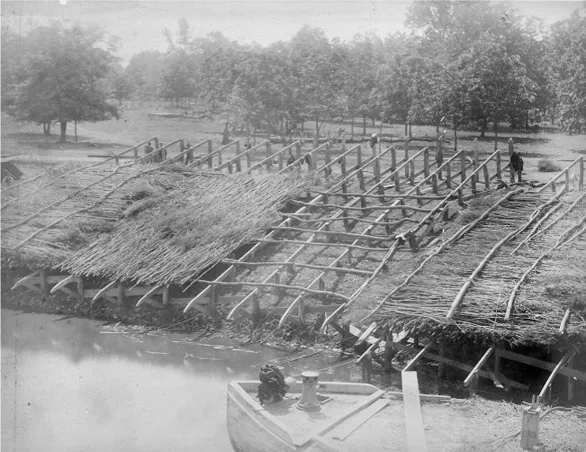
Figure 1.1. Mississippi River Improvements, 1882. Willow branches were fashioned into “mattresses” to protect the bends from erosion. (Wikimedia Commons)
Twain’s ambivalence over efforts to control the river in “these modern times” suggests the antimodernism discussed by T. J. Jackson Lears in his brilliant No Place of Grace. Lears explains that in the late nineteenth century, many cultural elites sought alternatives to the rationalized complacency of modernism. A sense of human finitude, especially in the face of a threatening nature, led them to seek more authentic experience through premodern craftsmanship, militarism, and religion. Lears argues that this search for authenticity and therapeutic self-fulfillment “eased their own and others’ adjustments to a streamlined culture of consumption” (xiv).
Antimodernism is an important motif in Life on the Mississippi. As Twain travels down the river, he frequently notes the economic and industrial progress of the towns. His home town of Hannibal “is no longer a village; it is a city,” and he reflects that “nearly all the river towns, big and little, have made up their minds that they must look mainly to railroads for wealth and upbuilding” (553, 449). He hopes that the growth of these cities will be accompanied by “intellectual advancement and the liberalizing of opinion,” and he predicts that such progress will help the South escape the pernicious influence of the romanticism of Sir Walter Scott that has left the region “modern and mediaeval mixed” (449, 501). Nevertheless, it is difficult to read without irony his praise of “the wholesome and practical nineteenth-century smell of cotton-factories and locomotives” or his putative celebration of “the plainest and sturdiest and infinitely greatest and worthiest of all the centuries the world has seen” (468–69). Twain is also uneasy with such efforts to imitate or transform nature as ice factories, artificial lights, and oleomargarine (396, 464, 523, 466). Meanwhile, the river itself is represented as a powerful force that literally undermines the confident belief in progress of those living along it: Twain marvels that the “self-complacent” town of Napoleon, Arkansas, has been completely destroyed by the erosive effects of the river (436).
One alternative to the banality and overcivilization of modernism for many late-nineteenth-century Americans was an excursion into wild nature. W. Douglas McCombs explores the development of the wilderness vacation as a response to the pressures of civilization. He notes that William Murray’s 1869 guide to the Adirondacks, Adventures in the Wilderness, initiated a rush of people seeking escape from the unhealthy environment of the city as well as therapy for psychological enervation (414). In 1878, Charles Dudley Warner, Twain’s friend and co-author of The Gilded Age (1873), published In the Wilderness, a series of sketches about vacationing in the Adirondacks; in part, they were intended as a parody of Murray, who presented the north woods as a welcoming place. For Warner, the “impassive, stolid brutality” of the “pitiless” Adirondack wilderness mocks any belief in “man’s superiority to Nature; his ability to dominate and outwit her” (20). This untamed nature is the reason why civilized people take temporary excursions into the wilderness: “it is the unconquered craving for primitive simplicity, the revolt against the everlasting dress-parade of our civilization” (78). Twain had both the magazine and book versions of Warner’s Adirondack essays in his library, and he included two of the sketches in Mark Twain’s Library of Humor (1888).2 Accordingly, it seems useful to begin by focusing on Huck’s excursion into the wilderness. Reading the novel from an ecocritical perspective confounds the opposition between civilization and nature: Huck’s flight into the wild nature of the 1840s frontier is thoroughly imbricated in the culture of industrial capitalism.
The novel opens with Huck in an uneasy relationship with those who are trying to “sivilize” him (1). At first, he finds living with the Widow Douglas and Miss Watson difficult because he must wear confining clothing, follow a structured schedule, and be subjected to educational and religious instruction. But after several months, he learns to tolerate civilized life, and when he needs a temporary escape, he slips out and camps in the woods (18). Huck’s gradual assimilation into middle-class culture is cut off by the arrival of his father. Disgusted by his son’s starchy clothes and education, Pap condemns Huck as an overcivilized effete, “a sweet-scented dandy,” before kidnapping him and taking him to the wilderness, a place “where the timber was so thick you couldn’t find it if you didn’t know where it was” (24, 29).
At first, Huck is content with this reversion to the wild, but Pap’s abuse soon makes him decide to run away. His initial plan is simple: he will take only a gun and fishing lines and “tramp right across the country” (32). But after he finds a drifting canoe, he decides to “camp in one place for good, and not have such a rough time tramping on foot” (38). To outfit this permanent camp, he takes “everything that was worth a cent” from the cabin:
I took the sack of corn meal … then I done the same with the side of bacon; then the whisky jug; I took all the coffee and sugar there was, and all the ammunition; I took the wadding; I took the bucket and gourd, I took a dipper and a tin cup, and my old saw, and two blankets, and the skillet and the coffee-pot. I took fish-lines and matches and other things. (39)
Not satisfied that his outfit was complete, Huck decides to stop at Jackson’s Island, where he could paddle over to town “and pick up things I want” (41). As Leo Marx has pointed out, this passage suggests that Huck is clearly not “an expositor of primitivist values”; indeed, his list is comparable to the extensive wilderness outfits described in Murray and other guidebooks (Machine 326).
Huck’s experience on Jackson’s Island begins as a moment of immersion into sublime nature. When he awakes, he is surrounded by “big trees”; he watches a friendly squirrel; and he admires the “pretty” river (45). But Huck quickly displays the desire to control nature that was central to late nineteenth-century excursions into the wilderness. He makes a “nice camp” and begins to feel a sense of ownership over the island: he boasts, “I was boss of it; it all belonged to me” as he surveys it for anything that would “come handy” (48). Later, Huck regrets that he cannot sell the giant catfish he catches, noting that “he would a been worth a good deal, over at the village” (66).
Huck continues to encumber his simple life by acquiring both practical camping gear and worthless possessions. The catalog of his finds from the floating house includes such potentially useful supplies as a lantern, knives, candles, a tin cup, a hatchet, and a fishing line with hooks (62). But the passage quickly turns into a parody of wilderness outfits with such worthless items as “a leather dog-collar, and a horseshoe, and some vials of medicine that didn’t have no label on them; and … a ratty old fiddle-bow and a wooden leg” (62). After a similar “rummaging” expedition on the wrecked steamboat, Huck boasts that he and Jim “hadn’t ever been this rich before, in neither of our lives” (81, 93). Far from the simple hunter-gatherer escape into nature that Huck first imagined, his trip has increasingly become encumbered with the possessions of civilization. Warnings against carrying excessive gear were commonplace in nineteenth-century wilderness guides: Warner mocks those who introduce “artificial luxuries” into camping excursions and thereby “reduce the life in the wilderness to the vulgarity of a well-fed picnic” (75).3
As Huck travels down the river, he periodically goes ashore, where he encounters a series of frontier communities that are corrupted both by the influences of consumer culture and the ruthless individualism of life on the edge of the wilderness. The Grangerford house is filled with the cheap goods of industrialization, such as chalk parrots, lithographic reproductions, and plaster fruit, which Huck sees as “much redder and ye...