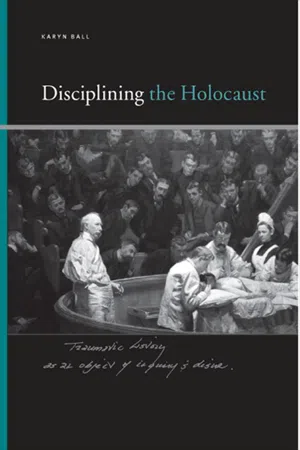
Disciplining the Holocaust
About this book
Explores the relationship between disciplinarity and contemporary ethics of scholarship about the Holocaust.
Disciplining the Holocaust examines critics' efforts to defend a rigorous and morally appropriate image of the Holocaust. Rather than limiting herself to polemics about the "proper" approach to traumatic history, Karyn Ball explores recent trends in intellectual history that govern a contemporary ethics of scholarship about the Holocaust. She examines the scholarly reception of Goldhagen's Hitler's Willing Executioners, the debates culminating in Eisenman's Memorial to the Murdered Jews of Europe in Berlin, Lyotard's response to negations of testimony about the gas chambers, psychoanalytically informed frameworks for the critical study of traumatic history, and a conference on feminist approaches to the Holocaust and genocide. Ball's book bridges the gap between psychoanalysis and Foucault's understanding of disciplinary power in order to highlight the social implications of traumatic history.
Frequently asked questions
- Essential is ideal for learners and professionals who enjoy exploring a wide range of subjects. Access the Essential Library with 800,000+ trusted titles and best-sellers across business, personal growth, and the humanities. Includes unlimited reading time and Standard Read Aloud voice.
- Complete: Perfect for advanced learners and researchers needing full, unrestricted access. Unlock 1.4M+ books across hundreds of subjects, including academic and specialized titles. The Complete Plan also includes advanced features like Premium Read Aloud and Research Assistant.
Please note we cannot support devices running on iOS 13 and Android 7 or earlier. Learn more about using the app.
Information
Table of contents
- DISCIPLINING THE HOLOCAUST
- Contents
- Illustrations
- Acknowledgments
- Introduction
- 1. Disciplining Traumatic History: Goldhagenâs âImproprietyâ
- 2. The Aesthetics of Restraint: Peter Eisenmanâs âJewishâ Solution to Germanyâs Memorial Question
- 3. âAuschwitzâ after Lyotard
- 4. âWorking throughâ the Holocaust?Toward a Psychoanalysis of Critical Refl ection
- 5. Unspeakable Differences,Obscene Pleasures: The Holocaust as an Object of Desire
- Notes
- Index
