- 247 pages
- English
- PDF
- Available on iOS & Android
About this book
Traces the history of two rival American economic moralities from colonial times to the present.
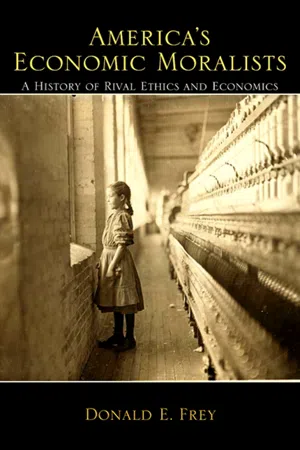
Since colonial times, two discernable schools have debated major issues of economic morality in America. The central norm of one morality is the freedom, or autonomy, of the individual and defines virtues, vices, obligations, and rights by how they contribute to that freedom. The other morality is relational and defines economic ethics in terms of behaviors mandated by human connectedness. America's Economic Moralists shows how each morality has been composed of an ethical outlook paired with a compatible economic theory, each supporting the other. Donald E. Frey adopts a multidisciplinary approach, not only drawing upon historical economic thought, American religious thought, and ethics, but also finding threads of economic morality in novels, government policies, and popular writings. He uses the history of these two supported yet very different views to explain the culture of excess that permeates the morality of today's economic landscape.
Frequently asked questions
- Essential is ideal for learners and professionals who enjoy exploring a wide range of subjects. Access the Essential Library with 800,000+ trusted titles and best-sellers across business, personal growth, and the humanities. Includes unlimited reading time and Standard Read Aloud voice.
- Complete: Perfect for advanced learners and researchers needing full, unrestricted access. Unlock 1.4M+ books across hundreds of subjects, including academic and specialized titles. The Complete Plan also includes advanced features like Premium Read Aloud and Research Assistant.
Please note we cannot support devices running on iOS 13 and Android 7 or earlier. Learn more about using the app.
Information
Table of contents
- AMERICA’S ECONOMIC MORALISTS
- Contents
- Acknowledgments
- 1. Introduction
- 2. Colonial Faith: Work,Wealth, and the Wider Welfare
- 3. Acting for Self ’s Sake: The Later Colonial Era
- 4. Laissez-Faire for Americans
- 5. Ethics Better than the Morals of Hermits
- 6. Religious Socialism: The Communal Moravians
- 7. Abolition: Human Dignity as a Boundary to Markets
- 8. Social Darwinists of Different Species
- 9. New Influences in Economics
- 10. The Social Gospel and Catholic Thought Around 1900
- 11. The 1920s and 1930s: Depressed Old Values
- 12. Too Agnostic, Too Certain: Welfare Economics, Chicago Economics
- 13. Moralists of Twentieth-Century Capitalism
- 14. Unconventional Alternatives to the Conventional Wisdom
- 15. An Ecumenical Consensuson Economic Ethics
- 16. Summary, Assessments,and a Projection
- Notes
- Works Cited
- Index