![]()
1
Introduction
A Very Brief History of Psychopathology in Cinema
HOMER B. PETTEY
THE HISTORY OF CINEMA REVEALS a fascination with psychopathology. No matter the psychological classification, in the main, cinema has willingly portrayed these psychic dimensions, symptoms, and perversions. The stages of the history of psychopathology onscreen accord with general public perceptions and misperceptions of mental illness. Early cinema treated what was called at the time insanity, rather than specific ailments, as a cause for bizarre behavior and criminality. The late 1920s and 1930s, with the introduction of sound, gave voice to horrific crimes of so-considered demonic madmen. In the postwar period, however, public sentiment leaned toward a more clinical, diagnostic view of mental incapacity. The new era of therapy, of psychoanalyzing everyday life, of psychosuggestive advertising, of personality, IQ, and Rorschach tests—all transformed and informed the public about the dimensions, distinctions, and degrees of mental abilities and disabilities. By the late 1960s and throughout the 1970s, psychopathology in mass media became categorizable into discrete patterns of recognizable misbehavior with nomenclature now understood by police, jurors, judges, teachers, editors, and anchormen. Universities required psychology majors to learn the differences among types of symptoms of abnormal psychology and the theories about their etiologies. The stigma of seeking therapy gradually ebbed away and a more accepting mass media turned to narratives of social responsibility for persons with mental illness. Of course, a simultaneous dissolution of mandatory institutionalization, either through exposure of corrupt management and horrific conditions or through removing state legislative economic support, produced an influx of mentally impaired people on urban streets. In contemporary cinema, shifts in attitudes toward afflicted people have now created a need for new social problem films, ones dealing with a variety of abuses and disorientations of the self. New awareness of disorder has become common parlance, so much so that news media, talk shows, and successful television comedy and dramatic series focus upon protagonists with anxiety and obsessive-compulsive behavior (Monk), manic-depressive bipolarity (Homeland), and even homicidal sociopathy (Dexter). Cinema continually expands its depictions of mental illness, almost as though with each new disorder, a film waits to be made. In the main, cinema holds up a mirror, no matter how dark or cracked, to reflect the public’s continual fascination with these typifications—still regarded by many as pathologies.
Much of the silent era treatment of mental illness accords with Oliver Sacks’s concept of the asylum:
Finally, coming back to the original meaning of asylum, these hospitals provided control and protection for patients, both from their own (perhaps suicidal or homicidal) impulses and from ridicule, isolation, aggression, or abuse so often visited upon them in the outside world. Asylums offered a life with its own special protections and limitations, a simplified and narrowed life perhaps, but with this protective structure, the freedom to be as mad as one liked and, for some patients at least, to live through their psychoses and emerge from their depths as saner and stabler people. (2)
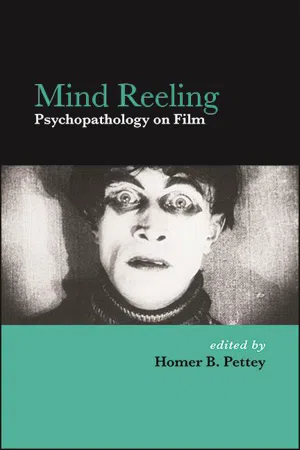
The popular view of the asylum as the residence for the marginal figures of society, the insane, befit their Victorian and oppressive structures. These hospitals provided shelter, mostly for society, from the inmates who suffered social diseases, syphilis in particular, and mental dysfunctions, paranoia being quite common. Professional interest in insanity certainly reached its initial stage in the nineteenth century with the founding of the American Journal of Insanity in 1844, whose organization, by the end of the century, would change its name to the American Medico-Psychological Association (1892), then to the American Psychiatric Association (1921) (Freedheim 32). While skeptics had predicted that moving pictures would cause nervous problems among their audiences, several asylums, including the Nebraska State Institute for the Insane, installed minitheaters in order to soothe patients “without the exciting effects of other forms of diversion” (Keil and Singer 29). Insanity appears in significant silent films, especially among those revealing the interiors of institutions for madness through visual hallucinations: Robert Wiene’s The Cabinet of Dr. Caligari (1919), Benjamin Christensen’s Häxan (1922), Roland West’s The Monster (1925), and Teinosuke Kinugasa’s Kurutta ippeji (A Page of Madness, 1926). Modernist art movements enhanced the sense of delirium experienced by residents of the asylums, ranging from expressionist mise-en-scène to surrealistic psychosexual imagery. Milos Forman’s Amadeus (1984), based on Peter Shaffer’s 1979 play, employs the concept of the voiceover narrator, Antonio Salieri (F. Murray Abraham), being the resident of an eighteenth-century asylum driven to murderous thoughts out of envy. Often forgotten about this tale of musical rivalry is that Alexander Pushkin first wrote a short play, Mozart and Salieri (1830), which begins with Salieri’s demented soliloquy against justice and the heavens for anointing Mozart with artistic genius:
Where, where is justice, when the sacred gift,
When deathless genius comes not to reward
Perfervid love and utter self-denial,
And toils and strivings and beseeching prayers,
But puts her halo round a lack-wit’s skull,
A frivolous idler’s brow? … O Mozart, Mozart! (Clark 430)
Forman’s film begins with Salieri’s failed suicide and his shout of “Mozart!” the source of his severe melancholy. Pushkin’s play concludes with Salieri unrepentant about his crime, but also adds his own mad elevation to a kind of suspect greatness:
So villainy and genius are two things
That never go together? That’s not true;
Think but of Buonarotti … Or was that
A tale of the dull, stupid crowd—and he
Who built the Vatican was not a murderer? (436)
Forman’s film concludes in a somewhat similar fashion, with Salieri showing no regret for his murderous intent, but elevating himself to being the patron saint of all mediocrities as an attendant wheels him past dismally treated residents in irons or sitting amongst straw and dung. Mental institutions proved to be a perpetual subject of cinema; among the numerous films with all or portions set in asylums, excluding more contemporary horror films, are these: Spellbound (1945); Bedlam (1946); The Snake Pit (1948); Harvey (1950); The Three Faces of Eve (1957); David and Lisa (1962); Captain Newman, M. D. (1963); Lilith (1964); King of Hearts (1966); One Flew over the Cuckoo’s Nest (1975); Girl Interrupted (1999); Spider (2002); Gothika (2003); The Jacket (2005); Asylum (2005); and Shutter Island (2010).
Three months before the release of The Cabinet of Dr. Caligari, Robert Reinert released in Munich Nerves (1919), whose aesthetic reflects the processes of nervous conditions spreading throughout the social classes: “Digressive and fragmentary, Reinert’s film follows a group of people whose nerves have been shattered by war and revolution; traumatized and racked with guilt, they exist on the edge of madness. The film’s own perplexing narrative structure imitates the liminal mental states it portrays, ranging from despondency to suicide, from agitation to delirium, from mental breakdowns to hallucinations of a harmonious life in nature” (Kaes 39). Key aesthetics for early cinema of madness required the perceptual experience of madness to be conveyed onto the screen. A fine example remains the hallucinations and misperceptions that drive a jealous husband to the brink of madness in Arthur Robison’s Warning Shadows (1923). Physicians and alienists often viewed criminality as symptomatic of extreme mental derangement: “As a symptom instead of a disease, the homicidal impulse became identified with two distinct mental conditions. In constitutional psychopathic states, a name given to the conditions brought about by a degenerating nervous system, the homicidal impulse, and impulses in general, were believed to be stigmata of degeneracy. In dementia praecox, alienists saw the homicidal impulse as evidence of the emotional indifference, deterioration of the will, and the impulsive as well as purposeless behaviors that were often destructive and dangerous” (Colaizzi 84). Anthony Asquith’s A Cottage on Dartmoor (1929) relies upon the prison escape of a love-obsessed, emotionally unstable man (Uno Henning). Louis Feuillade’s crime serials suggest transgressive acts among the underworld gangs of Les vampires (1915–16), particularly the vicious, sadistic Apache Irma Vep (Musidora). Silent horror films mix the macabre with touches of insanity; cases in point include John Barrymore’s film version of his sensational stage production of Dr. Jekyll and Mr. Hyde (1920); Lon Chaney’s remarkable performance in The Phantom of the Opera (1925); and Jean Epstein’s dark, disorienting film of Luis Buñuel’s adaptation of Edgar Allan Poe’s The Fall of the House of Usher (1928). The dual personalities of many of these early films can be attributed to Robert Louis Stevenson’s tale of Jekyll and Hyde, as well as to Morton Prince’s detailed study The Dissociation of Personality (1908), which dealt with descriptions of dual behavioral personality.
Duality certainly became a visual trope for Dada and surrealist cinema. In Anémic Cinéma (1926), Dadaist Marcel Duchamp created “rotoreliefs,” spinning conical-within-conical figures that were interspersed with spinning French phrases filled with puns and dual meanings. Significantly, Duchamp concluded this six-minute film with a copyright signed by Rrose Sélavy, or eros c’est la vie, his gender-split alter ego as a woman, of whom Man Ray took several portraits. Of course, such dual personality intrigued Luis Buñuel and Salvador Dali and influenced their Un chien andalou (1929), which also flirts with psychosexual fixation, fetishism, and sadism as the underpinnings for surrealism. Specifically, Dali and Buñuel reveal this duality as an expression of film aesthetics, with “dislocations and disruptions of space and of narrative continuity” presented in a way that seems to be matter-of-fact reality: “In their script the young woman’s lack of surprise as she turns around and sees the absent cyclist—whose frills, box, and collar she has just arranged on the bed—standing in another corner of the room” (Finkelstein 85). It is the subverting of cinematic conventions, along with the almost slapstick, silent film aesthetic, that contribute to the disturbing images that thwart the viewer’s expectations, but in an “unassuming way” (85). Buñuel in particular was fascinated with the cinema of Harry Landon and other silent comedians. Consequently, during the first showings of Un chien andalou at Studio 28, it featured “on a double bill with a Harold Lloyd comedy” (Adamowicz 72). In this way, the Surrealism of Dali and Buñuel eschews techniques of modernist films in order to reveal the banal workings of the popular psyche, best represented by the nonchalance in the face of a mad and chaotic world characterized by silent comedy, particularly Lloyd and Keaton.
By the 1930s, psychopathy, often associated with dangerous scientific experimentation and criminality, became commonplace in the era of great horror films. If, as Jack Shadoian has claimed, the rise of 1930s gangster films was “a paradigm of the American dream,” then, also during this same period, the rise of horror films was a paradigm of the American nightmare, the abhorrent psyche that repels as it compels audience attention (3). Horror subject matter involves the grotesque, the deformed, the demented, and the pathological; the worst fears of the institutions for the insane become realities in these films. Angela M. Smith shows a close relationship in 1930s horror films between medical science, often of the brain, and disability, a societal fear of the other, the ab-normal:
Their formulaic tropes and plots focus on characters/monsters who are clearly bodily, cognitively, or psychologically deformed or impaired; they engage the ethical dilemmas of scientific and medical “advances”; they explicitly mobilize the power dynamics of the medical gaze; and they repeatedly trouble any easy distinction between health professionals and the problematic bodies that they survey, interpret, diagnose, and seek to fix. To that extent, they indicate a popular anxiety about the powers wielded by medical men, a concern that eschews faith in eugenic principles and their proponents and, using the visual rhetoric of disability, transfigures doctors into monsters and monster-makers. (165)
Often, mad scientists have figures of physical disability surround them, as the classical horror films allegorize the physical with the mental instability of the mad doctor. In The Island of Lost Souls (1932), demented Dr. Moreau (Charles Laughton) uses biological-anthropomorphic surgeries to transform animals into humans. Of course, James Whale’s Frankenstein films associate the not-so-good doctor with a kind of mental pathology, displayed admirably by Colin Clive’s frenetic, campy exclamation, “It’s alive!” Frankenstein’s hunchbacked assistant Fritz represents a clearly allegorical physical marker for the not-so-good doctor’s mental state. Of course, the numerous cinematic retellings of the mentally and emotionally disturbed doctor have been part of film history since Edison Studio’s 1910 adaptation, but so too has the mad concept of reanimation and creating human life from base materials. In Michael Curtiz’s Doctor X (1932), Dr. Wells (Preston Foster) attempts to create artificial flesh by using a scalpel to remove body parts after first murdering his victims, making the crime scenes appear as though a mad cannibal now terrorizes New York City. Megalomanical Dr. Fu Manchu, based upon Sax Rohmer’s novels, began his cinematic criminal career in the 1923 British serial The Mystery of Dr. Fu Manchu, and debuted in the United States with Warner Oland as the infamous doctor in The Mysterious Dr. Fu Manchu (1929), The Return of Dr. Fu Manchu (1930), and The Dragon’s Daughter (1931). Perhaps the most well-known remains Boris Karloff’s insidiously mad and evil portrayal in Charles Brabin’s The Mask of Fu Manchu (1932). Experimenting with invisibility by using the drug “monocane,” Dr. Jack Griffin (Claude Rains) in The Invisible Man (1933) becomes increasingly madder and madder, eventually becoming an outrageous murderer who derails a train and thereby kills hundreds of passengers. In Night of Terror (1933), mad scientist Dr. Arthur Hornsby (George Meeker), in reality the homicidal maniac, fakes his own death, only to return to exterminate all of his relatives in order to secure his uncle’s fortune. The ending cannot be discussed, since the crazed doctor warns the audience that he will haunt them if they reveal the plot to a single soul. As campy as these films appear in retrospect, their significance still lies in how they depict not so much gothic terror, but rather societal phobias about the demented and deranged, in short, the mentally afflicted.
By the 1940s, the mad criminal morphs into figures wi...