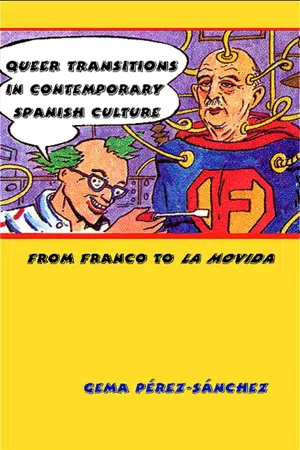
Queer Transitions in Contemporary Spanish Culture
eBook - PDF

Queer Transitions in Contemporary Spanish Culture

From Franco to LA MOVIDA

  1. 273 pages
  2. English
  3. PDF
  4. Available on iOS & Android
eBook - PDF

Queer Transitions in Contemporary Spanish Culture

From Franco to LA MOVIDA

About this book

Offers a sustained analysis of both high and low queer culture and its connections to cultural and political processes in Spain.

Gema Pérez-Sánchez argues that the process of political and cultural transition from dictatorship to democracy in Spain can be read allegorically as a shift from a dictatorship that followed a self-loathing "homosexual" model to a democracy that identified as a pluralized "queer" body. Focusing on the urban cultural phenomenon of la movida, she offers a sustained analysis of high queer culture, as represented by novels, along with an examination of low queer culture, as represented by comic books and films. Pérez-Sánchez shows that urban queer culture played a defining role in the cultural and political processes that helped to move Spain from a premodern, fascist military dictatorship to a late-capitalist, parliamentary democracy.

The book highlights the contributions of women writers Ana María Moix and Cristina Peri Rossi, as well as comic book artists Ana Juan, Victoria Martos, Ana Miralles, and Asun Balzola. Its attention to women's cultural production functions as a counterpoint to its analysis of the works of such male writers as Juan Goytisolo and Eduardo Mendicutti, comic book artists Nazario, Rubén, and Luis Pérez Ortiz, and filmmaker Pedro Almodóvar.

Frequently asked questions

Yes, you can cancel anytime from the Subscription tab in your account settings on the Perlego website. Your subscription will stay active until the end of your current billing period. Learn how to cancel your subscription.
No, books cannot be downloaded as external files, such as PDFs, for use outside of Perlego. However, you can download books within the Perlego app for offline reading on mobile or tablet. Learn more here.
Perlego offers two plans: Essential and Complete
  • Essential is ideal for learners and professionals who enjoy exploring a wide range of subjects. Access the Essential Library with 800,000+ trusted titles and best-sellers across business, personal growth, and the humanities. Includes unlimited reading time and Standard Read Aloud voice.
  • Complete: Perfect for advanced learners and researchers needing full, unrestricted access. Unlock 1.4M+ books across hundreds of subjects, including academic and specialized titles. The Complete Plan also includes advanced features like Premium Read Aloud and Research Assistant.
Both plans are available with monthly, semester, or annual billing cycles.
We are an online textbook subscription service, where you can get access to an entire online library for less than the price of a single book per month. With over 1 million books across 1000+ topics, we’ve got you covered! Learn more here.
Look out for the read-aloud symbol on your next book to see if you can listen to it. The read-aloud tool reads text aloud for you, highlighting the text as it is being read. You can pause it, speed it up and slow it down. Learn more here.
Yes! You can use the Perlego app on both iOS or Android devices to read anytime, anywhere — even offline. Perfect for commutes or when you’re on the go.
Please note we cannot support devices running on iOS 13 and Android 7 or earlier. Learn more about using the app.
Yes, you can access Queer Transitions in Contemporary Spanish Culture by Gema Pérez-Sánchez,Gema Perez-Sanchez in PDF and/or ePUB format, as well as other popular books in Social Sciences & European Literary Criticism. We have over one million books available in our catalogue for you to explore.

Table of contents

  1. Queer Transitions in Contemporary Spanish Culture
  2. Contents
  3. Illustrations
  4. Acknowledgments
  5. Introduction
  6. 1. Franco’s Spain and the Self-Loathing Homosexual Model
  7. 2. Reading, Writing, and the LoveThat Dares Not Speak Its Name: Eloquent Silences in Ana María Moix’s Julia
  8. 3. From Castrating Fascist Mother-Nation to Cross-Dressed Late-Capitalist Democracy: Eduardo Mendicutti’s Una mala noche la tiene cualquiera
  9. 4. A Voyage in Feminist Pedagogy: Citationality in Cristina Peri Rossi’s La nave de los locos
  10. 5. Drawing Difference: The Cultural Renovations of the 1980s
  11. Conclusion
  12. Notes
  13. Works Cited
  14. Index