- 300 pages
- English
- PDF
- Available on iOS & Android
About this book
Locates in Schelling a new understanding of our relation to nature in philosophy.
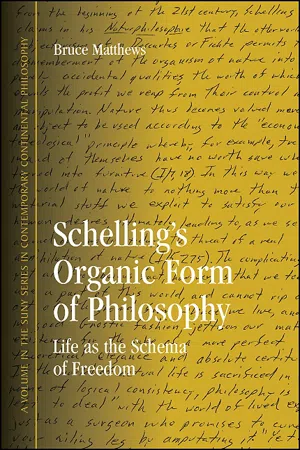
The life and ideas of F.W.J. Schelling are often overlooked in favor of the more familiar Kant, Fichte, or Hegel. What these three lack, however, is Schelling's evolving view of philosophy. Where others saw the possibility for a single, unflinching system of thought, Schelling was unafraid to question the foundations of his own ideas. In this book, Bruce Matthews argues that the organic view of philosophy is the fundamental idea behind Schelling's thought. Focusing in particular on Schelling's early writings, especially on Plato and Kant, Matthews explores Schelling's idea that any philosophical system must be perspectival and formed by each individual student of philosophy, providing a unique new understanding to an important and often overlooked figure in the history of philosophy.
Frequently asked questions
- Essential is ideal for learners and professionals who enjoy exploring a wide range of subjects. Access the Essential Library with 800,000+ trusted titles and best-sellers across business, personal growth, and the humanities. Includes unlimited reading time and Standard Read Aloud voice.
- Complete: Perfect for advanced learners and researchers needing full, unrestricted access. Unlock 1.4M+ books across hundreds of subjects, including academic and specialized titles. The Complete Plan also includes advanced features like Premium Read Aloud and Research Assistant.
Please note we cannot support devices running on iOS 13 and Android 7 or earlier. Learn more about using the app.
Information
Table of contents
- Schellingās Organic Form of Philosophy
- Contents
- Preface
- Acknowledgments
- Notes on Sources and Abbreviations
- 1. Life as the Schema of Freedom: Schellingās Organic Form of Philosophy
- 2. Beginnings: Theosophy and Nature Divine
- 3. The Question of Systematic Unity
- 4. The Timaeus Commentary
- 5. On the Possibility of a Form of All Philosophy: The Form Essay
- 6. Freedom and the Construction of Philosophy
- Appendix
- Notes
- Index