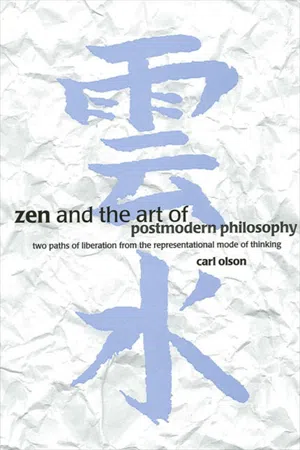
Zen and the Art of Postmodern Philosophy
eBook - PDF

Zen and the Art of Postmodern Philosophy

Two Paths of Liberation from the Representational Mode of Thinking

  1. 321 pages
  2. English
  3. PDF
  4. Available on iOS & Android
eBook - PDF

Zen and the Art of Postmodern Philosophy

Two Paths of Liberation from the Representational Mode of Thinking

About this book

Carl Olson is Professor of Religious Studies at Allegheny College in Pennsylvania. His previous books include The Indian Renouncer and Postmodern Poison: A Cross-Cultural Encounter and The Theology and Philosophy of Eliade: A Search for the Centre.

This book examines and compares the philosophical positions of various postmodern thinkers and Zen Buddhist philosophers on: language and play; modes of thinking; skepticism and doubt; self and other; time and death; nihilism and metaphysics; and the conception of the end of philosophy. The Zen thinkers dealt with are Dogen and Nishitani, and the Western thinkers are Derrida, Lacan, Heidegger, Lyotard, Foucault, Deleuze and Guatarri, Kristeva, and Levinas. Although each share similar notions concerning the shortcomings of representational thinking, major differences still exist. By clarifying these differences, Olson counters the tendency to overtly assert or covertly imply that postmodern and Zen philosophies are moving in the same direction. Some postmodern thinkers and Zen Buddhist philosophers share common philosophical ground with regard to a mutual philosophical attack and attempt to overcome the perceived shortcomings of the representational mode of thinking that conceives of the mind like a mirror and assumes a correspondence between appearance and reality that is supported by a metaphysical structure.

Frequently asked questions

Yes, you can cancel anytime from the Subscription tab in your account settings on the Perlego website. Your subscription will stay active until the end of your current billing period. Learn how to cancel your subscription.
No, books cannot be downloaded as external files, such as PDFs, for use outside of Perlego. However, you can download books within the Perlego app for offline reading on mobile or tablet. Learn more here.
Perlego offers two plans: Essential and Complete
  • Essential is ideal for learners and professionals who enjoy exploring a wide range of subjects. Access the Essential Library with 800,000+ trusted titles and best-sellers across business, personal growth, and the humanities. Includes unlimited reading time and Standard Read Aloud voice.
  • Complete: Perfect for advanced learners and researchers needing full, unrestricted access. Unlock 1.4M+ books across hundreds of subjects, including academic and specialized titles. The Complete Plan also includes advanced features like Premium Read Aloud and Research Assistant.
Both plans are available with monthly, semester, or annual billing cycles.
We are an online textbook subscription service, where you can get access to an entire online library for less than the price of a single book per month. With over 1 million books across 1000+ topics, we’ve got you covered! Learn more here.
Look out for the read-aloud symbol on your next book to see if you can listen to it. The read-aloud tool reads text aloud for you, highlighting the text as it is being read. You can pause it, speed it up and slow it down. Learn more here.
Yes! You can use the Perlego app on both iOS or Android devices to read anytime, anywhere — even offline. Perfect for commutes or when you’re on the go.
Please note we cannot support devices running on iOS 13 and Android 7 or earlier. Learn more about using the app.
Yes, you can access Zen and the Art of Postmodern Philosophy by Carl Olson in PDF and/or ePUB format, as well as other popular books in Philosophy & Eastern Philosophy. We have over one million books available in our catalogue for you to explore.

Information

Table of contents

  1. Zen and the Art of Postmodern Philosophy: Two Paths of Liberation from the Representational Mode of Thinking
  2. Contents
  3. Preface
  4. 1. Signing In
  5. 2. Language, Disruption, and Play
  6. 3. Ways of Thinking
  7. 4. Radical Skepticism and Doubt
  8. 5. The Body
  9. 6. The Self and Other
  10. 7. Time and Death
  11. 8. Nihilism and Metaphysics
  12. 9. Signing Out
  13. Notes
  14. Bibliography
  15. Index