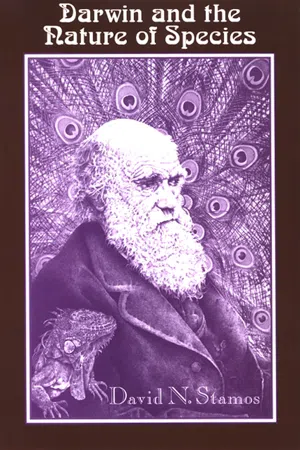
Darwin and the Nature of Species
eBook - PDF

Darwin and the Nature of Species

  1. 293 pages
  2. English
  3. PDF
  4. Available on iOS & Android
eBook - PDF

Darwin and the Nature of Species

About this book

Examines Darwin's concept of species in a philosophical context.

Since the 1859 publication of On the Origin of Species, the concept of "species" in biology has been widely debated, with its precise definition far from settled. And yet, amazingly, there have been no books devoted to Charles Darwin's thinking on the term until now. David N. Stamos gives us a groundbreaking, historical reconstruction of Darwin's detailed, yet often misinterpreted, thoughts on this complex concept.

Stamos provides a thorough and detailed analysis of Darwin's extensive writings, both published and unpublished, in order to reveal Darwin's actual species concept. Stamos argues that Darwin had a unique evolutionary species concept in mind, one that was not at all a product of his time. Challenging currently accepted views that believe Darwin was merely following the species ascriptions of his fellow naturalists, Stamos works to prove that this prevailing, nominalistic view should be overturned. This book also addresses three issues pertinent to the philosophy of science: the modern species problem, the nature of concept change in scientific revolutions, and the contextualist trend in professional history of science.

Frequently asked questions

Yes, you can cancel anytime from the Subscription tab in your account settings on the Perlego website. Your subscription will stay active until the end of your current billing period. Learn how to cancel your subscription.
At the moment all of our mobile-responsive ePub books are available to download via the app. Most of our PDFs are also available to download and we're working on making the final remaining ones downloadable now. Learn more here.
Perlego offers two plans: Essential and Complete
  • Essential is ideal for learners and professionals who enjoy exploring a wide range of subjects. Access the Essential Library with 800,000+ trusted titles and best-sellers across business, personal growth, and the humanities. Includes unlimited reading time and Standard Read Aloud voice.
  • Complete: Perfect for advanced learners and researchers needing full, unrestricted access. Unlock 1.4M+ books across hundreds of subjects, including academic and specialized titles. The Complete Plan also includes advanced features like Premium Read Aloud and Research Assistant.
Both plans are available with monthly, semester, or annual billing cycles.
We are an online textbook subscription service, where you can get access to an entire online library for less than the price of a single book per month. With over 1 million books across 1000+ topics, we’ve got you covered! Learn more here.
Look out for the read-aloud symbol on your next book to see if you can listen to it. The read-aloud tool reads text aloud for you, highlighting the text as it is being read. You can pause it, speed it up and slow it down. Learn more here.
Yes! You can use the Perlego app on both iOS or Android devices to read anytime, anywhere — even offline. Perfect for commutes or when you’re on the go.
Please note we cannot support devices running on iOS 13 and Android 7 or earlier. Learn more about using the app.
Yes, you can access Darwin and the Nature of Species by David N. Stamos in PDF and/or ePUB format, as well as other popular books in History & Philosophy History & Theory. We have over one million books available in our catalogue for you to explore.

Table of contents

  1. Darwin and the Nature of Species
  2. Contents
  3. Preface
  4. Acknowledgments
  5. 1. A History of Nominalist Interpretation
  6. 2. Taxon, Category, and Laws of Nature
  7. 3. The Horizontal/Vertical Distinction and the Language Analogy
  8. 4. Common Descent and Natural Classification
  9. 5. Natural Selection and the Unity of Science
  10. 6. Not Sterility, Fertility, or Niches
  11. 7. The Varieties Problem
  12. 8. Darwin’s Strategy
  13. 9. Concept Change in Scientific Revolutions
  14. 10. Darwin and the New Historiography
  15. Notes
  16. References
  17. Index