![]()
Part I
Aesthetics and Textuality
![]()
1
MURRAY POMERANCE
A Passing Node
The Asphalt Jungle
Changing shadows would flit over his face, and sometimes an almost rational light would appear in his eyes—but nonetheless all that could be said of him was that he was immobile—a distressing immobility, exhausting for the gaze that sought a hint of conscious life in it.
—Vladimir Nabokov, The Luzhin Defense
Where
“SAY IT,” WROTE WILLIAM CARLOS WILLIAMS, “no ideas but in things.” Cinema is entirely material, an organization of moving reflections of moving things, and the story of a film is but the career line upon which the reflections of a moment are hung.
We have to find a place to set all this, not just a set of coordinates by a collection of shapes and shadows, passageways, rooms, the penumbra of streetlamps. This setting needs to crackle with faded promise and disappointment, the drooping shadows of industry gone to pasture, empty streets in which civilians no longer wish to parade their hopes, a peculiar kind of darkness: not merely night, but that part of the night which is night’s nocturne, the night of night, so that all of the creatures who live there in confederate secrecy can come out from under the rocks. Think of John Sloan’s “Six O’Clock, Winter” (1912) or of Philip Church’s Furnace Harbor, and you’ll understand the peculiar, post-Depression, pre-LED darkness:
This night in Furnace Harbor will give you a
morning and empty you for the rest of your life.
This is your Cemetery Hill, buddy, and no shrink
will ever be able to explain why from this night
forward you will imagine nothing more to desire.
It is the very late 1940s. If wartime production is at a halt, still the assembly lines have not perked up again, and the women who made artillery shells have been sent home to bake and sweep and mourn. Producer Arthur Hornblow Jr. to Rudolf Monta of the MGM Legal Department on June 11, 1949: “Answering your memo of June 9th, it seems to add up to a conclusion that committing an act of libel is almost inevitable in the event we place the action of Asphalt Jungle against the background of an actual city. Nevertheless, in view of the need for reality, I should like to continue to pursue with you a course which, while protecting us legally, can still perhaps achieve the desired result.” Then: “It would be an aid to us if you also could suggest a city, preferably large and preferably in the middle-west, that we might approach on this point. St. Louis, Minneapolis or Kansas City would be acceptable but there are several others that could replace them. … John Huston and I would be grateful for your affirmative assistance” (Hornblow to Monta, June 11, 1949). Nota bene: “the need for reality.” Certainly in the film, certainly from the point of view of the artists and the marketers, who intend to show the American public a picture of its own most repressed, most nocturnal, darknesses, but also as a general condition of life after the war. The producer identifies a “need for reality,” as though the war was a kind of shapeless cauchemar, the need to put a clarifying light upon things, and to have them linger in darkness just in order that the clarifying light should best do its work. And note, too, “grateful for your affirmative assistance”; “affirmative” assistance, not just assistance, because having been at MGM already for seven years, Hornblow was no stranger to Rudy Monta’s circumlocutions, denials, reproachments, demurrers. The job of the legal deptartment was to tell these creative people why they oughtn’t to do things, and Monta was very good at his job.
July 8, he replies: “We will have to find a city that would cooperate, permitting photography in and out of their buildings, etc., and obtaining for us releases of necessary persons, where the facts or their position would give grounds pointing to identification” (Monta to Hornblow, July 8, 1949). This won’t happen, says Monta, without a final script we can show them. We have to have a final script. What spurred this was a letter Hornblow had written to the new production chief, Dore Schary, a month earlier, to the effect that he and Huston felt a “fictitious odor” would attach to falsely naming a city; and he shared this concern with Monta. “The city itself is a character in this story. The city is the Asphalt Jungle. And it is in the true-to-life and fresh handling of the crime problem of such a city that our picture finds both its theme and its strength. … It is our plan to use the background of an actual city” (Hornblow to Monta, June 2, 1949). On behalf of the studio, Monta was characteristically squeamish: “To obtrain the reality desired of any actual city it means that everyone will know” (Monta to Hornblow, June 9, 1949).
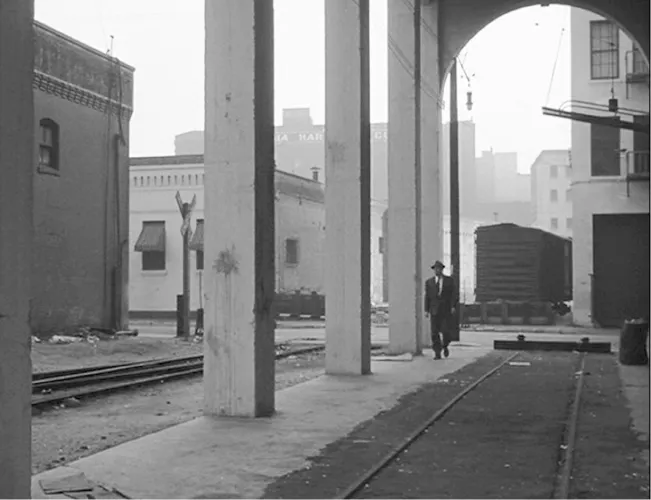
St. Louis, Minneapolis, Jersey City, Kansas City, and Chicago would not do: rather the once great urban center of the Midwest, now fallen, with its looming baroque mansions and its railroad skirting the Ohio: Cincinnati. No matter what it looks like in real life, it submits to John Huston’s portraiture, through the armature of Harold Rosson’s camera; it comes out angular and broken, staggering, stolid—George Tice’s Paterson with the sun turned out—a zone of pure intentions: the urgent railroad, the broad asphalt playing field of the streets. This is where things happen. This is where America becomes itself, the clash of personalities making sparks. You don’t get realer than this, emptied for the rest of your life; you don’t have any unresolved, itching need for reality.
Figure 1.1. Dix crosses through the fallen and baroque landscape of a decaying urban center.
Doc
The story, such as it is—no, it’s not really a story, it’s a meeting—centers upon Doc Riedenschneider (Sam Jaffe), just out of stir, very much an old hack (an artisan) who has all his tricks in order; a queer old owl whose eyes never stop scanning for approaching goons. He’s out, therefore, but he’s in; dressed in a hat and necktie as though strapped into striped pajamas, imprisoned for the rest of his life. He breezes into town (one of the prevalent conceits of modernity: denying that the city is a city by calling it “town”) and meets the pimp bookie Cobby (Marc Lawrence), a creature who gives new meaning to the word “unctuous,” persuading him that he has a great plan for a massive jewel heist if only he can get bankrolled. Cobby consults his puppeteer, the gracile and dirty-handed lawyer Emmerich (Louis Calhern), who buys in. A team is put together, including, as thug, Dix Handley (Sterling Hayden)—a handleyman; as cracker, the loyal Catholic family type Louis Ciavelli (Anthony Caruso); as driver, Dix’s pal Gus Minissi (James Whitmore), humpbacked cat lover and staunch loyalist. Police commissioner Hardy (John McIntire) is hot for publicity and aggressive for arrests; his lieutenant Ditrich (Barry Kelley) has been on Cobby’s take for some time, but will do anything to save his own skin. As for Emmerich, even bolstered by a suspicious private detective, Brannom (Brad Dexter), he is hopelessly down in the gutter. The involvement with Doc and his team becomes fatal. The girl he has been keeping in a lovers’ nook, Angela Phinlay (Marilyn Monroe), is either an innocent waif floating through the filthy channel of the action or a canny, utilitarian grifter; we never have an opportunity to know.
Everything goes wrong except the heist itself. A guard shoots Louis during the escape, and he is brought home to his wife to die. The ambitious Hardy sets Ditrich to prey on Cobby, forcing the names of the robbers from this coward who would trade his mother to avoid pain. Doc and Dix confront Emmerich with their booty, demanding payment, but he begs off, having no money in hand. When Brannom suddenly pulls a gun, Dix kills him, but not before being shot. Gus is arrested, as is Cobby. Creeping around the rail yards at night, Doc and the wounded Dix are confronted by a cop who beats Doc on the head. The two retreat to Dix’s girl Doll’s (Jean Hagen) apartment for nursing and then Doc makes his way out of town, only to be caught at a roadhouse where he has been entranced by a teenaged girl dancing to music from a jukebox. With Doll as company, Dix drives all the way to his horse farm in Kentucky, dying as he crosses the fields. If in film noir generally, as R. Barton Palmer points out, the detective “remains beyond the reach of the criminal” (84), here at least some of the criminals exceed the reach of the detective.
Doc Riedenschneider is a European gentleman, and perhaps, indeed, something of a doctor—another mystery: does he “doctor” safes and jewel caches, or was he once a medical man, now unfrocked and sent to work on the dark side? He knows his etiquette—how to bow to a lady, how to lay a bevy of nickels on a tabletop so an eager girl can dance all night—knows the way around the social machine. We would peg him as an immigrant from Berlin, probably a man who fled the Nazis, got into trouble in the US of A, never stops feeling hunted. Delivered by taxi to Cobby’s book joint, he’s got some ideas for a good heist: Cobby (Marc Lawrence) can set anybody up with anybody.
A note about Doc’s nationality, since his echt Germanity runs considerably deeper than a demonstration of fluid sociability and a sense of decorum: late in the film, fleeing for his life after the jewel heist collapses in its finale, the old man falls into a taxicab and persuades the driver to take him to Cleveland. They get to talking, each, as it turns out, a German émigré. Doc has found his haven in this moving cab—a quintessentially American idea, the merger of heimlichkeit and continuous mobility—and we have the sense, now as the plot is almost entirely unwound, that in this flickering darkness, and for the very first time in our view, he is able to relax. While Doc does not actually pronounce the words “They don’t understand,” Jaffe’s delicate performance allows us to grasp his deep thought that American culture is an alien one: the way that when he discovers the driver is German he settles back into his seat; the curling smile on his lips; his casual use of German words to salt his English ones:
DOC: Sie haben Verwandten in Deutschland.
SCHURZ: Ach, ja. Sie sprechen gut Deutsch.
DOC: I haven’t spoken German for a long, long time.
SCHURZ: You have a München accent.
DOC: Naturlich, I was born there! But you know what they say: Home is where the money is.
He addresses the driver, whose license tabs him as Frank Schurz, as Franz:
DOC: Let’s not stop here [for gas] … Let’s wait until we get out of town, then we can do everything at once. Have a little meal, beer, cigar, and go in comfort.
SCHURZ: I can see you’re a man who likes his pleasures.
DOC: Well, Franz, what else is there in life, I ask you.
Doc’s talk is an appeal to a culture now regarded as decadent and defeated, a place where pleasure rules. (He wants a German beer.) Here in America, he implies, where you and I are outsiders, Franz, there is too much strife, too much angst, too much confusion. They can’t understand us, can’t appreciate the correct and gemutlich way of being that allows for a genteel cigar, a moment of patient reflection, a focus on things which are good in life.
The cabbie is by far the younger man, probably in his midthirties (the actor, Henry Rowland, was thirty-six during shooting). We can put Riedenschneider at about fifty-five or fifty-six, and thus imagine that in 1929, he himself was the driver’s age. Schurz is thus a living memorial—incitement—and Riedenschneider a fading pointer to a recollection or reconstitution of Germany in 1929, that “année terrible,” in Harry Graf Kessler’s words. “One piece after another of the world, as I and my generation knew it, disappears,” with Hugo von Hofmannsthal, Gustav Stresemann, and Serge Diaghilev all dying and the German economy dropping into “another freefall in the months and years that followed: banks closed; businesses shut; unemployment rocket[ing] skyward” (Eksteins; Kessler qtd. in Eksteins 306). As indicated by the etiquette of their brief conversation, the Germany to which Doc and Schurz implicitly refer in meeting one another is a lost paradise of formalities and décor, even in its underbelly.
Also called up in Doc’s pervading gemutlichkeit is a shadow of another Germany, the one that would have been most prominent in viewers’ minds in 1950 and to which Schurz, in his somewhat porcine personification, makes explicit reference. This is the Germany that Wolfgang Schivelbusch refers to as a “culture of defeat,” the nation that lost World War II (Eksteins shows how the rise of Hitlerianism was a direct response to the cultural agonies of the late 1920s in Berlin). Now working for the “Globe Cab Co.,” Schurz gives the distinct appearance, with his fleshy face gaudily overlit (to suggest the glare of oncoming traffic), of a man who fought in the Wehrmacht and later found his way to America or a man related to soldiers back home. He has a fixed stare (at once that of a man watching the road and that of a zealot), and he responds to Doc’s requests and hints with a fully registered authoritarian submissiveness (see Adorno), as though still functioning in a rigid vertical hierarchy. After the Second World War, Germans who were established in North America carried an aura of self-protective, always defensive strangeness, as though they were implicitly always enemies in hiding. One sees this spelled out pointedly with the character of Keller in Hitchcock’s brilliant I Confess (1953): a killer, a liar, a coward, and also (and like both Schurz and Doc) a man whose “bulbous, ravenous eyes … see everything not only analytically but with a certain exigent and cupidinous Weltschmerz—Nietzschean eyes, certainly; eyes that incorporate and digest; greedy eyes that strain to limit and possess through definition” (Pomerance 186).
Jaffe’s huge eyes are the signal operative marks of his personality as Riedenschneider. He sees too much; he cannot see enough. Is he grasping for a vision in his helplessness and alienation, or is he using his eyes to control and dispossess his associates and victims? He recalls Lang’s Mabuse in these “occult powers of his vision, his ability to hypnotize victims at a distance, bend them to his will through a focused stare. … The gaze operates as a ray of power” (Gunning 106). We see this emphatically when Doc confronts the embarrassed, squeamish Emmerich who hasn’t managed to muster the fence money for the robbery take; and when he bids farewell to the wounded henchman, Dix, staring at him hard and sincerely, his hungry eyes wide open, while Dix urges him to take a gun (“You shoot a policeman—ah, bad rap, hard to beat. You don’t carry a gun, you give up when they hold one on you”). “That square-head, he’s a funny little guy. I don’t get him at all,” Dix muses to Doll, and with eyes glittering and soft in withdrawal she replies, “Maybe it’s because he’s a foreigner. They just don’t think like us.”
Dix
“There are very few actors who can make you believe they think,” Orson Welles told Peter Bogdanovich, adding, “not that they’re thinking about what they’re saying, but that they think outside of the scene” (Welles et al. 302). Of all the members of the very striking cast in The Asphalt Jungle, only one manages, here as in his other film appearances, to convey this impression, and that is Sterling Hayden. Partly contributory is his habit with that opened mouth, the way preparation for speech immediately precedes speech, as though he is working out the best syntax. But there is also a peculiar quality to Hayden’s gaze, which seems, in a particular way, transcendent. While he is openly and plainly regarding the other persons in a scene, even detecting and manipulating key objects, he is also, and evocatively, engaged in examining a world that is outside the one under presentation. He is seeing consequences, causes, histories, futures, implications, side effects. He has a view of things in a wider frame than the camera can capture, a view of the “greater” reality of which the circumstantial moment, given to us here and now, is but a passing node.
Dix has a looming presence, a tall and ponderous body, a thick gaze. He is to be taken seriously. Indeed, he has been brought onto the Bellatier heist project by that sheister-macher-bookie Cobby as “muscle,” since here and there a morsel of aggression might be needed. Late in the film, to be sure, confronting a police guard near the railway yards late at night, he is called upon to be brutal in order to protect Doc, whom the guard has recognized and set upon. But the scene, played with the veteran...