![]()
Part I
The
GREENING
of
US FAITH
COMMUNITIES
![]()
1 GENESIS AND EVOLUTION OF FIFTEEN SUSTAINABILITY INITIATIVES
THE FIFTEEN CASE STUDIES that provide the basis for this research share an overarching narrative: the sustainability initiatives emerged in response to specific triggering events and their development was shaped by the cultures, local geographic contexts, and resources of the faith communities. Within this common narrative, however, there is considerable variation. The triggers differed across cases: some began with one person’s idea for a specific project or a small group that wanted to study connections between earth care and their faith tradition while others developed in response to a community-wide decision to adopt an earth-care ethic. The resulting initiatives progressed along divergent paths as the faith communities moved toward integration of sustainability into their congregational social norms. This chapter introduces the fifteen faith communities, giving a brief summary of how their initiatives began, how they evolved over time, and what activities were undertaken in their efforts to practice and promote more environmentally sustainable behavior. The following chapter analyzes notable similarities and differences observed across these cases and constructs an analytical framework to be used for deeper exploration of factors that enabled the emergence and implementation of these sustainability initiatives.
OVERVIEW OF THE FAITH COMMUNITIES
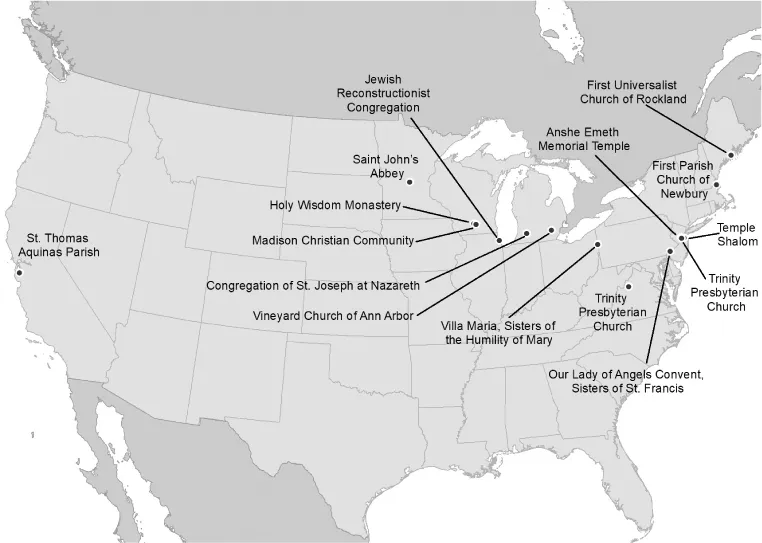
The sustainability initiatives examined in this project were undertaken by faith communities from across the United States. Most of the communities are in the upper Midwest/Great Lakes and northeast regions, with the exception of two congregations, one in California and another in Virginia (see Map 1.1). Study of these faith communities provided valuable opportunities to examine factors that contribute to the development of consequential and durable faith-based sustainability initiatives. As noted in the previous chapter, these case-study sites were selected because the communities have implemented initiatives that include multiple activities and they have maintained these efforts for at least four years. In addition, site selection attempted to ensure inclusion of cases representing the various types of sustainability activities that are being undertaken by faith communities in the United States. During preliminary research for this project, an examination of the range of faith-based environmental actions in the United States revealed three categories of activity. First, and most prevalent, faith communities engage in conservation practices in which they make changes to behavior and infrastructure in order to prevent pollution and conserve resources such as energy, water, and forests. Second, faith communities develop sustainable land stewardship, or resource management, systems for their lands in order to protect and restore ecosystems such as prairies, forests, and wetlands. Third, community members engage in advocacy efforts to influence local, regional, or national policies related to environmental sustainability. The three categories are not mutually exclusive, and a community’s focus may shift from one emphasis to another over time.
MAP 1 Map of Case-Study Sites
The fifteen case-study sites selected for inclusion in this research include communities that provide examples of all three types of activities. Conservation practices take center stage in the sustainability initiatives of ten urban/suburban non-monastic faith communities. Land stewardship practices are prominent in the sustainability initiatives of five monastic faith communities that have extensive land holdings. These monastic communities are religious organizations in which men (brothers) or women (sisters) have chosen to make religion the full-time focus of their lives. Four of the five communities were established in the nineteenth century and previously practiced subsistence agriculture on their lands. Advocacy efforts appear in both non-monastic and monastic faith communities but are not ubiquitous in either group.
The fifteen communities share several general characteristics: all have memberships that are predominantly white and middle-class, and all are well-established organizations, ranging in age from 39 to more than 150 years. The prevalence of white, middle-class members reflects biases in the case selection processes. Potential sites were located through use of databases created by the National Council of Churches Eco-justice Ministry, the National Religious Partnership for the Environment, Yale’s Forum on Religion and Ecology, and GreenFaith. Middle-class congregations dominate the Stewardship Stories in these databases. The selection criteria of “multiple activities sustained over at least four years” may also have privileged higher-income communities over lower-income and people-of-color faith communities that engage in environmental efforts focused on a single activity or of shorter duration. Social engagement is also a shared characteristic. With the exception of one evangelical church, these communities belong to mainline Protestant, Unitarian Universalist, Jewish, and Catholic denominations that have been historically associated with social justice work in American society. Denomination was not a consideration in case selection since the research sites were chosen for the quality of their environmental activities, however, the cross-case analysis does examine denomination as a variable affecting factors that enabled the faith communities to develop their sustainability initiatives. The communities varied in size, from 40 individual members to 1,800 families, and in physical context, from an urban congregation with a building, parking lot, and no green space to a rural abbey with 2,800 acres of forest and its own zip code.
The descriptions of the fifteen cases in this chapter are divided into three clusters. Because the five monastic faith communities differ from the non-monastic cases in their emphasis on land stewardship as well as organizational structure and size of infrastructure and land holdings, it made sense to analyze patterns in the genesis and evolution of their initiatives separately from those of the non-monastic faith communities. The ten non-monastic faith communities are subdivided into two groups: a cluster of six cases in which the sustainability initiatives evolved gradually in response to ideas and programmatic structures that developed organically from within the faith communities, and a separate cluster of four cases that enrolled in green certification programs managed by external organizations that provide applicants with a standardized framework for incorporating earth care into a religious organization. Because the certification programs affected the scope and structure of the faith communities’ sustainability initiatives, it was useful to describe the emergence and development of these four initiatives separately in order to discern patterns among the green-certified initiatives and to compare and contrast them with the cases that developed their structures organically. Table 1 provides a list of faith community names, location, size, and most prominent activities.
TABLE 1 OVERVIEW OF THE FIFTEEN CASES
| CASE TYPE | FAITH COMMUNITY | LOCATION | DENOMINATION | TYPES OF ACTIVITIES |
Organic
structure | 1. Trinity Presbyterian Church | Harrisonburg VA | Presbyterian Church (USA) | Environmental advocacy, conservation practices |
Organic
structure | 2. Madison Christian community | Madison WI | Evangelical Lutheran Church in America and United Church of Christ (ecumenical) | Conservation practices, solar panels, community gardens, prairie restoration |
Organic
structure | 3. Jewish Reconstructionist Congregation | Evanston IL | Reconstructionist Jewish | Conservation practices, green building |
Organic
structure | 4. First Parish Church of Newbury | Newbury MA | United Church of Christ | Community gardens, nature-themed preschool |
Organic
structure | 5. Vineyard Church of
Ann Arbor | Ann Arbor MI | Evangelical | Conservation practices, community garden |
Organic
structure | 6. St. Thomas Aquinas Parish | Palo Alto CA | Catholic | Conservation practices, advocacy |
Green
certified | 7. First Universalist Church of Rockland | Rockland ME | Unitarian Universalist | Conservation practices, CSA, Community Supported Fishery |
Green
certified | 8. Trinity
Presbyterian Church | East Brunswick NJ | Presbyterian Church (USA) | Conservation practices, community garden |
Green
certified | 9. Anshe Emeth Memorial Temple | New Brunswick NJ | Reform Jewish | Conservation practices, environmental advocacy |
Green
certified | 10. Temple Shalom | Aberdeen NJ | Reform Jewish | Conservation practices, solar, community garden |
| Monastic | 11. Congregation of St. Joseph at Nazareth | Kalamazoo MI | Catholic Women | Conservation practices, land restoration |
| Monastic | 12. Saint John’s Abbey
Saint John’s University | Collegeville MN | Catholic Benedictine Men | Conservation practices, sustainable forestry, solar panels |
| Monastic | 13. Villa Maria, Sisters of the Humility of Mary | Villa Maria PA | Catholic Women | Conservation practices, sustainable forestry, organic gardening, CSA |
| Monastic | 14. Holy Wisdom Monastery,
Benedictine Women | Madison WI | Ecumenical Benedictine Women | Conservation practices, prairie restoration, green building |
| Monastic | 15. Our Lady of Angels, Sisters of St. Francis of Philadelphia | Aston PA | Catholic Franciscan Women | Conservation practices, CSA, environmental justice advocacy |
The brief case summaries presented in this chapter introduce the faith communities and their sustainability initiatives, with special attention to notable features of each case. The summaries describe the events that triggered the initiatives and provide an overview of each case’s development, including factors such as key individuals and activities that were particularly significant for the initiatives. By comparing these case summaries, it is possible to identify themes that are shared across the cases and to discern distinctive features of initiatives that only become evident when they are juxtaposed with other cases. Identification of common themes and notable variations elucidates topics that require deeper exploration and will be taken up in greater detail in the subsequent sections of the book.
CASE CLUSTER I: FAITH COMMUNITIES WITH ORGANIC INITIATIVES
The first six case studies describe sustainability initiatives that emerged and developed organically within their faith communities. These initiatives were inspired by a variety of triggering events. The case with the longest-running initiative began slowly when a few church members with environmental interests formed a group for shared study and worship. After several years, threats to their local environment inspired them to increased levels of action, and they developed a sustainability initiative with diverse activities focused on advocacy and conservation practices. For the other five faith communities, sustainability initiatives emerged in response to more clearly defined triggering events. In two cases, the faith communities were at crossroads in which members had to make decisions about the future of their religious organizations, and sustainability was adopted as a community focus during the decision process. For two other communities, the triggering events came from the pastors, who presented ideas for environmental stewardship to their congregations. In the final case, the triggering event came from an external source, when the regional denominational organization instituted a new program to encourage sustainability efforts among member congregations.
1Trinity Presbyterian Church (TPC*), Harrisonburg, Virginia Membership: 165
In 1996, lay members of Trinity Presbyterian Church formed a Restoring Creation House Church, which was later renamed the Earth Care House Church. House churches are small groups through which members engage in ministry work as a way to express the church’s mission of “striving to be the church in the world through servant ministries.” Any member of the congregation may propose formation of a house church to address a perceived need such as food security or poverty alleviation. If other members share interest in the topic, the group creates a formal covenant describing the mission of the house church and the activities through which the group will fulfill its mission. The Earth Care House Church mission is “to promote Church and community awareness and involvement in restoring creation.” It fulfills this mission through group study of theology and environmental texts, leading the Earth Day Sunday service, and organizing outdoor activities for youth.
Along with these study and worship activities, the Earth Care House Church promotes involvement in restoring creation through community outreach and practical actions, areas of activity that have evolved over time. In the beginning, the group studied how theology connected with earth care and did outreach by sharing information on environmental issues with the congregation. After a few years, however, the group began to feel the need for increased action, especially since many of the house church participants were longtime environmentalists who were well informed about issues of pollution, biodiversity loss, and climate change.
Faith soon motivated the Earth Care House Church members to a new level of environmental action when they found that a beloved local natural area was being damaged by pollution. As outdoor enthusiasts, the house church participants often visited Shenandoah National Park. In 2001 they became aware the park suffered from air quality problems, especially acid rain. The issue could not be solved locally since the pollution came from coal-burning power plants in West Virginia; only federal legislation could regulate interstate pollution. According to Lynn Cameron, a founding member of the group, the scope of the problem intimidated them because “what could a little house church do about such a big issue?” However, their pastor, Reverend Ann Held, suggested that the Earth Care House Church might be able to gain support for addressing the issue of coal pollution if they presented a resolution to the annual General Assembly meeting of the Presbyterian Church (USA) denomination. Telling each other that “God does not call us to do little things,” the members of the house church decided they had to try to protect their beloved park. They worked with the Southern Environmental Law Center to craft a resolution that called for the Presbyterian Church (USA) to educate Presbyterians about the environmental and health consequences of coal-fired power plants. It also asked all Presbyterians to exercise stewardship of the earth by urging government officials to support policies and legislation that would enforce existing clean air laws, enact new laws for power plants to reduce pollution, and end “grandfather” loopholes that exempt older coal-fired plants from current regulations. Furthermore, the resolution directed that the new policy should be communicated to power companies and that these concerns about air quality should be incorporated into the advocacy work of the Washington Office and Environmental Justice Office of the Presbyterian Church (USA). The resolution was unanimously approved by the 214th General Assembly in 2002.
Buoyed by their success, which Cameron said left them feeling that “there was no stopping us now,” members of the Earth Care House Church continued to do advocacy work while also expanding their range of activities by undertaking resource conservation projects at the church. Cameron notes that environmental work often starts with being against something, but, she says, “Eventually, you have to ask, ‘What are you for?’ ” Study of eco-theological reports published by the Presbyterian Church (USA) such as Restoring Creation for Ecology...