![]()
The Letters
The following brief note was Fred’s first communication with his family. He had been away from home just a few hours when he hurriedly scribbled a couple of lines on a postcard. The postmark shows that it was mailed from Sterlington, New York, on February 28, 1918. When the train taking him from Olean stopped briefly at the station there, he must have run out to deposit the card in a mailbox.
Still on are way to Camp it is now 12:30 and we are still 45 min away feeling like a king dont worry.
My regards to all
Fred
♦ ♦ ♦
Fred’s destination was Camp Upton, located in Yaphank, about 60 miles east of New York City on Long Island. Upton was one of several dozen new training camps that were hastily built in the months after the United States entered the war. The U.S. Army would expand to nearly twenty times its pre-war size by the end of 1918. The site of Camp Upton had been a dense, muddy forest in the summer of 1917. Thousands of civilian and army workmen had transformed it into a huge training facility by the time Fred arrived there. The camp could hold more than 40,000 soldiers at a time. During Fred’s weeks there, most of the soldiers belonged to the 77th Division, which included the regiment to which Fred was assigned. The camp was so large that many new recruits got lost while trying to find their way around.
The most famous soldier in the camp was Irving Berlin, who had already become a wealthy legend for his ragtime songs and Broadway shows. The 29-year-old Berlin had been drafted in 1917. The army did not want him to fight, but rather to compose patriotic songs. While at Upton in 1918, Berlin wrote a popular musical revue entitled “Yip Yip Yaphank.” The revue’s most popular song was “Oh! How I Hate to Get Up in the Morning.” One of its stanzas goes as follows:
Someday I’m going to murder the bugler,
Someday they’re going to find him dead;
I’ll amputate his reveille
And step upon it heavily,
And spend the rest of my life in bed.
Fred obviously realized that Berlin was joking. As will be seen further below, he chose to become a bugler.
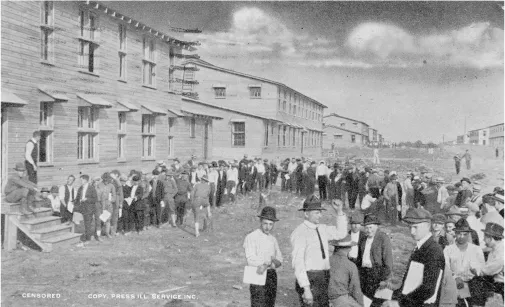
FIGURE 1. New recruits being mustered at Camp Upton (Author’s Collection).
♦ ♦ ♦
Camp Upton
2-28-1918 9:00 pm
Dearest Mother, sister and brother,
I haven’t much time to write a very long letter at this time as it is bed time. We did not arrive into Camp Upton until pretty near 6:00 pm, then we had to stand around until they could find accomadations for us. We then proceeded to the Mess hall, and our feed tasted pretty good to us because we were all tired out and hungry, the only thing that they served us on the train was three sandwiches a couple of fried eggs and a cup of coffee. For supper we had Boiled beef, mashed potatoes, gravey and canned corn, cocoa, lard bread, the only thing seemed very funny for me was the fact that there was’nt any butter on the table.
After supper our company went out to the toilet and washed up. (We ate supper without even cleaning up)
The next thing in order, said company, had to report to the commanding officer and answer to roll call, also to get an identification card, as we are liable to get lost in the camp. Mother you dont and can’t even realize how large this camp is, some of the fellows said it was about 15 miles square. —March 1, We had to get up at 5:45 am this morning, something new for me eh what? After breakfast, which consisted of Oat meal, hass [hash?], bread and coffee we had to go out on the parade grounds and drill for about one hr. After that we marched to the Medical Examiners, and got examined, vaccinated, and got a shot in the arm
They sent us back to barracks to rest, so I [am] finishing letter I started last night, so I am patiantly waiting for dinner. They said we would get our uniforms today so I’ll probably will be sending my clothes, and a little bit more of that super baggage I took along.
All the boy’s, including myself, are well and contented with this life, as far as it has gone. There were 574 men on the train that brought us from Olean, Ger, but it was tiresome trip, beleive me.
Now mother and sister I want to pour forth a little praise for you, on my leaving home, you done yourself a big credit. Now I dont want you to worry about me at all, because as soon as I get a furlough I will come home.
Mother there is some things that I want, and that is a few one cent stamps and one good pencil. Harry told me that you didn’t need another stamp on those post cards, but I found out and they said I did. The Engineer corp down here is going over [to France] next week, so I wont try to get in that until they form a new division. Now dont worry and fret about me because I am in a good company, and will take good care of myself. The watch Harry gave I can’t regulate at all, I will try again to day and if she is not alright will send it back.
Give all the neighbours my best and tell them I will write later.
With love to all,
Fred.
My temporary address is
Casual Barracks*
Btry F 304th F.A.
Camp Upton
P.S. Am sending a few views of Camp Upton. Tell me if you have heard from Aunt Frieda.
♦ ♦ ♦
Fred’s brother Harry, born in 1898, was exempted from the draft for two reasons: he was under the age of 21, and after Fred departed he was the sole breadwinner supporting the family. By the time of this letter, Harry had taken a job with Fred’s former employer, the Pennsylvania Railroad.
♦ ♦ ♦
3-2-18
Dear Brother,
This certainly has been one busy day for yours truly up at Revellee, which is at 5:45 breakfast at 7:00 drill from 8:00 until 11:30 dinner drill at 1:00 until 5:00pm then supper, the rest of the time I will spend in writing. God, is awful to have so many friends. Well Harry I suppose this card will bore the life out of you but I have got to fill it up. Harry this is a pretty good life for a young boy like myself.
Will write a letter later, so don’t fret.
♦ ♦ ♦
Below Fred reports that he chose Field Artillery as his branch of service, because, he says, it is easiest. That was only partly true. The doughboys in the infantry suffered the highest mortality rates, but all the men risked death or injury. During active fighting, those in the field artillery generally were situated a few thousand yards behind the infantry regiments. The job of the artillery was to bombard the enemy with hours of shelling prior to an infantry attack. Once the infantry began to move, the artillery kept up its firing on the enemy. But just as American artillery could hurl shells well into enemy lines, so too enemy artillery could fire shells or gas canisters at American artillery emplacements. Here and in later letters Fred does his best to conceal from his family the real dangers that he faced.
Of the four million draftees and volunteers in the Army by the end of 1918, two million served in France in the American Expeditionary Force (AEF). The war ended before the other two million could be processed and shipped across the ocean. Fred and the great majority of the soldiers at Camp Upton during his time there were part of the 77th Division. This division was one of the first army divisions composed primarily of draftees. The 77th consisted of approximately 30,000 troops—the number varied, as many officers and men were constantly being transferred in or out. Most of the men in this division came from the greater New York City area, and thus the 77th came to be called variously “New York’s Own” as well as the “Statue of Liberty Division,” the “Metropolitan Division,” and the “Empire State Division.” Thousands of the 77th’s new recruits were immigrants who spoke no English. Thus, in addition to learning how to be soldiers, they had to learn the language. Fred belonged to contingents arriving from Olean, Buffalo, and other cities in western New York. By the spring of 1918, the 77th also included a smattering of recruits from the Midwest. A Major General commanded the division. The 77th was divided into three brigades—two of infantry and one of field artillery. The field artillery brigade contained three artillery regiments plus three machine gun battalions, an engineer regiment, a field signal battalion, and several other units. The regiment to which Fred was assigned was the 304th Field Artillery, which was commanded by a Colonel or Lieutenant Colonel. The 304th was divided into two battalions, each under a Major. The second battalion consisted of Batteries D, E, and F. The last one would be Fred’s “home” for the duration of the war. Battery F had about 200 men in it at any given time. It was usually led by a Captain and two Lieutenants. Howard’s regimental history lists twelve other Olean men, most of them Fred’s friends, in this same battery.
Fred’s conviction that he was fighting for an honorable cause can be seen throughout his letters. In this he reflected the sentiments of the great majority of Americans. Already by 1915 sentiment across the country had slowly been turning in favor of Britain and its allies. While not being jingoistic, the Olean newspapers from 1917 to 1919 wholeheartedly supported the cause and reported on all the Olean men who went “over there.” Repeatedly, the people from Fred’s hometown oversubscribed the liberty bond drives that were held periodically to provide the government with funds for the military. Olean’s mayor, Foster Studholme, declared that all able-bodied men must “Either work, fight, or go to jail.… There is work enough for all and to go around.… I have instructed the local police to pick up able-bodied idlers and make them give an account of themselves.… Olean does not care to harbor a gang of loafers.… We’ll give them work if they want work. They can get into the army, if they want to fight. They can go to jail, if they won’t do either.”
♦ ♦ ♦
Camp Upton 12:15pm
Sat. March 2, 1918
Dearest Mother and sister,
It is one beautiful day, I don’t think I will have to drill this afternoon so I’ll probably take a walk up the avenue and go sight seeing.
Well we were sworn into the U.S. service last night and are now considered soldiers although we haven’t our uniforms yet, but they think we will get them this afternoon.
Mother I saw one of the most marvelous sights yesterday I ever beheld, it was a review of all the soldiers in Camp Upton, on parade. There were quiet a few notable men here reviewing them, namely Gov. [Charles]...