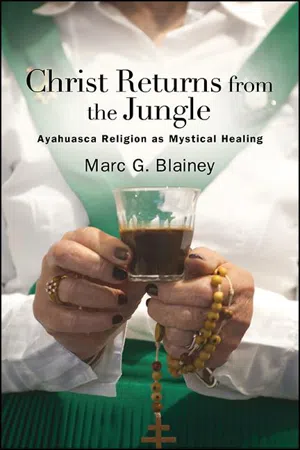
![]()
PART I
FRAMING AND TACKLING THE QUESTION
WHY SANTO DAIME IN EUROPE?
![]()
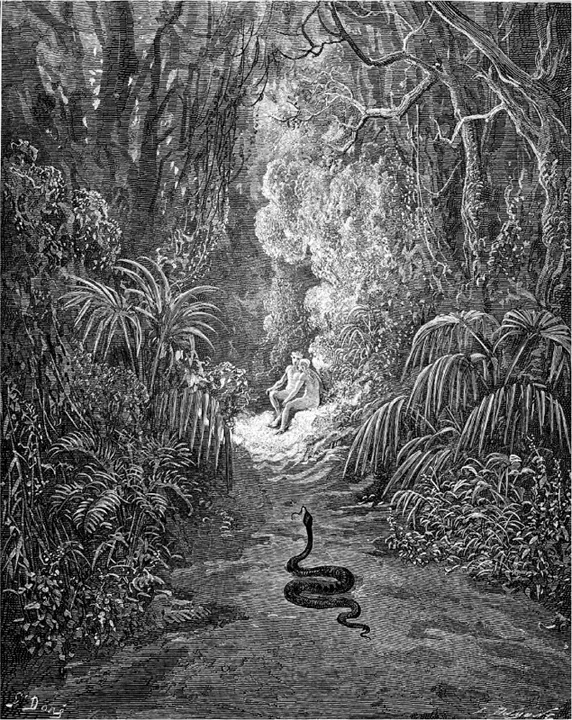
Figure 1.1. The First Approach of the Serpent, engraving by Gustave Doré (1866), published with permission from the Bibliothèque nationale de France (BnF).
The believer possesses the ever-sure antidote to despair: possibility; since for God everything is possible at every moment. This is the health of faith which resolves contradictions. The contradiction here is that in human terms the undoing [i.e., mortality] is certain and that still there is possibility. Health is in general to be able to resolve contradictions.
—Søren Kierkegaard, The Sickness unto Death
| Encontrei uma chave | I found a key |
| Para ser feliz | To be happy |
| É fazer | It’s to do |
| O que Jesus me diz | What Jesus says to me |
| … | |
| Se errar Deus perdoa | If one makes mistakes God forgives |
| E eu peço perdão | And I ask for forgiveness |
| Limpai a minha mente | Cleanse my mind |
| E o meu coração | And my heart |
—from Santo Daime hymn #8, “Eu Encontrei uma Chave” (I Found a Key), in Flores de São João (Flowers of St. John), by Cristina Tati
1
Introduction
On Mother’s Day 2005, I found myself hurtling down an Amsterdam highway in a compact car driven by a petite Dutch grandmother. In her mid-sixties at the time, Jacoba1 is a veteran member of Santo Daime, a new religion from Brazil organized around the psychoactive beverage ayahuasca. Through prior email contacts I had made with a local congregation, Jacoba was appointed as chaperone for my first trabalho (“work” in Portuguese), the apt identification of Santo Daime ceremonies as performative and introspective labor. As I was then just a backpacker curious about why ayahuasca had found its way to Europe,2 Jacoba kindly shepherded me to and from the rural outskirts of the Netherlands’ capital city. Upon entering a little rented chapel where the ritual was held, she introduced me to her fellow daimistas, a term encompassing both uninitiated parishioners and full-fledged Santo Daime members (fardados /fardadas), those dressed in white, green, and blue fardas (“uniforms”).
Noticing that I was confused by the whirlwind of activities and conversations going on inside the church, my fardada chaperone guided me to the registration table where I paid 30€ and signed my name in the official participants’ log. She then handed me a small hymnbook before turning me over to the elderly fardado in charge of assigning individuals to their “place” on the “men’s side” of the salão (“hall”). Although I have since acquired a deeper appreciation of Santo Daime works in Europe, a spiritual behavior that is the main subject of this book, my memories of this introductory ayahuasca ritual are mostly a blur due to an utter lack of bearings in 2005. After swigging my first glass of the ayahuasca, which fardados lovingly dub “Daime,” I spent the next six hours trying but mostly failing to sing along with a seemingly endless string of repetitive hymns. To the accompaniment of guitars, flute, and a bongo drum, I clumsily attempted to dance back and forth in the manner of the daimistas, a task that became trickier the more the effects of the Daime kicked in. At phases where the music paused in between hymns, the sudden silence was accompanied by an uneasy sensation of being trapped in an intergalactic dream sequence resembling the final scenes3 of Stanley Kubrick’s (1968) film 2001: A Space Odyssey. Whenever the music proceeded, I felt lucky not to be joining the ranks of fellow participants making loud retching noises as they vomited into plastic buckets at the back of the room. Amid all this, the foremost recollection of my first Daime work is that every time I closed my eyes, the ambient sounds of vocalized hymns produced in my mind’s eye a vivid image of semi-naked tribal celebrations in Africa or South America—akin to National Geographic documentaries I watched as a child—but when I opened my eyes I was shocked to remember that these chants were being emitted by Europeans dressed in pristine formalwear. This was no ordinary church service!
Flash forward to a sunny afternoon in the summer of 2010. I had arrived back in Amsterdam and now sat across from Jacoba on the flower-covered balcony of her apartment. While my maiden Daime voyage had been a sightseer’s whim five years earlier, her facilitation of that enigmatic experience inspired me to return to gather ethnographic data about Santo Daime groups in Europe. Now, as I record an interview with Jacoba, she speaks in accented but fluent English about what her life was like before she began attending Santo Daime works twelve years ago. She tells me that she had a distressing childhood, beginning with her birth in The Hague in 1941. She states that because her family was then taking shelter during World War II and there were “bombs falling around us … [we] had to go [into] hiding in the factory of my grandfather in Leiden.” She then tells me that she was physically and psychologically abused by family members and teachers while she was a youth, attributing the pain inflicted on her to the projection of collective wounds suffered by Europeans at that time: “In Holland we are still in shock from the war; it’s really very bad what people can do to each other.” Claiming that these ordeals weighed heavily on her well into adulthood, Jacoba now radiates a sense of steely calm through her blue-grey eyes as she touts the psychotherapeutic effects of Santo Daime. She characterizes the ayahuasca “sacrament” as a spiritual being. She earnestly believes that the brew gives access to a divine interlocutor that can steer people who drink it to become better versions of themselves by helping them resolve internalized stings of past trauma: “I say all the time, the Daime (the spirit in the bottle [of ayahuasca]), that’s my best friend: it cares about me, it corrects me, it makes me realize how I relate to other people (because I’m not always so nice to other people) … and I think that’s the same person as God. … God has many faces.”
Needless to say, fardados’ view of the Daime beverage as containing a direct link to God is very different from the generally negative attitude about “hallucinogenic drugs” in Europe. For instance, Jacoba has two daughters, one of whom has two daughters of her own. She now has a close relationship with her granddaughters, but it took some time for their mother to let them visit with their grandmother again after she found out that Jacoba was involved with Santo Daime. Jacoba says she is hurt that some members of her family are staunchly opposed to ayahuasca. She tries to patiently accept that the stigmatized status of her religious orientation has caused such rifts in her family, but she confesses that “it is difficult!”
Whereas social bigotries can perpetuate laws that exacerbate the very problems they are designed to resolve, ethnography informs more effective public health and crime policies by shining a light on unseen realities lived by marginalized groups (Fleisher 1995, 5/243–47).4 Based on stories of youths experiencing “bad trips” a half-century ago during the “psychedelic sixties,” in Western societies so-called hallucinogens are assumed to be inherently dangerous. Popular fears about the hippie counterculture’s promotion of psychedelics provoked a worldwide criminalization of this class of chemicals, enacted by the United Nations’ Convention on Psychotropic Substances in 1971 (Beyerstein and Kalchik 2003; Spillane and McAllister 2003). Since then, 184 member states have signed this UN treaty, which obliges each signatory to also legislate their own national sanctions.5 Globally, the International Narcotics Control Board (INCB) now adjudicates international prohibitions of these psychoactive materials (see Tupper and Labate 2012). Because DMT, the mind-altering molecule found in ayahuasca, is also officially classified as a banned “hallucinogen,” Santo Daime rituals remain a punishable offense in most countries6 (Horák, Novák, and Vozáryová 2016). Consequently, in many liberalist nations where the freedom of religion is enshrined, those whose religious convictions revolve around ayahuasca now risk incarceration. Even while ayahuasca’s constituents are condemned in most places, Santo Daime has managed to earn full legitimacy in Brazil, as well as in small sections of Europe7 (Netherlands, Spain), the United States (Oregon), and most recently in Canada.8 In these exceptional localities, courts of law upheld fardados’ right to practice their religion as superseding statutes that outlaw ayahuasca. On the other hand, the United Kingdom, Ireland, France, Portugal, and Germany have opposed this religious use of ayahuasca, arresting and in some cases imprisoning fardados for importation and distribution of an illicit substance (Dawson 2013, 31–35; Labate and Feeney 2012; see also Silva Sá 2010). By contrast, fardados flatly reject the terms hallucinogen—which implies that the substance engenders delusions—and psychedelic—reminiscent of hedonistic use during the 1960s. Instead, they prefer the terms sacred plant and entheogen. Meaning “to generate god/s within” in Greek, entheogen denotes “vision-producing” substances employed “in shamanic or religious rites” (Ruck et al. 1979, 146). This vocabulary of entheogens as revealing an inner divinity is crucial for apprehending fardados’ nonconformist approach to life. Now, years later, sifting through the transcriptions of interviews I recorded with fardados across Europe, I find that the essence of these testimonies is neatly summarized in the words of Jacoba.
I had asked Jacoba why she chooses to participate in these Christianized ayahuasca works, a question I put to every fardado I met during more that a year of fieldwork in Europe. Jacoba paused, and thought for a moment before saying, “Of course, we come to the Daime because of our despair.” When I invited her to elaborate on what she means when she pinpoints “despair” as a motivation for attending Daime works, she resumed:
It’s despair … the feeling of estrangement … from others … and isolation … there is no unity at all. …
Everybody is always looking for the answer of why we are here. What is this all about? You know, at my age sometimes I’m bored; is this all there is?9 I’ve seen everything of theatre, of art; it’s all repeating itself. And then I found something so new … it is so intriguing, so fascinating, so fitting and logical. I thought it was a fantasy, but as a child I was connected with spirits. … So there was already a clairvoyance in me before I went to school, and then I was abused [at] school, very repressed … and all these layers you have to [take] them off, one by one, and that [took me] at least ten years [of Daime] works. …
In a [Daime] work, in the beginning I got a lot of corrections. It’s called “peia” [in Portuguese]; it’s actually an “obstacle” you have to overcome … it’s very good lessons … it’s like suffering, but it’s also good for you to be humbled. …
What the Daime gives me is that I observe myself observing, and that means I can change. … You observe the observer observing, and that’s why you can change yourself with the click of your fingers, because you see directly the implementation you have on others, but also on yourself, and you see the whole picture, like [from] a helicopter. … After Daime works it stays in you all the time, that’s really the big progress you see [over] the years.
Peia is a complex concept. When taken in Jacoba’s sense of “obstacle,” peia is like the Daime form of karma. As will become more apparent in the ensuing chapters, daimistas view their ayahuasca ceremonies as a microcosm of life itself. They presume that whatever negative thoughts or actions a person puts out into the world will eventually come back as a corrective reaction from the universe (Schmidt 2007, 167). As a word for what outsiders might conceive to be a “bad trip” during Daime rituals, peia is seen by worshippers of ayahuasca religions “as a sign that something inside the person must be out of tune with the cosmic order,” which is often “manifested as a physical symptom; thus, the act of vomiting is seen as an expulsion of pernicious matter, as an act of purification” (Henman 2009[1985]). Besides the physiological reaction of vomiting, peia can also convey the connotation of “aggression (as in ‘beating up’),” which accounts for devotees viewing difficult or horrifying ayahuasca experiences as a psychophysical “cleansing” (Soibelman 1995, 104). In a theological treatise that summarizes some of the basic tenets of Daime belief and practice, a widely respected daimista elder gives this gloss for peia (Polari de Alverga 1998, 212):
Peia—A purgative and mimetic process that sometimes occurs with the use of the sacramental Daime beverage. This is considered a cleaning of the physical level and a necessary discipline to unlock resistance and crystallization in the interior level.10
This seemingly upside-down interpretation of severe and harrowing episodes as therapeutic provides a convenient starting point for framing fardado perspectives on ayahuasca rituals. As such, the ways that daimistas describe the suffering in Daime works and in everyday life as ultimately restorative “processes” are mirrored by the psychiatric concept of “creative illness.” According to Henri Ellenberger (1968, 443), to value the “good usage of illnesses” can appear like a “moral masochism” from the standpoint of physicalist biomedicine: “With the advent of Positivism, the hedonistic utilitarian notion came to prevail that [mental] illness is simply and exclusively a disorder of psychological origin, to be cured or to be prevented by scientific methods.” But what might ordinarily be taken as a self-destructive drive to undergo torments that one should really try to avoid is the crux of disagreements between materialist approaches to psychotherapy and the initiatory trials of shamanic dismemberment or mystical death/rebirth experiences (Ellenberger 1968, 445–47). Such disparity means that strictly physicalist approaches to understanding Santo Daime cannot but misunderstand the perspectives of fardados. On the contrary, Jacoba’s perception of sicknesses temporarily imposed by ayahuasca as signifying a healing of despair calls to mind notions from existentialist psychology. As an ethnography that brings existentialism to bear in explaining daimistas’ entheogenic piety, the present study contributes to anthropological liaisons with philosophy and theology on the question of what it means to be human.
In advancing these new interdisciplinary ventures, the present text turns to various philosophers and theologians to draw instructive links between conventional Western thought and the unfamiliar social context of Santo Daime. To start, we turn to the nineteenth-century Danish philosopher/theologian Søren Kierkegaard, a founding father of existentialism who has long received scant attention from cultural anthropologists (the writings of Ernest Becker 1997[1973] are one major exception). Recently, Kierkegaard has been gaining notice in the now-blossoming subfields of existential anthropology, the anthropology of Christianity, and the anthropology of Santo Daime (Jespersen 2016; Lambek 2015; Rapport 2002; Tomlinson 2014; Willerslev and Suhr 2018). As displayed in interview narratives from European fardados, my informants are preoccupied with self-confrontation and faith as antidotes to existential anxiety and despair. Thus, I deploy perspectives from the existential anthropology of Christianity as an efficient framework for apprehending Santo Daime beliefs and practices.
Another key observation derived from ethnographic fieldwork and interviews is that European fardados disregard the dualist split between secular science and traditional religion as obsolete. For my informants, “belief” or “nonbelief” are beside the point of human flourishing. They say that they have jettisoned belief in favor of “experience” mainly because of the phenomena they must navigate within ayahuasca states of consciousness. They say Santo Daime provides them a dependable path for directly encountering a primordial source of healing and serenity that they could not find through the established secular and religious options in Europe. They value the otherworldly happenings of the Daime rituals as opportunities to effectively confront and resolve defects of their individual selves. But apart from the power of existential anthropology for elucidating alternative systems of thought, how does the ethnographer go about appreciating fardados’ quest for self-enhancement through Santo Daime? Using visual and gustatory metaphors, one of my Belgian informants communicated the ineffability of experiences brought on by the Daime sacrament:
I can’t tell with words … you can [only] have an experience to get close. … It’s like [trying] to describe colors to a blind person … you know or you don’t know. How do you explain the taste of chocolate to somebody who has never eaten chocolate?
Despite the dubious identity of his key informant Don Juan, Carlos Castaneda (2016[1968])11 was right that the most important anthropological insights about New World plant medicines can only be tapped by having expert informants guide us through the experience directly.
The dialectic compilation of both first- and secondhand data about what a specific cultural experience feels like comprises a method of inquiry known as ethnophenomenology (see chapter 2). Relationships between existential “analysis of what constitutes existence” and investigations into “the question of the meaning of Being” (ontology) are a cornerstone of phenomenology, an analytic technique defined by Martin Heidegger (1962[1927], 32–33, 58–63) as a “way of access to what is to be the theme of ontology.” Thus, the ethnophenomenologist elects to temporarily set asid...