![]()
REGION THREE
Central New York
Including parts of Chemung, Chenango, Cortland, Delaware,
Fulton, Herkimer, Madison, Montgomery, Oneida,
Onondaga, Otsego, and Schoharie Counties
![]()
28
Kirk Douglas Park
Amsterdam
Montgomery County
The ragman’s son.
Many famous people have come from this city located along the Mohawk River. Politicians, artists, writers, and athletes. But none has ever reached the level of fame and familiarity of one Issur Danielovich Demsky.
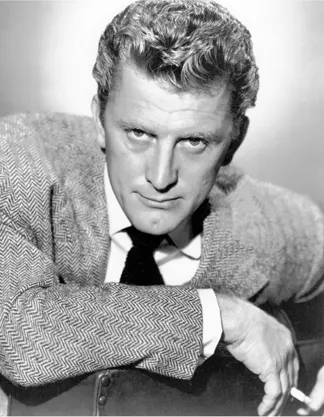
Kirk Douglas.
Douglas was born in 1916 on Eagle Street in this blue-collar city of eighteen thousand. His father was an Eastern European immigrant who couldn’t speak English and collected and sold rags to provide for his family. Issur chafed under the stifling conditions of his family’s poverty as a youth in Amsterdam, and using all of his inchoate acting wiles, he talked his way in to St. Lawrence University, about seventy-five miles north of his hometown.
He later enlisted in the Navy where he suffered an injury, and after his discharge went to New York City, where he began acting in radio and in workshops. Within a couple of years, an also young Lauren Bacall gave him a tip about a role in an upcoming film. Douglas made his film debut in The Strange Love of Martha Ivers in 1946, costarring with screen legend Barbara Stanwyck. He had just turned thirty years old.
Douglas soon became a Hollywood favorite and embarked on one of the most storied careers in Hollywood history.
He may have left Amsterdam, but Amsterdam never really left him. Totally.
“Old timers around here say that even well into his nineties if you listen closely to Kirk Douglas you can still hear that familiar Amsterdam twang,” Rob von Hasseln told me. He is the Amsterdam city historian.
“Kirk Douglas surely left our Mohawk Valley many decades ago, but no matter where he lived or how famous he got he always kept a little bit of his hometown with him. Not all of his memories were good ones, of course. He was dirt poor; his parents didn’t speak English. His father was a rag picker, and he was Jewish. But the actor still called longtime friends once in a while to ask how they were doing, to find out if they had seen his latest movie or to ask them a favor, like making a short trip to Schenectady to check on an ailing relative.”
The Great Depression years in Amsterdam oddly were good times for many of the young people. The mills were humming, churning out brooms, caskets, pearl buttons, metal springs, and of course carpets. Some of the largest carpet mills in the nation were located right here along the Chuctanunda Creek.
“Issur Demsky wanted out of Amsterdam. His best friend, Pete, decided that they were going to go to college at St. Lawrence University, north of us. Of course they had no money. So they hitchhiked to the college on the back of a manure wagon. When they arrived, the school admission officer was horrified at the sight (and smell) of the two young men, but they talked their way in. Again, the fact that he was just a ragman’s son was not a plus when it came time for him to enroll at St. Lawrence. Still, he was accepted and it was a turning point in his life. The two young adventurers would remain close friends for many years after that little trip on the back of the wagon.”
The actor would slip in and out of Amsterdam over the decades, always trying to visit without fanfare. In 1985, he came and visited with three of his sisters who lived here: Marianne, Ida, and Fritzi. He was known to contribute monetarily to local charities such as the area American Heart Fund.
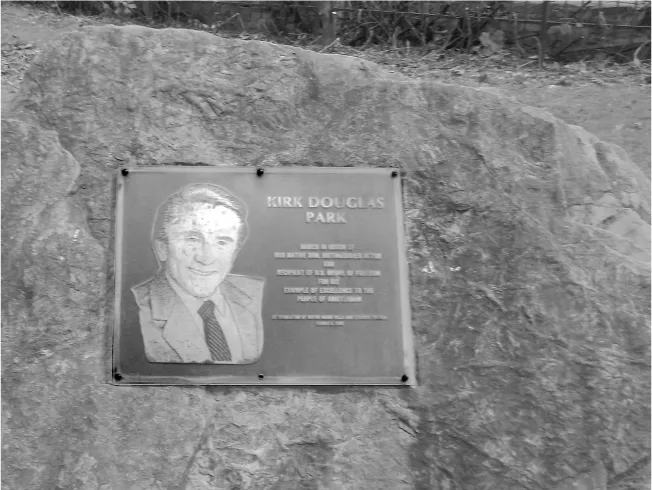
“Of course our city is proud to call Kirk Douglas a native son. We carved out a beautiful little park in our downtown area and dedicated it to him back in 1988. We held a Kirk Douglas Day. The streets were packed with excited onlookers as the actor and his wife rode in an open car waving to the crowd. His manure wagon–riding best friend, Pete, was sitting right next to him fifty years after their escapade to St. Lawrence University. At the park we dedicated a monument to the actor. A large boulder was placed prominently for all to see. On its face is a bronze plaque featuring the actor’s famously handsome chiseled features. The inscription reads: “Kirk Douglas Park. Named in Honor of Our Native Son, Distinguished Actor and Recipient of the U.S. Medal of Freedom for his Example to the People of Amsterdam.”
The park is situated along the banks of the roaring Chuctanunda Creek, Amsterdam’s most famous and important waterway.
“This creek and the falls near the park were vital to Amsterdam’s growth,” von Hasseln told me. “At one time there was no park and you could barely even see the creek. Giant mills stood shoulder to shoulder along either side, harnessing the rushing water to power their machines and giant knitting looms. It was the heartbeat of Amsterdam and a place of incredible activity. It is said that all you had to do was look at the color of the water to know what color fabric was being made at the mills that day. As the mills dumped their waste into the creek, the water would run red one day, green the next, then blue. Of course, that was a long time ago.”
The last of the giant mills stopped churning out carpets and other products in the 1960s. “The work left Amsterdam and went overseas. We really took a hit,” he said.
Amsterdam’s population was around thirty-thousand in 1950. Today it is about eighteen thousand.
So what is in store for Kirk Douglas’s old hometown?
“We like to look forward. I think in terms of a ‘Rule of 14.’ In 1714, if you predicted that in sixty years the pristine wilderness would be gone, with no Mohawk villages to be found, people would say you were crazy. In 1814, if you predicted that in sixty years the little village would grow so big you couldn’t even see the Chuctanunda anymore, people wouldn’t believe you. In 1914, if you said in sixty years that all the mills would be closed and gone and you could see the creek again, you would be laughed at. So now it is 2014. And we think Amsterdam’s future is bright. With the growth of Upstate’s high-tech triangle (Malta to Schenectady to Albany), we are perfectly positioned for a rebirth. People seeking high wages in those locales can live here, just a half hour away, and enjoy all the urban amenities while living in the center of the most beautiful area of Upstate. I like to say, ‘You don’t have to get out of our city to get into the country.’ We really are excited about our future.”
And what about Kirk Douglas’s memory in the future?
“As the old timers fade away, including many locals who actually knew him, we will continue to hold his memory dear. We have the park, and once in a while organizations have exhibits and displays of his career. The house he was born in is still over on Eagle Street (a private residence) and certainly his legend as a Hollywood superstar will never fade away. And if you really want to see a lasting memory of Kirk Douglas’s time here as a kid, you can go over to his old high school and see for yourself,” he told me.
What is there?
“If you go over to Wilbur Lynch Middle School [then his high school], inside you can see an old wooden beam with the name ‘Izzy Demsky’ scratched into it.”
Other Nearby Attractions or Sites
Amsterdam is a fascinating little city with several interesting stops for a weekend trip. The Walter Elwood Museum tells the story of the Mohawk Valley against the backdrop of a thousand unusual items from the collection of Mr. Elwood, one of the city’s great pack rats. Elwood, an esteemed educator in the city school district in around 1900, traipsed around the world trying to satiate his desire for gathering things. Victoriana, ethnographic treasures, art, oddities, nature rarities, photographs, military memorabilia, and rooms full of Mohawk Valley history all add up to make this a highly entertaining and enlightening destination.
Kirk Douglas posted some pretty remarkable figures over the century he graced us with his presence: a sixty-year career, more than ninety movies, three best actor nominations, one Academy Award for Lifetime Achievement, and a marriage of over sixty years to his wife, Anne.
Perhaps the most exciting news concerning Amsterdam’s future is the creation of the Mohawk Valley Gateway Overlook. This attractive park-like pedestrian bridge over the Mohawk River is bringing new tourists to this area (including waterway travelers). It connects the historic north and south sides of the city and affords a rare overhead vista of the old Erie Canal waterway. Governor Andrew Cuomo authorized construction of the sixteen-million-dollar “Park-over-the River” in 2014.
Essentials
What: Kirk Douglas Park
Where: Amsterdam, on Guy Park Avenue across the street from the back of the Amsterdam Public Safety Building; Montgomery County
Contact
Amsterdam history, tourism, and events: www.Amsterdamny.gov (city)
Walter Elwood Museum: www.walterelwoodmuseum.org (museum)
Kirk Douglas Foundation: www.douglasfoundation.org (Kirk Douglas Family Foundation)
![]()
29
The Shrine of the North American Martyrs
Auriesville
Montgomery County
The church of seventy-two doors.
In the 1600s, the Mohawk Nation built an outpost high on a bluff overlooking the Mohawk River in what is now Montgomery County. Between 1642 and 1646, three French Jesuit missionaries came to their village, named Ossernenon (now Auriesville). Within a short period, their missionary work turned deadly and all three were savagely killed by the Indians. Rene Goupil, Isaac Joques, and Jean LaLande were later canonized by the Roman Catholic Church. Goupil was the first canonized North American martyr.
The site of the ancient Mohawk village of Ossernenon is now known as the Shrine of the North American Martyrs. It is a unique place in Upstate New York and one of the most holy places for Catholics in North America. Tens of thousands of pilgrims visit here each year to honor and worship at this revered place where four saints actually walked. Blessed Kateri Tekakwitha, who was canonized and elevated to sainthood by Pope Benedict XVI in 2012, was born in Auriesville in 1657.
The shrine is spread over four hundred acres of Mohawk Valley splendor. Walking paths, secluded resting areas, dozens of religious statues, small chapels to pray in, and abundant landscaping all contribute to make this parklike place unlike any other Upstate religious site. At a precipice on the property you stand in the middle of Teresa’s Rosary. A vast “rosary” of large white stones is laid out over a field; some have called it the largest rosary in the United States. It symbolizes a small set of rosary beads made from tiny pebbles secretly used by a captured Huron maiden who was imprisoned here by the Mohawks (Teresa Chihwatenha). From this rosary, the view out and over the Mohawk Valley is one of the best in the state.
Reliquaries can be found throughout the grounds holding relics and artifacts from the original martyrs. There is also a beautiful replica of Michelangelo’s Pieta. A wooded glen, known as the Ravine, surrounds the stream where some of the martyrs were killed. It is one of the holiest places at Auriesville.
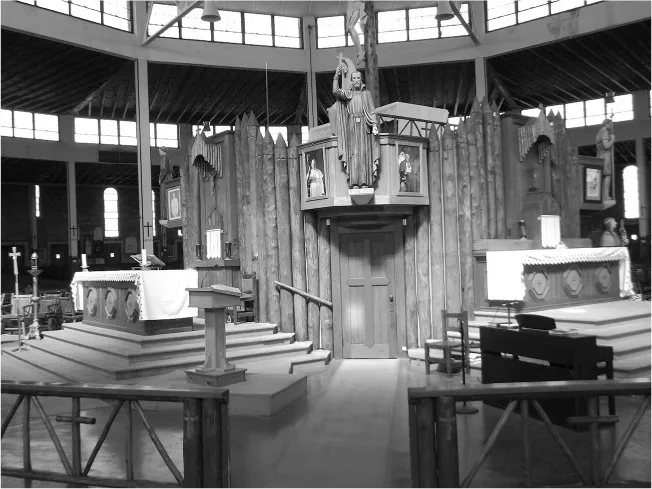
The magnificent centerpiece of this religious shrine is the Coliseum. Thousands have visited this enormous church for services over the decades (it was built in 1930, from donations from worshipers). I happened to visit Auriesville and the Coliseum...