- 256 pages
- English
- ePUB (mobile friendly)
- Available on iOS & Android
eBook - ePub
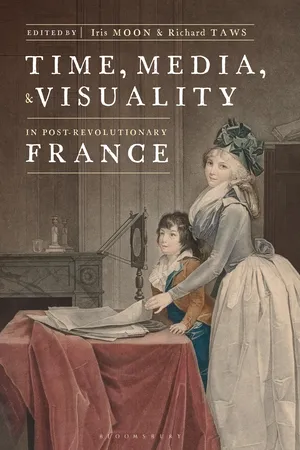
Time, Media, and Visuality in Post-Revolutionary France
About this book
The radical break with the past heralded by the French Revolution in 1789 has become one of the mythic narratives of our time. Yet in the drawn-out afterlife of the Revolution, and through subsequent periods of Empire, Restoration, and Republic, the question of what such a temporal transformation might involve found complex, often unresolved expression in visual and material culture.
This diverse collection of essays draws attention to the eclectic objects and forms of visuality that emerged in France from the beginning of the French Revolution through to the end of the July Monarchy in 1848. It offers a new account of the story of French art's modernity by exploring the work of genre painters and miniaturists, sign-painters and animal artists, landscapists, architects, and printmakers, as they worked out what it meant to be "post-revolutionary."
This diverse collection of essays draws attention to the eclectic objects and forms of visuality that emerged in France from the beginning of the French Revolution through to the end of the July Monarchy in 1848. It offers a new account of the story of French art's modernity by exploring the work of genre painters and miniaturists, sign-painters and animal artists, landscapists, architects, and printmakers, as they worked out what it meant to be "post-revolutionary."
Tools to learn more effectively

Saving Books

Keyword Search

Annotating Text

Listen to it instead
Information
1
Miniature Style, 1789–1815
Jann Matlock
In memory of Linda Nochlin
A young woman, barely out of her teens, has ventured, in the company of her servant, into the streets and up the stairs to the apartment of a young man (Plate 5). We can guess her purpose from the object she dandles over the back of a chair, caressing it with one hand—or perhaps she’s hiding it—as she pauses, seems to wait. From the anxious expression on her companion’s face, the visit appears surreptitious, possibly in contravention of family values. The love affair made material through this exchanged painted object will, we can already guess, end in tears, trauma, and humiliation for the young lady. Associated with the mode of sentimentality (la sensibilité), portrait miniatures belonged to a booming eighteenth-century business in personalized luxury commodities. By the time of the French Revolution, when Louis-Léopold Boilly painted this work, Le Cadeau délicat,1 small portraits had become standard tokens of exchange in relationships, licit and illicit, as is suggested by a number of contemporary representations, including miniatures themselves.2 And indeed, the girl in Boilly’s c. 1791 picture seems hopeful of a love sealed by her gift. Her project, as the sentimental exchange would require, is one of imagining sympathy. The man who receives the portrait is, ostensibly, to become an ideal spectator for the figure represented by the miniature. If the girl’s gamble is to pay off, what has been created as a kind of commodity will stop being fungible because the young man will desire to keep it close to him just as he keeps her, as it were, in his heart. In a perfect world, Boilly’s painting would represent the perfect functioning of the artwork. But this is not a perfect world.
Boilly’s genre paintings from the early 1790s will not surprise us in their representation of the failures of sympathy. Thematized portraits turn up in no fewer than six of the eleven Boilly works gifted and commissioned by Antoine Calvet de Lapalun between 1789 and 1792, evoking both the powers of portraiture and the fragility of the bonds it purports to forge.3 In Le Retour d’un infidèle aux pieds de sa maîtresse of 1790, a miniature portrait—presumably that of a rival—is tendered by a boyfriend supplicating the return of his beloved. In L’Amant jaloux, a portrait miniature is stomped upon by an aging pretender. Here, in the closely related Cadeau délicat, “fellow feeling” seems scarce: as the girl leans eagerly toward the young man, the giftee remains oblivious. The foreground is full of noise: a door swings open, skirts rustle, feet tap across wooden floorboards, the servant girl whispers warning. Has the young lady already called a name as she suspends her gift behind the chair? Despite all the racket, the gentleman continues to pore over a text, hand clasped to his forehead. Is he purposely ignoring her? Is he holding his head in his hands as he reads something she has written? Or does his concentration signal literary pretensions that leave him unmoved by love?
But for its title, Boilly’s composition might leave doubt as to who is in the little painted frame. The delicacy of the gift figured in that title evokes, on the one hand, the etymology of the word “miniature” (deriving, according to the Encyclopédie, from mignard or “délicat”).4 On the other hand, the title underlines the very trickiness of the situation: something delicate is easily damaged and thus requires special handling. The gift transmogrifies figuratively into the girl’s self, or becomes a proxy for her virtue. As a part for the whole, that bust of a girl disembodied in a tiny frame, the cadeau risks synecdochically dropping into the gaping hole of the man’s chapeau on the chair. The painting warns that the hat trick here may be far less magical than the hopes the girl has entrusted to her miniaturized double.
I begin with Boilly’s Cadeau délicat because it does such a fine job of staking out the workings—and risks—of painted miniatures, especially, as I show here, in the revolutionary decade. Such a gift requires reciprocity, interest, investment, a recognition not just of the value of the gift but of the meaning of the resemblance. One must recognize the person in the picture and value not just the image’s similitude to the original but also the person represented. And that value must be shared. Boilly’s painting sets up an inevitability that this token of affection will not result in shared feeling. In doing so, it evokes eventualities: the portrait might be returned, like the larger likeness in Boilly’s 1790 Les Malheurs de l’amour. The portrait might be destroyed (is one like it already burning in the fireplace in his 1791 Les Conseils maternels?). Or it could be simply cast aside: pawned for quick cash, lost at the bottom of a drawer, left behind in moving, discarded like last year’s gloves.5 Its owner’s frontal gaze will go on abrogating propriety, but its painted touch of gouache will dissolve in whatever storm the future brings; its fragile ivory base will dull the passage of light and muddy the complexion of the girl depicted there. One day, if neglect, harsh handling, inclement weather, and disinterest have not destroyed the brushstrokes or bled the colors through weeping glass, this portrait—or one like it—might turn up in a museum as an anonymous portrait of an anonymous woman (Figure 1.1).6
In this essay, I ask what happens when representations go awry. What happens to these works when there is no longer a singularity to celebrate or a unique human sentiment to signify? What happens when pictures like these go “missing”? What endures when there is no subject to distinguish? This research takes as its principal corpus unidentified portraits (some of them also by unknown artists) for the period 1789–1815 in the Musée du Louvre, drawing on shadow cases from the Musée Cognacq-Jay, the Tansey Miniatures Foundation, and the Metropolitan Museum of Art.7 Because of the preponderance of portraits of women—and even more so of unidentified women—in collections of French miniatures from this era, this essay concentrates on their representation. I ask what the popularity of miniature painting, reaching a pinnacle in France between Thermidor and the advent of the Napoleonic Empire (1794–1805), can tell us about the fantasmatics of this era, and especially about post-revolutionary attempts to imagine the feeling of others. What subjectivities might have been secured through the exchange and preservation of these tiny artworks? Even detached from their sitters and owners, what values do they still relay?

Figure 1.1 Anonymous, Jeune Fille brune en négligé, c. 1795, miniature on ivory, mounted on the cover of a round box, 6 × 6 cm (Musée du Louvre, Paris. Photo: © Musée du Louvre, Dist. RMN-Grand Palais /Martine Beck-Coppola).
Small Fashions
The market for miniatures exploded in the French revolutionary period through three cumulative shifts. First, new conditions for exhibiting art made way for mutations in the prestige and commercial viability of full-scale as well as miniature portraiture. The suppression of the French Academy—along with the opening of the Salon well beyond elected academicians—meant that artists whose participation had been limited by gender, training, or age could for the first time show their work in the Louvre.8 Genres that had previously been given little institutional support now commanded space. Particularly boosted, Régis Michel has shown, were portraiture and genre painting, respectively quadrupling and doubling in number in the Salons between 1789 and 1791.9 By the time of the Directory Salons, miniatures—and especially miniature portraits—had similarly catapulted into a new visibility. Miniatures popped up everywhere, rising from 6 percent of the number of portraits exhibited in 1787 to 19 percent in 1798 and 25 percent in 1801.10 The sheer numbers, notes Amy Freund, “creat[ed] the impression that public space was being taken over by tiny portraits.”11 Some critics railed about the confusion that portraits created between commerce and art,...
Table of contents
- Cover
- Half-Title Page
- Title Page
- Contents
- List of Illustrations
- List of Contributors
- Acknowledgments
- Introduction Iris Moon and Richard Taws
- 1 Miniature Style, 1789–1815 Jann Matlock
- 2 Rupture, Interrupted: Rococo Recursions and Political Futures in Percier and Fontaine’s Napoleon Fan Iris Moon
- 3 A Draughtsman’s Contract: Court and Country in the Work of Louis Lafitte Stephen Bann
- 4 Jean-Baptiste Huet’s Lions and the Look of the Captive in Post-Revolutionary France Katie Hornstein
- 5 First as Farce, then as Tragedy: Art, Vaudeville, and Modern Painting after the French Revolution Steven Adams
- 6 Monsieur Crouton, The Shop Sign Painter: The Unexceptional Artist in Early Nineteenth-Century Satirical Print Kathryn Desplanque
- 7 Medium as Museum: Marie-Victoire Jaquotot’s Porcelain Painting and Post-Revolutionary Fantasies of Preservation Daniel Harkett
- 8 The Cultural Politics of Fashion and the French Revolution of 1830 Susan L. Siegfried
- 9 A Storm is Coming: Georges Michel in the Wind Richard Taws
- Index
- Plates
- Copyright
Frequently asked questions
Yes, you can cancel anytime from the Subscription tab in your account settings on the Perlego website. Your subscription will stay active until the end of your current billing period. Learn how to cancel your subscription
No, books cannot be downloaded as external files, such as PDFs, for use outside of Perlego. However, you can download books within the Perlego app for offline reading on mobile or tablet. Learn how to download books offline
Perlego offers two plans: Essential and Complete
- Essential is ideal for learners and professionals who enjoy exploring a wide range of subjects. Access the Essential Library with 800,000+ trusted titles and best-sellers across business, personal growth, and the humanities. Includes unlimited reading time and Standard Read Aloud voice.
- Complete: Perfect for advanced learners and researchers needing full, unrestricted access. Unlock 1.4M+ books across hundreds of subjects, including academic and specialized titles. The Complete Plan also includes advanced features like Premium Read Aloud and Research Assistant.
We are an online textbook subscription service, where you can get access to an entire online library for less than the price of a single book per month. With over 1 million books across 990+ topics, we’ve got you covered! Learn about our mission
Look out for the read-aloud symbol on your next book to see if you can listen to it. The read-aloud tool reads text aloud for you, highlighting the text as it is being read. You can pause it, speed it up and slow it down. Learn more about Read Aloud
Yes! You can use the Perlego app on both iOS and Android devices to read anytime, anywhere — even offline. Perfect for commutes or when you’re on the go.
Please note we cannot support devices running on iOS 13 and Android 7 or earlier. Learn more about using the app
Please note we cannot support devices running on iOS 13 and Android 7 or earlier. Learn more about using the app
Yes, you can access Time, Media, and Visuality in Post-Revolutionary France by Iris Moon,Richard Taws in PDF and/or ePUB format, as well as other popular books in Art & European Art. We have over one million books available in our catalogue for you to explore.