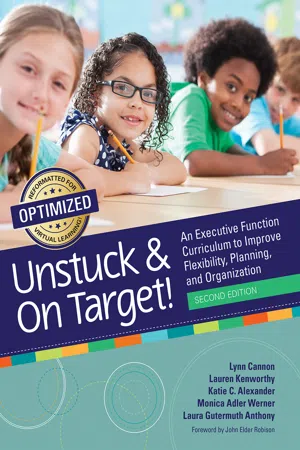
Unstuck and On Target!
eBook - ePub

Unstuck and On Target!

An Executive Function Curriculum to Improve Flexibility, Planning, and Organization

  1. 304 pages
  2. English
  3. ePUB (mobile friendly)
  4. Available on iOS & Android
eBook - ePub

Unstuck and On Target!

An Executive Function Curriculum to Improve Flexibility, Planning, and Organization

About this book

For students with executive function challenges, problems with flexibility and goal-directed behavior can be a major obstacle to success in school and in life. With the enhanced second edition of this popular curriculum— now optimized for both in-person and virtual instruction —you'll have everything you need to explicitly teach executive function skills in today's educational environment.


A highly effective intervention for students ages 8–11, Unstuck & On Target! gives you 21 ready-to-use, field-tested lessons that boost critical skills like cognitive flexibility, problem solving, coping, and goal setting. Ideal for use with learners with autism, ADHD, and other challenges that affect executive function, this curriculum includes a comprehensive manual and a package of digital, downloadable components that are easy to print and use in face-to-face or virtual settings.


Unstuck and On Target! Benefits:

  • Optimized for the way you teach today. The new reconfigured format makes the kit more flexible—you can use it in schools or during remote instruction.
  • Meets the needs of MTSS Tier 2 learners. This proven curriculum is one of the few tailored to the needs of Tier 2 students who need more focused instruction.
  • Gives you explicit, step-by-step routines, activities, and scripts to help students improve executive function skills.
  • Targets the flexibility and planning skills every student needs to learn effectively, reduce stress, get along with others, problem-solve, and more.
  • Can be done with any class, by any teacher. Each ready-to-use lesson comes complete with clear instructions, materials lists, and tips for teachers.
  • Makes learning fun with engaging games, role plays, stories, and lively class discussions.
  • Reinforces new skills through 19 Home Practice handouts in English and Spanish.


WHAT'S IN THE REFORMATTED KIT: One print manual * Two digital, print-ready gameboards, available as one-page 11x17 PDFs, two-page 8.5x11 PDFs, and PowerPoint files * Four digital, print-ready posters * 50+ handouts—digital downloads now available as fillable PDFs


Want preprinted gameboards and posters? You can still order them here.


Already have the 2nd edition? Then you already have access to the new digital files! Just visit the existing downloads page on the Brookes Download Hub to access the files.

Frequently asked questions

Yes, you can cancel anytime from the Subscription tab in your account settings on the Perlego website. Your subscription will stay active until the end of your current billing period. Learn how to cancel your subscription.
At the moment all of our mobile-responsive ePub books are available to download via the app. Most of our PDFs are also available to download and we're working on making the final remaining ones downloadable now. Learn more here.
Perlego offers two plans: Essential and Complete
  • Essential is ideal for learners and professionals who enjoy exploring a wide range of subjects. Access the Essential Library with 800,000+ trusted titles and best-sellers across business, personal growth, and the humanities. Includes unlimited reading time and Standard Read Aloud voice.
  • Complete: Perfect for advanced learners and researchers needing full, unrestricted access. Unlock 1.4M+ books across hundreds of subjects, including academic and specialized titles. The Complete Plan also includes advanced features like Premium Read Aloud and Research Assistant.
Both plans are available with monthly, semester, or annual billing cycles.
We are an online textbook subscription service, where you can get access to an entire online library for less than the price of a single book per month. With over 1 million books across 1000+ topics, we’ve got you covered! Learn more here.
Look out for the read-aloud symbol on your next book to see if you can listen to it. The read-aloud tool reads text aloud for you, highlighting the text as it is being read. You can pause it, speed it up and slow it down. Learn more here.
Yes! You can use the Perlego app on both iOS or Android devices to read anytime, anywhere — even offline. Perfect for commutes or when you’re on the go.
Please note we cannot support devices running on iOS 13 and Android 7 or earlier. Learn more about using the app.
Yes, you can access Unstuck and On Target! by Lynn Cannon,Lauren Kenworthy,Katie Alexander,Monica Werner,Laura Gutermuth Anthony in PDF and/or ePUB format, as well as other popular books in Education & Inclusive Education. We have over one million books available in our catalogue for you to explore.

Information

Year
2021
Print ISBN
9781681254906
eBook ISBN
9781681254913
Edition
2
Foundational Skills
SPECIAL INSTRUCTIONS: Although it is important to provide the vocabulary and frameworks set forth in this topic, the group leader is expected to modify the activities as necessary to better meet the students’ needs.
Summary: Topic 1 introduces foundational skills that promote successful participation in group sessions and implementation of the Unstuck and On Target! curriculum. It introduces a Code of Conduct (ground rules) for the group sessions and a universal script (or routine) for completing work and organizing the group sessions called Goal, Why, Plan, Do, Check (GWPDC). Topic 1 also teaches students how to use a visual rating tool to identify their feelings (Feelings Target), how to link feelings to behaviors and outcomes (Feelings Chain), and common coping techniques for managing overwhelming feelings (e.g., deep breathing).
Prerequisite skills: None
Related skills: Awareness of body, use of visual rating tool

OUTCOME—CRITERIA FOR MASTERY

  1. The student understands and attempts to follow the code of conduct for group sessions.
  2. The student can state the meaning of the goal and plan and check phases of the Goal, Why, Plan, Do, Check (GWPDC) routine.
  3. Using a visual chart, the student can rate his or her current feeling state.
  4. The student can identify and access several coping strategies and use them when needed.

TOPIC BACKGROUND AND RATIONALE

This topic introduces several foundational skills as well as a set of ground rules for behavior in the group sessions. Students are taught a standard operating procedure for reaching goals known as the Goal, Why, Plan, Do, Check (GWPDC). GWPDC is a fundamental script that underlies every session of Unstuck and On Target! It is a generic and widely applicable self-regulatory/problem-solving script that provides a template for approaching a problem, situation, or project. The first part of this script is an introduction to the concept of a goal. Making the definition of goal explicit is a very important step for students with executive dysfunction because they can easily over-focus on details and lose sight of the main reason for, or goal of, their activity. GWPDC breaks down any activity into small, achievable chunks, helping the student to focus on the right goal from the beginning. It promotes flexibility by encouraging the development of a plan, revision of the plan, and development of an alternative plan (Plan B). Students are encouraged to try things out (their plan) and then go back and check on the success of the plan. This provides a prompt for the self-monitoring that is often difficult for them. An additional virtue of this approach is that the focus is on the plan, not on the student’s difficulties; therefore, a breakdown in the situation can be blamed on an unhelpful plan rather than on the student.
Topic 1 also introduces foundational skills for identifying feelings, linking feelings to actions and events, and using coping strategies effectively to manage overwhelming feelings. Unstuck teaches routines for regulating behavior in the face of flexibility demands and expectations for independent, goal-directed work (e.g., completing homework). These are hard skills for students with executive dysfunction and can be hindered by overwhelming feelings. Furthermore, students often struggle with identifying their feelings. As a result, they can fail to recognize their own stress until it is very high and they feel overwhelmed. It is important that instruction in executive function skills be accompanied by active support for increasing coping skills that will help students know what they feel and will give them strategies for managing overwhelming feelings.

Lesson 1    Get to Know You

PURPOSE

The purpose of this lesson is to welcome the students into the group, help them get to know one another, and generate a Code of Conduct. The Code of Conduct should serve as the guidelines for how students can be successful group members. The Code of Conduct creates a common language around behaviors and expectations. There are two activities in this lesson.

Materials Required for All Activities

Not Included
  • Whiteboard or chart paper
  • Regular markers (if using chart paper) or dry erase markers (if using a whiteboard and when using the poster; see Included list at right)
  • Pencils
  • Group Reinforcement Visual (i.e., groupgoal/tally box and thermometer)
  • One full-size three-ring binder for each student to use as his or her Unstuck and On Target! (UOT) Notebook
Included
  • GWPDC for Lesson 1
  • Handout: All About Me!
  • Code of Conduct poster
  • Classroom Practice 1
  • Home Practice 1
LESSON 1
INTRODUCTION
Preview: GWPDC
Review
~3 minutes

Materials

Not Included
  • Whiteboard or chart paper
  • Regular markers (if using chart paper)or dry erase markers (if using awhiteboard and when using the poster;see Included list at right)
Included
  • GWPDC for Lesson 1

Instructions

At the beginning of every session, post the Goal, Why, Plan, Do, Check (GWPDC) on the board before the lesson begins. Since this is your students’ first time seeing a GWPDC, you will want to briefly explain that… each time the group comes together you will have something you want to accomplish or a goal. The “W” stands for why. It is always useful to know why we want to achieve this goal. In order to accomplish the goal you will need to follow a plan and think about why the goal is important. Once you follow the plan, you always want to come back and check to se...

Table of contents

  1. Unstuck Fast Facts
  2. About the Online Materials
  3. About the Authors
  4. ForewordJohn Elder Robison
  5. Acknowledgments
  6. Introduction
  7. Reinforcement System
  8. Icon Glossary
  9. Script Practice Throughout the Manual
  10. Topic 1 Foundational Skills
  11. Lesson 1 Get to Know You
  12. Introduction
  13. Activity 1: Code of Conduct
  14. Activity 2: Who Knows Whom?
  15. Handout: All About Me!
  16. Closing
  17. Classroom Practice 1
  18. Home Practice 1
  19. Lesson 2 Introduction to Goal, Why, Plan, Do, Check
  20. Introduction
  21. Activity 1: Introduction to GWPDC
  22. Activity 2: Wacky GWPDC
  23. Handout: Wacky GWPDC
  24. Closing
  25. Classroom Practice 2
  26. Home Practice 2
  27. Lesson 3 Emotional Identification
  28. Introduction
  29. Activity 1: Feelings Target
  30. Visual: Feelings Target
  31. Materials: Feelings Target Cards
  32. Activity 2: How Does It Make Me Feel?
  33. Activity 3: Feelings Chain
  34. Visual: Feelings Chain Scenarios
  35. Handout: Feelings Chain Blank
  36. Closing
  37. Classroom Practice 3
  38. Home Practice 3
  39. Lesson 4 What Can You Do to Feel Better?
  40. Introduction
  41. Activity 1: Disappointment and Coping
  42. Handout: Disappointment and Coping
  43. Activity 2: Coping Skills Investigation
  44. Handout: How to Feel Just-Right
  45. Handout: Just-Right Strategies Investigation
  46. Handout: My Mission to Get Back to Just-Right
  47. Handout: Deep Breathing
  48. Activity 3: Strategy Cards
  49. Handout: Strategy Card Examples
  50. Additional Activity: Coping Choices
  51. Closing
  52. Classroom Practice 4
  53. Home Practice 4
  54. Topic 1 Progress Report
  55. Topic 2 What Is Flexibility?
  56. Lesson 5 Flexibility Investigation
  57. Introduction
  58. Activity 1: Flexible vs. Rigid Scavenger Hunt
  59. Activity 2: Flexible Is Faster (and More Efficient)
  60. Closing
  61. Classroom Practice 5
  62. Home Practice 5
  63. Lesson 6 Flexibility
  64. Introduction
  65. Activity 1: Mystery Word—Flexibility
  66. Handout: Mystery Word 1
  67. Educator Guide: Mystery Word 1 Key
  68. Handout:Unstuck and On Target! Dictionary—Flexible
  69. Activity 2: As Flexible as Putty
  70. Handout: Flexible Fun
  71. Handout: Fun Putty Recipe
  72. Closing
  73. Classroom Practice 6
  74. Home Practice 6
  75. Lesson 7 Getting Stuck
  76. Introduction
  77. Activity 1: Mystery Word—Stuck
  78. Handout: Mystery Word 2
  79. Educator Guide: Mystery Word 2 Key
  80. Handout:Unstuck and On Target! Dictionary—Stuck
  81. Activity 2: Flexible/Stuck Role Play
  82. Closing
  83. Classroom Practice 7
  84. Home Practice 7
  85. Topic 2 Progress Report
  86. Topic 3 How to Be Flexible
  87. Lesson 8 Plan A → Plan B
  88. Introduction
  89. Activity 1: Mystery Words—Plan A→ Plan B
  90. Handout: Mystery Word 3
  91. Educator Guide: Mystery Word 3 Key
  92. Handout:Unstuck and On Target! Dictionary—Plan A→ Plan B
  93. Activity 2: Speed B
  94. Activity 3: Build a Plan A, B, C
  95. Handout: Build a Plan A, B, C
  96. Closing
  97. Classroom Practice 8
  98. Home Practice 8
  99. Lesson 9 Compromise
  100. Introduction
  101. Activity 1: Mystery Word—Compromise
  102. Handout: Mystery Word 4
  103. Educator Guide: Mystery Word 4 Key
  104. Handout:Unstuck and On Target! Dictionary—Compromise
  105. Activity 2: Compromise Game
  106. Materials: Compromise Game Cards
  107. Closing
  108. Classroom Practice 9
  109. Home Practice 9
  110. Lesson 10 Big Deal/Little Deal
  111. Introduction
  112. Activity 1: Mystery Words—Big Deal/Little Deal
  113. Handout: Mystery Word 5
  114. Educator Guide: Mystery Word 5 Key
  115. Handout:Unstuck and On Target! Dictionary—Big Deal/Little Deal
  116. Activity 2: Big Deal/Little Deal Practice
  117. Materials: Big Deal/Little Deal Cards
  118. Activity 3: Converting Big Deals to Little Deals
  119. Handout: Big Deal/Little Deal Scale
  120. Closing
  121. Classroom Practice 10
  122. Home Practice 10
  123. Lesson 11 Choice/No Choice
  124. Introduction
  125. Activity 1: Mystery Words—Choice/No Choice
  126. Handout: Mystery Word 6
  127. Educator Guide: Mystery Word 6 Key
  128. Handout:Unstuck and On Target! Dictionary—Choice/No Choice
  129. Activity 2: Choice/No Choice Practice
  130. Materials: Choice/No Choice Cards
  131. Closing
  132. Classroom Practice 11
  133. Home Practice 11
  134. Lesson 12 Expect the Unexpected
  135. Introduction
  136. Activity 1: Expect the Unexpected Introduction
  137. Activity 2: Handling the Unexpected Exploration
  138. Educator Guide: Handling the Unexpected Game Rules
  139. Materials: Handling the Unexpected Game Board
  140. Materials: Handling the Unexpected Game Cards
  141. Closing
  142. Classroom Practice 12
  143. Home Practice 12
  144. Topic 3 Progress Report
  145. Topic 4 Why Be Flexible?
  146. Lesson 13 The Advantages of Being Flexible
  147. Introduction
  148. Activity 1: What to Do When What I Want Is Impossible
  149. Educator Script: My Two Choices
  150. Visual: Group Flexibility Chant
  151. Activity 2: Flexibility Freeway Game
  152. Educator Guide: Flexibility Freeway Game Rules
  153. Materials: Flexibility Freeway Game Board
  154. Materials: Flexibility Freeway Game Cards
  155. Closing
  156. Classroom Practice 13
  157. Home Practice 13
  158. Lesson 14 Being Flexible Can Make Good Things Happen
  159. Introduction
  160. Activity 1: Flexibility Powers
  161. Educator Script: Flexibility Gives You Power Scenarios
  162. Activity 2: Flexible Reputation
  163. Educator Script: Marble Jar: Flexible Reputation Scenarios
  164. Closing
  165. Classroom Practice 14
  166. Home Practice 14
  167. Topic 4 Progress Report
  168. Topic 5 Your Goals: Getting What You Want
  169. Lesson 15 Setting and Achieving Goals Using GWPDC
  170. Introduction
  171. Activity 1: Think Pink—GWPDC
  172. Handout: Think Pink—GWPDC
  173. Closing
  174. Classroom Practice 15
  175. Home Practice 15
  176. Lesson 16 GWPDC Application and Practice
  177. Introduction
  178. Activity 1: Cereal
  179. Additional Activity: What Is a Target Goal?
  180. Additional Activity: Target Goal Example
  181. Closing
  182. Classroom Practice 16
  183. Home Practice 16
  184. Lessons 17 & 18 GWPDC Stations
  185. Introduction
  186. Activity 1: Plan B Strategies
  187. Activity 2: GWPDC Stations
  188. Handout: GWPDC Station 1
  189. Handout: Compromise Station 2
  190. Handout: GWPDC Station 3
  191. Materials: Distractor Game Cards Station 4
  192. Materials: Distractor Game Cards Answer Key Station 4
  193. Materials: Distractor Game Tracking Sheet Station 4
  194. Handout: GWPDC Station 5
  195. Handout: GWPDC Station 5 Scenarios
  196. Closing
  197. Classroom Practice 17 & 18
  198. Home Practice 17 & 18
  199. Lesson 19 Event Planning
  200. Introduction
  201. Activity 1: Planning a Class Event
  202. Closing
  203. Classroom Practice 19 & 20
  204. Home Practice 19 & 20
  205. Lesson 20 Event
  206. Topic 5 Progress Report
  207. Topic 6 Flexible/Goal-Directed Futures
  208. Lesson 21 Interview (& Optional Game)
  209. Introduction
  210. Activity 1: Talk Show
  211. Handout: Flexible Futures
  212. Additional Activity: Four Corners
  213. Educator Script: Four Corners Questions & Answer Key
  214. Closing
  215. Handout: Graduation Certificate
  216. Classroom Practice 21
  217. Home Practice 21
  218. Topic 6 Progress Report
  219. Appendix
  220. Index