![]()
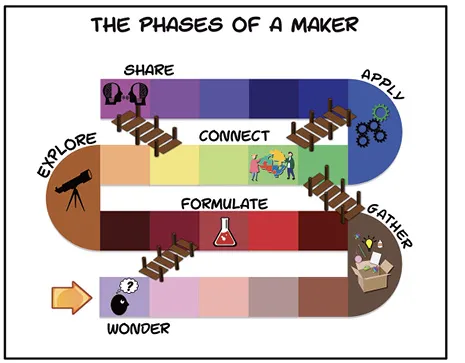
In this chapter, we explore the phases that children often go through as they are involved in a makerspace experience. Preschoolers seem almost compelled to explore their immediate environment. They use all their senses to touch, poke, stare at, smell, or carefully listen to the environment and objects around them. We have observed a variety of approaches children display when they first encounter a makerspace. We have also noticed a progression of growth as children become more comfortable exploring, problem solving, and developing new ideas, which we call “the phases of a maker”:
- The wonder phase
- The gather phase
- The formulate phase
- The explore phase
- The connect phase
- The apply phase
- The share phase
Some of you may be familiar with a board game called Chutes and Ladders by Hasbro, in which the players spin a spinner and move the number of spaces indicated. A player may land on a space where a ladder advances them quickly to the next level, or in some instances a chute will take the player right back to the beginning of the game. The phases of a maker are much like this game. Children sometimes move through the phases in the order presented, but they may also move through the phases in a different sequence. We like to think of it as children following different paths on their makerspace journeys. Younger children often stay in the explore phase longer than older children. With more experience in a makerspace, children spend more time in the apply phase. Teachers can support children by recognizing the phase a child is in. Let’s take a look at the phases in more detail.
The Wonder Phase
Wonder is an emotion similar to the surprise that a person feels when encountering something unexpected or unfamiliar. Wonder is often linked with curiosity and sparks exploration. Children experiencing a makerspace for the first time may be a bit timid and may feel reluctant to touch the materials and tools. Some children will wait and observe the teacher or peers from a distance before engaging with any of the materials. Children may wonder what to do and how to use the tools and materials. They may watch with wonder as other children interact with materials. Being able to observe others provides these children with time to evaluate and determine how they will interact with the items in the space. Some children, especially if they are highly curious, move through the wonder stage without hesitancy and immediately begin examining materials, testing tools, and gathering items of interest.
Remember that children will approach makerspace experiences differently. We discovered that younger children or those who were participating in makerspace for the first time often approach the materials differently than older children or those who had previously been exposed to makerspace experiences. Younger children often spend more time investigating materials and usually work independently. One way to promote collaborative learning experiences is to engage children in a variety of small design challenges.
In Callie’s class at Handprints in the Highlands, the three-year-old children spent most of their time working alone. She noticed that, occasionally, some of the children would watch and copy one another, but they rarely collaborated on their designs. Callie set a goal to develop opportunities that would encourage the children to work together.
The next day, in the makerspace interest center, Callie placed the children into small groups for a design challenge. She noticed that even when she was intentionally trying to encourage the children to work together, many of the younger children still worked independently. Callie was not discouraged and decided to take a more active role in the process. She joined a small group of th...