A rich history of underwater filmmaking and how it has profoundly influenced the aesthetics of movies and public perception of the oceans
In The Underwater Eye, Margaret Cohen tells the fascinating story of how the development of modern diving equipment and movie camera technology has allowed documentary and narrative filmmakers to take human vision into the depths, creating new imagery of the seas and the underwater realm, and expanding the scope of popular imagination. Innovating on the most challenging film set on earth, filmmakers have tapped the emotional power of the underwater environment to forge new visions of horror, tragedy, adventure, beauty, and surrealism, entertaining the public and shaping its perception of ocean reality.
Examining works by filmmakers ranging from J. E. Williamson, inventor of the first undersea film technology in 1914, to Wes Anderson, who filmed the underwater scenes of his 2004 The Life Aquatic with Steve Zissou entirely in a pool, The Underwater Eye traces how the radically alien qualities of underwater optics have shaped liquid fantasies for more than a century. Richly illustrated, the book explores documentaries by Jacques Cousteau, Louis Malle, and Hans Hass, art films by Man Ray and Jean Vigo, and popular movies and television shows such as 20,000 Leagues Under the Sea, Creature from the Black Lagoon, Sea Hunt, the Bond films, Jaws, The Abyss, and Titanic. In exploring the cultural impact of underwater filmmaking, the book also asks compelling questions about the role film plays in engaging the public with the remote ocean, a frontline of climate change.
eBook - ePub
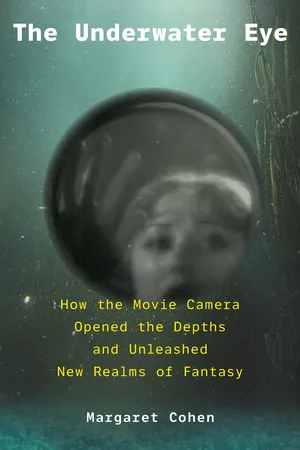
The Underwater Eye
How the Movie Camera Opened the Depths and Unleashed New Realms of Fantasy
- 272 pages
- English
- ePUB (mobile friendly)
- Available on iOS & Android
eBook - ePub
The Underwater Eye
How the Movie Camera Opened the Depths and Unleashed New Realms of Fantasy
About this book
Trusted by 375,005 students
Access to over 1.5 million titles for a fair monthly price.
Study more efficiently using our study tools.
Information
Publisher
Princeton University PressYear
2022Print ISBN
9780691299587
9780691197975
eBook ISBN
9780691225524
1
Vision Immersed, 1840–1953
1.1. The Aquarium Is Not the Underwater Eye (Immersive Vision, 1840–1890)
In May 1853, the first public aquarium opened at the London Zoo. The glass tanks in the zoo’s Fish House may have been small, but they swarmed with life. There, visitors observed “58 species of fish and 200 invertebrates including 76 species of mollusc, 41 crustaceans, 27 coelenterates, 15 echinoderms, 14 annelids as well as a sprinkling from the small invertebrate groups.”1 Viewers were enthralled. Of course, people knew fish and shellfish as food, and they could peruse specimens classified on the pages of naturalist books, with every scale and fin crisply drawn. Middle- and upper-class vacationers had perhaps caught fish or collected shellfish, caught up in the century’s growing enthusiasm for beachside leisure, even if they usually lived far from the sea. How different, it was, nonetheless, to observe water-dwelling creatures alive in their fluid element, mobilis in mobili, to cite Jules Verne’s device for his imaginary submarine named after a magnificent cephalopod, the nautilus.
A year later, Philip Henry Gosse, the designer of the London Zoo’s Fish House, published The Aquarium: An Unveiling the Wonders of the Deep Sea. In this book about aquarium keeping and specimen collecting, he evoked viewer pleasure in the aquarium’s underwater spectacle, such as the lady marveling at the “pellucid” bodies and “smooth gliding movements” of prawns, leading her to compare them to “ghosts.”2 The Aquarium provided details to encourage amateurs to keep home aquariums, which proliferated in ensuing years, as did guides such as Gosse’s, directed to crossover audiences, women, and also children. By the later nineteenth century, public aquariums became fixtures in major cities and resorts, and pop-up tanks drew crowds in transatlantic international exhibitions, most famously world’s fairs.
The Paris World’s Fair of 1867 had two grand saltwater and one freshwater installation among the attractions that drew between 11 million and 15 million viewers. The aquarium spectacles, like all of the exhibition, were the talk of the transatlantic world. Jules Verne and Hans Christian Andersen were among many writers and artists inspired by what one German contemporary called its “ ‘magical castle on the ocean floor,’ revealing ‘secrets of the frigid deep.’ ” While aquariums had initially been developed to aid marine biologists, they “stand among the most successful medializations of the sea,” from the Victorian era into the present day.3 As Natascha Adamowsky concisely and lyrically observes, “the aquarium is a dream of the ocean given material form.”4 Curators starting with Gosse arranged aquariums with one eye on keeping animals alive and the other on attraction, drawing inspiration notably from the decorative arts. In containing real marine creatures arranged to tempt the imagination, the aquarium is an exhibition form at the threshold where biology meets fantasy, and in this way, it belongs to the same lineage as underwater cinema, which, as I have mentioned, also troubles the documentary/imaginative divide.
Yet another way aquariums resemble underwater film is that curators organized their novel spectacles drawing on aesthetics inspired by the submarine environment that predated modern access to the depths. Three aesthetics stand out. The framing of installations around prized specimens hearkened back to the cabinets of curiosities, which displayed rare, beautiful shells that had started to flow into Europe from expanding overseas trade.5 Another inspiration was the baroque grotto, also dating to the early modern era when the arts were so powerfully shaped by Europeans’ seaward ambitions. In baroque fantasies, classical water deities fused into ornate, rustic shelters, often ornamented with shells and rocks. The most magnificent of these installations bathed the environments in a humid atmosphere, thanks to early modern hydraulics.6 Aquarium exhibitions also drew on the more intimate rococo style that was an inheritor of the baroque in the eighteenth century. Cultivating whimsy and irregularity, this aesthetic, too, took inspiration from the sea. It was “often described in terms of liquidity” and featured “shelly, florid, scrolling forms that seem to melt or flow seamlessly from one to the next.”7 All three of these aesthetics—the cabinet of curiosities, the baroque, and the rococo—shape, in miniature, for example, Gosse’s installation for the Aesop prawn, as it appeared in a chromolithographic illustration for The Aquarium (fig. 1.1). Set off like a prized specimen (although common in coastal waters), the jewel-like prawn is nestled in a tiny grotto taking the form of an irregular arch decorated with sea stars. On its head, what Gosse called the “slender filiform appendages” are, in his words, “continually thrown into the most graceful curves,” and its delicate legs rest lightly on a paving of irregular barnacles, tinged in complementary pastel colors.8

FIG. 1.1. “The Aesop Prawn, &c.” from Philip Henry Gosse, The Aquarium: An Unveiling of the Wonders of the Deep Sea (London: John Van Voorst, 1954), plate 6, p. 222. Photograph © The Royal Society. Gosse’s installation frames this cold-water shrimp native to British waters, Pandalus montagui, as an exquisite specimen in a miniature baroque grotto.
In his preface, Gosse noted that he had heard about an “elaborate … scheme” of a French zoologist, who, in order to study marine life, “had provided himself with a water-tight dress, suitable spectacles, and a breathing tube; so that he might walk on the bottom in a considerable depth of water, and mark the habits of the various creatures pursuing their avocations.”9 Gosse expressed skepticism about whether such a dive was “really attempted,” predicting “feeble results,” even if it was, and reassured readers that “THE MARINE AQUARIUM … bids fair … to make us acquainted with the strange creatures of the sea, without diving to gaze on them.”10 Gosse thereby dismissed the investigations of the first scientific diver, Frenchman Henri Milne-Edwards, who published the observations he made when diving off the coast of Sicily in 1844.11 Gosse’s lack of interest was shared by other scientists as well by general transatlantic publics in the middle decades of the nineteenth century in a lapse so remarkable in hindsight that Adamowsky calls it “hydrophobia.”12 Despite such lack of recognition at the time, Milne-Edwards was pioneering a transformative method of submarine observation, with the diving helmet that provided the layer of air the human eye needs to focus, along with enabling breathing below the surface.
This layer of air was not available to free divers noted for their prowess since antiquity, such as sponge divers of the Mediterranean. European mariners were famously averse to swimming. When Europeans landed in the Americas, they were astounded by the ease in the water of Indigenous peoples. According to Robert Marx, “[t]he Spanish historian, Oviedo,” writing in 1535, was one among many who “marveled at their abilities, saying that they could descend to depths of nearly a hundred feet, [and] remain submerged as long as 15 minutes.”13 Similar capacity characterizes traditional free divers on the other side of the globe, most famously Ama, the Japanese pearl fisherwomen. Recently, scientists have coined the term “sea nomads,” to describe the Bajau peoples of the Southeast Asian archipelagoes, who have physiological adaptations enabling them to spend remarkable periods of time (up to thirteen minutes) underwater with a single breath.14 Perhaps Oviedo’s observations half a millennium ago about the breath-holding capacities of Indigenous divers in the Americas were not a travel writer’s exoticizing exaggerations. In any case, the difficulty in focusing the eyes underwater, along with lack of air, limits what the free diver can observe. The best technology available for providing the eye with enough air to focus in the premodern period was translucent shells used as coverings.
Through the helmet’s layer of glass, nineteenth-century divers looked at a planetary environment that had never before been observed, let alone described. A version of the diving bell was improved for observation as well, when in 1865, French engineer Ernest Bazin devised a diving chamber “of high grade steel” with “two viewing ports and an external electric lamp for underwater illumination” to “search for a treasure sunk in Vigo Bay, Spain.”15 In 1875, an Italian engineer enhanced the diving chamber’s safety by supplying compressed air that would refresh the atmosphere. Yet these technologies were, until the 1880s, almost exclusively used for industry. “No one questioned the incomparable value of diving or the wholly new opportunities and fields of research it opened,” yet “one was unlikely to encounter interest in underwater landscapes or lyrical effusions”—in sum, descriptions of the environment based on observations while immersed.16
What did transatlantic publics know about submarine conditions in the era between the inception of modern industry diving and the invention of the photosphere? As a prelude to exploring how filmmakers shaped the submarine realm for publics, I review in this section what details were disseminated during this era, using the scant secondary literature on the subject, which directed me to a few primary examples as well. The picture emerging from this survey is that the material conditions of the underwater environment were almost entirely unknown to general audiences at the time. Such lack of knowledge is important context because it underlines how unhampered filmmakers were by viewer expectations once they had technology to film below. This lack of expectations was at once freeing and also provided a challenge. While creators could shape imagery according to their visions, at the same time, this imagery had to convince audiences that it was indeed the undersea environment, a challenge all the greater because the environment was inaccessible to them.17 Leisure diving would not develop until the advent of scuba in the post–World War II era.
Writing about diving in Sicilian waters in 1844, Henri Milne-Edwards commented, “I saw perfectly everything that surrounded me.”18 From the murky waters most often plied by industry divers of the northern Atlantic, the reports that came to the general public were of underwater gloom. In The History of Underwater Exploration, Robert Marx quotes in full the anecdote from an anonymous amateur who dove in the Thames in 1859. This viewer compared the underwater ambience to “the London atmosphere in a November fog,” with “living forms floating about here and there,” although he could not “say what they were.”19 A year later, Charles Dickens, from the fog-filled bank at night, rather than the murky river, wrote “methought I felt much as a diver might, at the bottom of the sea.”20 The underwater gloom was more enjoyable for Robert Louis Stevenson, in his brief firsthand account of a dive, which he made in 1868, published in 1888. The black sheep of a noted British family of lighthouse and civil engineers, Stevenson described how as a young man he visited a construction site on the Bay of Wick and persuaded a “certain handsome scamp of a diver,” Bob Bain, to let him experience helmet div...
Table of contents
- Cover
- Title Page
- Copyright Page
- Dedication
- Epigraph
- Contents
- List of Illustrations
- Note on Timestamps
- Acknowledgments
- Introduction
- 1. Vision Immersed, 1840–1953
- 2. The Wet Camera, 1951–1961
- Color Plates
- 3. Liquid Fantasies, 1963–2004
- Epilogue: On the Underwater Film Sets of Documentary: Fact and Fiction in Blue Planet II
- Notes
- Works Cited
- Index
Frequently asked questions
Yes, you can cancel anytime from the Subscription tab in your account settings on the Perlego website. Your subscription will stay active until the end of your current billing period. Learn how to cancel your subscription
No, books cannot be downloaded as external files, such as PDFs, for use outside of Perlego. However, you can download books within the Perlego app for offline reading on mobile or tablet. Learn how to download books offline
Perlego offers two plans: Essential and Complete
- Essential is ideal for learners and professionals who enjoy exploring a wide range of subjects. Access the Essential Library with 800,000+ trusted titles and best-sellers across business, personal growth, and the humanities. Includes unlimited reading time and Standard Read Aloud voice.
- Complete: Perfect for advanced learners and researchers needing full, unrestricted access. Unlock 1.5M+ books across hundreds of subjects, including academic and specialized titles. The Complete Plan also includes advanced features like Premium Read Aloud and Research Assistant.
We are an online textbook subscription service, where you can get access to an entire online library for less than the price of a single book per month. With over 1.5 million books across 990+ topics, we’ve got you covered! Learn about our mission
Look out for the read-aloud symbol on your next book to see if you can listen to it. The read-aloud tool reads text aloud for you, highlighting the text as it is being read. You can pause it, speed it up and slow it down. Learn more about Read Aloud
Yes! You can use the Perlego app on both iOS and Android devices to read anytime, anywhere — even offline. Perfect for commutes or when you’re on the go.
Please note we cannot support devices running on iOS 13 and Android 7 or earlier. Learn more about using the app
Please note we cannot support devices running on iOS 13 and Android 7 or earlier. Learn more about using the app
Yes, you can access The Underwater Eye by Margaret Cohen in PDF and/or ePUB format, as well as other popular books in Social Sciences & Literary Criticism for Comparative Literature. We have over 1.5 million books available in our catalogue for you to explore.