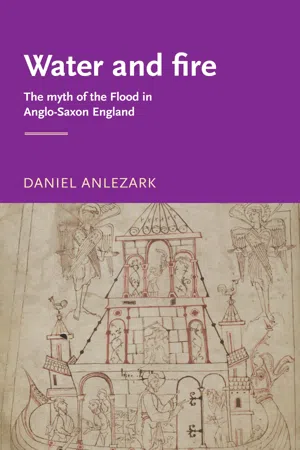
Noah's Flood is one of the Bible's most popular stories, and flood myths survive in many cultures today. This book presents the first comprehensive examination of the incorporation of the Flood myth into the Anglo-Saxon imagination. Focusing on literary representations, it contributes to our understanding of how Christian Anglo-Saxons perceived their place in the cosmos. For them, history unfolded between the primeval Deluge and a future – perhaps imminent – flood of fire, which would destroy the world. This study reveals both an imaginative diversity and shared interpretations of the Flood myth. Anglo-Saxons saw the Flood as a climactic event in God's ongoing war with his more rebellious creatures, but they also perceived the mystery of redemption through baptism.
Anlezark studies a range of texts against their historical background, and discusses shifting emphases in the way the Flood was interpreted for diverse audiences. The book concludes with a discussion of Beowulf, relating the epic poem's presentation of the Flood myth to that of other Anglo-Saxon texts.
- 398 pages
- English
- ePUB (mobile friendly)
- Available on iOS & Android
eBook - ePub
About this book
Trusted by 375,005 students
Access to over 1.5 million titles for a fair monthly price.
Study more efficiently using our study tools.
Information
1
‘You see the water, you see the wood’: The Bible and the Fathers
A range of cultures from across the globe tell stories of floods survived by ancestral figures. Despite some efforts to harmonize these accounts to prove the historical truth of the biblical account of Noah’s flood, the myths and legends from the Americas, the Pacific, Asia, Africa and Europe present a range of incompatible details. They suggest the universality of the mythic theme, rather than the memory of one ancient cataclysm that overwhelmed the globe. Paralleling the many accounts of floods – which destroyed anything from an ancestral homeland to the whole world – are legends of catastrophic fires, which also had to be endured by ancestral figures.1
Various explanations have been offered for the popularity of these stories, but undoubtedly the real difficulties of surviving a hostile environment which occasionally threatened the continuation of family or tribe, if not nation, account for their ubiquity. It is also possibly the case that for many legends and myths a remembered natural disaster on a grand scale, such as a flood – a disaster which might also be expected to recur – lies behind the inherited story. In the account found in Genesis, which tells of the origins of the whole human race, the Flood myth is stripped of pagan gods found in Mesopotamian analogues, and has a strong moral character. The Flood in the Bible is clearly a punishment, though the sin is not so well defined, and forms part of a historical pattern of sin and punishment extending back to Eden, and carried forward through the sin and exile of Cain. The biblical Flood is presented as no local disaster, but as a universal calamity.
The story of the Flood presented in Genesis is essentially cyclical in character: it begins with a decision by God to destroy humanity, and ends with the decision not to do so again.2 The basic structure of the narrative parallels the creation narratives, revealing that the Flood is a story appended to the creation account. What was created to be good is not: humanity is wicked (6 :5–6) and the earth corrupt (6 :11–12 ). The Flood also represents a new insight tied to the creation narrative: human beings cannot take for granted their existence in the world. Despite the threat to destroy all of humanity, no tension builds in the story around this possibility, because, if the obliteration had been successful, no memory would have been passed on. The interest in the unfolding story is therefore the question how and why the race survived; in the biblical narrative, as in most versions, this is because of the decision to save one individual and his family.
The presence of human beings throughout the story also gives it a character different from creation stories. In the Flood story, narration is predominantly from the human perspective because human beings are present throughout, making it both a primeval and a historical event. The strong dose of historicism in biblical mythology is one of its striking elements, and a unique one in the context of other Mediterranean mythologies; it has also severed links with nature myths and develops an abstract conception of monotheism.3 ‘Before the creation’ is an unknowable mystery from the human point of view, as is the reason for it; before the Flood and after the Flood are both part of the human story, and the reasons for the Flood are known, and therefore clearly define a new element in humanity’s relationship with God.
The drama of the Flood narrative is developed in the tension between destruction and preservation – most will be destroyed, a small few saved, and so the Flood becomes two stories emerging from a twofold divine decision. After the judgment has been passed, the story of those destroyed is not told at all: there are no cries, laments or pictures of their suffering. Those shut inside the ark did not witness this moment, and the story of those obliterated is destroyed with them; their perspective on the action is negated as thoroughly as they are. Noah’s story is fully told because as both the survivor and the reason for survival, he is of much greater interest. He alone receives the prophetic warning of the Flood, he responds, and successfully comes through the ordeal. This response is inseparable from his salvation: Noah is the one who survives to walk on the earth, and to make a sacrifice.
The Old Testament
The biblical account of Noah and the Flood begins at the end of Genesis 5 and continues, with reference to his descendants, into Genesis 10.4 Modern biblical scholarship has determined that the details of the Flood narrative in Genesis present a combination of two accounts from the so-called Yahwist and Priestly authors, and this can give the story a repetitive character at times; medieval readers were aware of the problem, though not the reason.5 Noah is named by his father Lamech (Gen 5:28–9) – the Hebrew etymology of the name suggests Noah is one who will give ‘comfort’ or ‘rest’. In prophesying Noah’s future role, Gen 5:29 plays on a Hebrew verb with a similar root – nacham (‘comfort’, ‘relieve’).6 The derivation of the name was widely appreciated and commented upon by Christian commentators, and is reflected in the Vulgate:
vocavitque nomen eius Noe, dicens: iste consolabitur nos ab operibus et laboribus manuum nostrarum, in terra cui male-dixit Dominus.
[And he called his name Noah, saying: This same shall comfort us from the works and labours of our hands on the earth, which the Lord has cursed.]7
Noah was the tenth generation after Creation, and after his 500th year he had three sons – Shem, Ham and Japheth (Gen 5:32). The biblical description of Noah’s character is pivotal to the development of the Flood narrative: in a world fallen into evil (Gen 6:1–7),8 he alone finds grace, and is described as ‘just’ in the midst of this evil generation (Gen 6:9).
When God decides to destroy all creatures living on the earth, in a cataclysmic Flood, only Noah, his three sons and their four wives, are to be saved in the ark for the regeneration of the human race, along with all kinds of clean and unclean animals (Gen 6–9). The biblical instructions for the building of the ark, and the numbering of the animals, are closely detailed (Gen 6:18–7:5). The Genesis account also provides an elaborately detailed chronology: Noah was 600 years old when the Flood began (Gen 7:6), the waters of the Flood came seven days after the entry into the ark, which took place on the seventeenth day of the second month (Gen 7:10–11), the rains falling for forty days and forty nights (Gen 7:12). This careful elaboration of the passing of time continues all the while Noah and his family are in the ark, notably in the episode of the sending out of the dove.9
After the departure from the ark, Noah offers sacrifice from among the clean animals, a holocaust which is pleasing to God (Gen 8:20–1), who then lifts his curse from the earth, allowing for regular seedtime and harvest (8:22). In the context of the sacrifice, God makes his first promise not to repeat the annihilation, even if man’s nature is evil. The theme of the restoration of bountiful nature suggested by the regularity of the seasons is complemented by God’s repeated injunction to the survivors of the ark to increase, multiply and fill the earth (Gen 8:17, 9:1, 7). The impression that creation is making a new beginning is reenforced by the dominion which mankind is given over all living things, closely echoing the wording of Gen 1:26–8, where this dominion had been granted to Adam and Eve. The reference to the change in diet for the human race – where from the beginning of creation this had been vegetarian (Gen 1:29), it would now include the meat of animals (Gen 9:3) – provides another close echo of the creation story, and the new dietary provision also emphasizes the sense that humanity is making a fresh start under a new dispensation. Whereas Adam and Eve had been ejected from Eden under a curse, Noah and his family leave the ark and receive promises of blessing. With the new dietary allowance comes the prohibition against eating the blood of animals (Gen 9:4), and the command against shedding human blood (Gen 9:5–7), with a reminder that man was first made in the divine likeness (Gen 1:27; 9:6).
After the divine command to fill the earth, and the commandments relating to blood,10 the narrative moves on to the establishment of a covenant, not only between God and Noah and his sons, but with all living things which had been aboard the ark (Gen 9:8–11):
Haec quoque dixit Deus ad Noe, et ad filios eius cum eo: ecce ego statuam pactum meum vobiscum, et cum semine vestro post vos, et ad omnem animam viventem, quae est vobiscum, tam in volucribus quam in jumentis, et pecudibus terrae cunctis, quae egressa sunt de arca, et universis bestiis terræ. Statuam pactum meum vobiscum, et nequaquam ultra interficietur omnis caro aquis diluvii, neque erit deinceps diluvium dissipans terram.
[Thus also said God to Noah, and to his sons with him: Behold I will establish my covenant with you; and with your seed after you. And with every living soul that is with you, as well in all birds as in cattle and beasts of the earth, that have come forth out of the ark: and in all the beasts of the earth. I will establish my covenant with you; and all flesh shall be destroyed no more with the waters of a flood: neither shall there be from henceforth a flood to waste the earth.]
This first covenant between God and his creatures in the Old Testament, and the guarantee that no second flood of water would obliterate the earth, is commemorated by the sign of the rainbow (Gen 9:12–17).
The tone and thematic focus of the biblical narrative changes markedly after the description of the significance of the rainbow, as Noah the farmer (Vulg. agricola, Gen 9:20) plants the first grapevine, and is the first to experience the effects of its fermented fruit. Integral to this shift in narrative interest is the first designation of Noah’s three sons as the ancestors of the nations of the earth, and in particular the characterization of Ham as the father of Canaan (Gen 9:18–19). The episode of Noah’s drunkenness, in which Ham’s laughter at his father’s nakedness is contrasted with his two brothers’ piety, is introduced by this genealogical reference, and concluded with the much fuller genealogy of Genesis 10, which leads into the story of Babel (Gen 11:1–10). This framework provides the context for the blessing of Shem and Japheth, and the cursing of Ham, whose Canaanite descendants will serve the offspring of his brothers (Gen 9:24–7). Noah lives another 350 years after the Flood, dying at the age of 950 (Gen 9:28–9).
As a key figure in the history of the world, Noah is mentioned in a number of biblical books. Some of the references to him, both in the Old and New Testaments, are simply genealogical (1 Chron 1:4; Luke 3:36). In other places, again in a tradition extending across both Old and New Testaments, Noah is treated as a great saint of the ancient past. In Sirach [Ecclesiasticus] 44:17–19, Noah is listed between Enoch and Abraham as one of the ‘men of mercy, whose godly deeds have not failed’, and whose posterity is ‘a holy inheritance’. Noah’s particular role in history and his virtue are described:
Noe inventus est perfectus, iustus, et in tempore iracundiae factus est reconciliatio. Ideo dimissum est reliquum terrae cum factum est diluvium. Testamenta saeculi posita sunt apud illum, ne deleri possit diluvio omnis caro.
[Noah was found perfect, just: and in the time of wrath he was made a reconciliation. Therefore was there a remnant left to the earth, when the Flood came. The coven...
Table of contents
- Cover
- Half Title Page
- Title Page
- Copyright Page
- Contents
- Acknowledgments
- Abbreviations
- Introduction
- 1 ‘You see the water, you see the wood’: The Bible and the Fathers
- 2 A manifold mystery: Bede on the Flood
- 3 Learning the lesson of the Flood
- 4 Flood, covenant and apocalypse in Old English poetry
- 5 Planting Noah’s seed
- 6 Beowulf and the myth of the Flood
- Conclusions
- Bibliography
- Index
Frequently asked questions
Yes, you can cancel anytime from the Subscription tab in your account settings on the Perlego website. Your subscription will stay active until the end of your current billing period. Learn how to cancel your subscription
No, books cannot be downloaded as external files, such as PDFs, for use outside of Perlego. However, you can download books within the Perlego app for offline reading on mobile or tablet. Learn how to download books offline
Perlego offers two plans: Essential and Complete
- Essential is ideal for learners and professionals who enjoy exploring a wide range of subjects. Access the Essential Library with 800,000+ trusted titles and best-sellers across business, personal growth, and the humanities. Includes unlimited reading time and Standard Read Aloud voice.
- Complete: Perfect for advanced learners and researchers needing full, unrestricted access. Unlock 1.5M+ books across hundreds of subjects, including academic and specialized titles. The Complete Plan also includes advanced features like Premium Read Aloud and Research Assistant.
We are an online textbook subscription service, where you can get access to an entire online library for less than the price of a single book per month. With over 1.5 million books across 990+ topics, we’ve got you covered! Learn about our mission
Look out for the read-aloud symbol on your next book to see if you can listen to it. The read-aloud tool reads text aloud for you, highlighting the text as it is being read. You can pause it, speed it up and slow it down. Learn more about Read Aloud
Yes! You can use the Perlego app on both iOS and Android devices to read anytime, anywhere — even offline. Perfect for commutes or when you’re on the go.
Please note we cannot support devices running on iOS 13 and Android 7 or earlier. Learn more about using the app
Please note we cannot support devices running on iOS 13 and Android 7 or earlier. Learn more about using the app
Yes, you can access Water and fire by Daniel Anlezark, Anke Bernau in PDF and/or ePUB format, as well as other popular books in History & British History. We have over 1.5 million books available in our catalogue for you to explore.