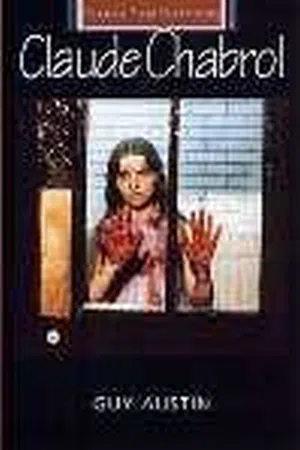
- 197 pages
- English
- ePUB (mobile friendly)
- Available on iOS & Android
eBook - ePub
Claude Chabrol
About this book
This is the first book-length study in English on Chabrol since 1970. Chabrol has always been a neglected figure in the French New Wave but has recently been declared 'possibly the greatest living film director in France'.. Coincides with the recent renewal of interest in Chabrol, which has seen his back catalogue released in the UK on video.. Celebration of Chabrol's fiftieth film recently, Rien ne va plus prompted many festivals and retrospectives. Publication coincides with Chabrol's new film which is discussed in this study.. Writtten by one of the liveliest critics in French cinema - author of Contemporary French Cinema.
Information
Subtopic
Film & Video1
Chabrol and friends
In the autumn of 1997, at the age of 67, Claude Chabrol released Rien ne va plus, his fiftieth film. The leading French film magazine, Cahiers du cinéma, marked the occasion with a special issue devoted entirely to his work. The editorial described him as ‘le cinéaste français le plus productif, et peut-être le plus “rentable”, des quatre dernières décennies’1 (Toubiana 1997:4). (His achievement is all the more remarkable when one notes that in recent years several previously successful French film directors have been more or less obliged to abandon the cinema, including Léos Carax, Jean-Jacques Beineix and Bertrand Blier.) Chabrol’s forty-year career is in some ways a history of recent French cinema and society: neorealism, the new wave, the trauma of the Algerian War, the political legacy of 1968, the rise of the consumer society and the ‘pompidolien’ bourgeoisie,2 the perennial popularity of the thriller, the tension between television and cinema, the decline of Marxism. Chabrol has known periods of great success (the launching of the new wave in 1958, the superb Hélène cycle of the late 1960s – including his most famous film Le Boucher – his return to form in the 1990s), and also periods of inactivity and failure (a year in the early 1960s without shooting a single scene, a general loss of direction in the late 1970s). Twice he has relaunched his career, with the comeback films Les Biches in 1967 and Poulet au vinaigre in 1985. Through it all, Chabrol has seen his artistic reputation questioned because of the sheer volume and perceived inconsistency of his output.
Until recently, Chabrol suffered from a paradoxical reputation as simultaneously lazy and prolific: lazy in his uncritical acceptance of any project that came along, prolific in the number of such projects that made it to the screen. His own belief was that ‘la première qualité d’un musicien, c’est de composer, d’un écrivain, d’écrire, d’un peintre de peindre, d’un cinéaste de filmer’3 (Chabrol 1976: 353). But his willingness to accept commissions and to be a director for hire flew in the face of the new wave conception of the film director as an auteur, a sacred, isolated artistic figure. In contrast with this Romantic conception of cinema as art rather than commerce, and as solitary rather than collective, Chabrol has always acknowledged and enjoyed the fact that cinema is most often a collective, commercial enterprise. This has implications for his filming methods and his choice of popular genres, as we shall see. However, it has also resulted in neglect or condescension from the critics. For twenty years, between 1962 and 1982, Cahiers du cinéma (for which he himself once wrote in the 1950s) did not interview Chabrol once. In 1976 he could say without fear of contradiction that ‘je suis plus respecté hors de nos frontières qu’en France’4 (Chabrol 1976: 231). Five years later, Cahiers was still ranking him in French cinema’s second division.5 But the last ten years or so have seen a gradual reassessment of his work. On the release of La Cérémonie in 1995, Cahiers asked if Chabrol was not in fact le plus grand cinéaste français’.6 Two years later, with the publication of the Cahiers special issue, Chabrol’s belated critical rehabilitation was complete. (Their previous neglect of Chabrol is further illustrated by the fact that Cahiers had long since devoted special issues not just to his contemporaries such as Godard and Duras but also to the newcomer Leos Carax and, ironically, to one of Chabrol’s favourite actresses, Isabelle Huppert. Most tellingly, Carax merited a special issue for his third film – Chabrol only for his fiftieth!)
Chabrol’s films break down the dubious critical barrier between art cinema and popular cinema. Commercial as well as artistic considerations are crucial to his film-making, and he remains disdainful of those directors (like Godard) whose films are elitist rather than populist. Chabrol sees no shame in considering himself a craftsman and takes pride in bringing his films in on or under budget. For L’Œil du malin in 1961, he even agreed to shoot the film at half the originally agreed cost. His pragmatic and practical approach to cinema dates from the early 1960s, when a series of box-office disasters (including, ironically, L’Œil du malin) left him unable to find financial support for any more personal projects. In order to keep filming, he decided to accept various comedy-thrillers and spy movies considered (by his colleagues in the new wave) artistically beneath him. In the terms of the politique des auteurs, he had become a metteur en scène rather than a cinéaste.7 But it was this commercial and auto-didactic period which made Chabrol. It allowed him to hone his technical skills and to come to terms with popular genres, thus paving the way for his mature style of the late 1960s and 1970s. Since that period, he has been happy to take on projects suggested by others as well as those he has long nurtured himself. He has also shot films – such as Le Cri du hibou in 1987 – against the advice of his regular producer (in this case, Marin Karmitz, who refused to be involved in the project). For Chabrol, cinema has to be learned by filming (not by writing about it, hence his dismissal of film criticism, including his own for Cahiers in the 1950s). And one must never be afraid to get one’s hands dirty on a supposedly inferior or unworthy project: ‘il ne faut pas avoir peur de tremper les mains dans la merde s’il Ie faut pour tirer des choses’8 (Biette et al. 1982: 6). The result is a filmography which contains turkeys (Folies bourgeoises, Quiet Days in Clichy) as well as masterpieces (the Hélène cycle, Betty, La Cérémonie), but which is finally being recognised as a landmark in French cinema.
Typically, Chabrol’s autobiography is published not in an auteurist cinema collection but in the series ‘Un homme et son métier’.9 For him, directing is a job which can be demystified from the auteurist/Romantic idea of it. His concept of cinema privileges the spectator as well as the creator – hence the importance of genre in his work, since it is often via the expectations aroused by popular genres that a spectator approaches a given film. Rejecting the avant-garde and the experimental, Chabrol chooses (even when he doesn’t have to, financially speaking) to work within the confines of established genres. In 1979 he declared that ‘I’ve always tried to hold on to the cinema of genre because I think it’s the only way to make films. These days in France, but not only there, one veers mostly towards an overly intellectual vision of things, and I think the only solution is to make some good policiers, some good soap-operas and comedies’ (Yakir 1979: 2). Chabrol has in fact filmed farce (Folies bourgeoises), melodrama (La Rupture), fantasy (Alice ou la dernière fugue), war films (La Ligne de démarcation, Une affaire de femmes), spy films (the Tigre series and La Route de Corinthe) and glossy literary adaptations (Quiet Days in Clichy, Madame Bovary). But the crime thriller is his usual choice of genre, because it allows him to engage the spectator via the plot, and then explore the complexities of character, morality, society and politics within an accessible and satisfying framework. Or as he puts it, ‘c’est le genre qui emmerde le moins le public’10 (Sorg 1998: 35). He has often been described as specialising in the psychological thriller, but this is slightly misleading. Although he is greatly interested in character and situation, Chabrol does not concern himself with psychology as an area of knowledge. Human motivations remain obscure rather than transparent. Actions (particularly crimes) and their consequences are shown in uncompromising – and often blackly comic – detail, but no comforting explanations are given. As Chabrol says, ‘mon grand plaisir, c’est de révéler l’opacité’11 (Guérin and Jousse 1995: 30). This is particularly true of his female characters. How much do we learn about the enigmatic and ultimately disembodied12 female protagonists of films such as Le Boucher, Les Innocents aux mains sales, Violette Nozière, Betty and La Cérémonie? Even the male characters – whose psychology is often less obscure – tend to maintain an ambivalence which thwarts simple definitions of good and evil. From Le Beau Serge and Les Cousins, via Que la bête meure and Le Boucher, to Masques and Le Cri du hibou, they are simultaneously victims and perpetrators. Moral relativism is the recurrent theme of Chabrol’s work: ‘my “great testament,” my “definitive message” is ... Don’t judge!’ (Yakir 1979: 5).
Although there is a personal (moral) imperative underlying Chabrol’s films, their means of production is collective. This is of course true of almost all films, but with Chabrol there is great emphasis on the contribution of the film crew. From his very first films, Chabrol built up a trusted team which has continued to work with him more or less throughout his career. The heart of the crew has been as follows: Jean Rabier (cinematography), Guy Chichignoud (sound), Pierre Jansen (music), Jacques Gaillard/Monique Fardoulis (editing). There have also been favourite actors at various periods of Chabrol’s career, including Jean-Claude Brialy, Michel Bouquet, Jean Yanne, Stéphane Audran and Isabelle Huppert. Audran and Huppert have been especially important, incarnating the enigmatic and ultimately unknowable heroines of some of Chabrol’s most famous work. Audran was Chabrol’s second wife, and has appeared in over twenty of his films, from Les Cousins in 1958 to Betty in 1992. Above all, she starred in the Hélène cycle of 1968–71, in which she embodied the bourgeoisie of the period and facilitated Chabrol’s ambivalent attitude towards it: ‘Elle en représente une idéalisation ... L’idée était que les films devenaient doubles: à la fois une satire de la bourgeoisie et un aboutissement, une sorte de modàle’13 (Jousse and Toubiana 1997: 8). In 1978, Isabelle Huppert took the lead in Violette Nozière while Audran played her mother. The torch was in a sense being passed from one to the other, with Huppert going on to work regularly with Chabrol over the next two decades.
Always a metaphorical family, Chabrol’s film crew has recently become something of a literal family too. His third wife Aurore is still the ‘script-girl’ (as she has been since the 1970s) and his stepdaughter Cécile Maistre is now the first assistant. One of his sons, Matthieu, composes the score (replacing Pierre Jansen in 1982), while another, Thomas, has appeared in Une affaire de femmes, Madame Bovary, Betty and L’Enfer. Chabrol has always been renowned for his good humour on the set, and for the affection generated within his film crews, actors included: ‘La création se fait mieux dans la joie. Pourquoi ne pas vivre en bons compagnons, être doux les uns avec les autres, de temps en temps faire la fête, en tout cas se marrer le plus souvent possible, bien bouffer?’14 (Chabrol 1976:186). It may well be that the relaxed atmosphere of his shoots and his well-known love of good food and drink added to his long-standing reputation as a casual film-maker. It is certainly true that he filmed Ten Days’ Wonder in Alsace solely in order to enjoy the local cuisine, and that he was drunk for most of the shoot on La Ligne de démarcation. But his attitude remains unchanged. As he recently told Télérama on the set of his fifty-first film, Au cœur du mensonge, ‘On ne sait jamais si un film sera réussi ni s’il aura du succes.... Par contre, on peut toujours réussir le tournage, et en faire un succes’15 (Sorg 1998: 35).
Although Chabrol wrote some of his most famous films alone (including La Femme infidèle and Le Boucher), he collaborated with his friend Paul Gégauff on many screenplays over the first twenty years of his career. Perhaps the most productive influence within Chabrol’s cr...
Table of contents
- Cover
- Half Title Page
- Title Page
- Copyright Page
- Contents
- LIST OF PLATES
- SERIES EDITORS’ FOREWORD
- ACKNOWLEDGEMENTS
- 1 Chabrol and friends
- 2 The new wave
- 3 The Hélène cycle
- 4 Family plots
- 5 The power of the gaze
- 6 Stories of women
- 7 Master of Cérémonie
- Afterword
- FILMOGRAPHY
- SELECT BIBLIOGRAPHY
- INDEX
Trusted by 375,005 students
Access to over 1.5 million titles for a fair monthly price.
Study more efficiently using our study tools.
Frequently asked questions
Yes, you can cancel anytime from the Subscription tab in your account settings on the Perlego website. Your subscription will stay active until the end of your current billing period. Learn how to cancel your subscription
No, books cannot be downloaded as external files, such as PDFs, for use outside of Perlego. However, you can download books within the Perlego app for offline reading on mobile or tablet. Learn how to download books offline
Perlego offers two plans: Essential and Complete
- Essential is ideal for learners and professionals who enjoy exploring a wide range of subjects. Access the Essential Library with 800,000+ trusted titles and best-sellers across business, personal growth, and the humanities. Includes unlimited reading time and Standard Read Aloud voice.
- Complete: Perfect for advanced learners and researchers needing full, unrestricted access. Unlock 1.5M+ books across hundreds of subjects, including academic and specialized titles. The Complete Plan also includes advanced features like Premium Read Aloud and Research Assistant.
We are an online textbook subscription service, where you can get access to an entire online library for less than the price of a single book per month. With over 1.5 million books across 990+ topics, we’ve got you covered! Learn about our mission
Look out for the read-aloud symbol on your next book to see if you can listen to it. The read-aloud tool reads text aloud for you, highlighting the text as it is being read. You can pause it, speed it up and slow it down. Learn more about Read Aloud
Yes! You can use the Perlego app on both iOS and Android devices to read anytime, anywhere — even offline. Perfect for commutes or when you’re on the go.
Please note we cannot support devices running on iOS 13 and Android 7 or earlier. Learn more about using the app
Please note we cannot support devices running on iOS 13 and Android 7 or earlier. Learn more about using the app
Yes, you can access Claude Chabrol by Guy Austin, Diana Holmes, Robert Ingram, Diana Holmes,Robert Ingram in PDF and/or ePUB format, as well as other popular books in Media & Performing Arts & Film & Video. We have over 1.5 million books available in our catalogue for you to explore.