eBook - ePub
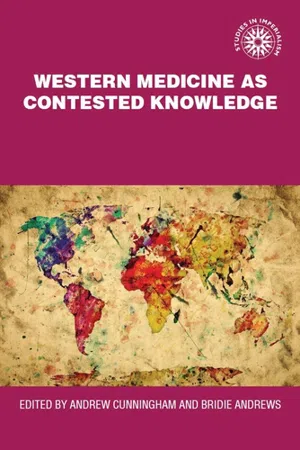
Western medicine as contested knowledge
- 294 pages
- English
- ePUB (mobile friendly)
- Available on iOS & Android
eBook - ePub
Western medicine as contested knowledge
About this book
Medicine has always been a significant tool of an empire. This book focuses on the issue of the contestation of knowledge, and examines the non-Western responses to Western medicine. The decolonised states wanted Western medicine to be established with Western money, which was resisted by the WHO. The attribution of an African origin to AIDS is related to how Western scientists view the disease as epidemic and sexually threatening. Veterinary science, when applied to domestic stock, opens up fresh areas of conflict which can profoundly influence human health. Pastoral herd management was the enemy of land enclosure and efficient land use in the eyes of the colonisers. While the native Indians of the United States were marginal participants in the delivery or shaping of health care, the Navajo passively resisted Western medicine by never giving up their own religion-medicine. The book discusses the involvement of the Rockefeller Foundation in eradicating the yellow fever in Brazil and hookworm in Mexico. The imposition of Western medicine in British India picked up with plague outbreaks and enforced vaccination. The plurality of Indian medicine is addressed with respect to the non-literate folk medicine of Rajasthan in north-west India. The Japanese have been resistant to the adoption of the transplant practices of modern scientific medicine. Rumours about the way the British were dealing with plague in Hong Kong and Cape Town are discussed. Thailand had accepted Western medicine but suffered the effects of severe drug resistance to the WHO treatment of choice in malaria.
Information
Topic
MedicineSubtopic
World HistoryI. WHO and uncontested Western medical paternalism
Today it seems obvious that the health of the people is subject to political and ideological contests. Yet, throughout the first thirty years of the World Health Organization, Western or Westernised medical doctors controlled its knowledge and practices, and the nature of ‘world health’ went uncontested. In 1948, during the first meeting of the World Health Organization’s World Health Assembly, the delegate from India remarked that ‘India has great hopes that the beneficent activities of this organization will spread throughout the countries of the world and especially to those unfortunate areas where the existing low standards of health are crying out for immediate assistance.’1 That statement, loaded as it was with implicit acceptance of Western medicine’s methods and standards of health care, was typical of the thinking of WHO delegates. No challenge to this ideology and WHO’s corresponding practices arose until the 1970s, when WHO accepted the membership of China. The Chinese presented WHO with an astonishing example of successful, low-technology health care by ‘barefoot doctors’. It was a programme born of China’s socialist revolution. By 1978, as the Chinese challenge was absorbed, the Director General of WHO proclaimed, ‘Gone are the days of donor-recipient relationships between WHO and its Member States; an era of real partnership has replaced them.’2
Throughout the first thirty years of its existence, the essence of WHO’s programme had gone unquestioned. The conflicts were only over matters of degree and not substance, as WHO members haggled over how much aid must be delivered from the rich countries to the poor. The ideology of diffusion – of knowledge, practices, professional medicine generally – which lay at the heart of WHO’s policies was a seeming boon for the developing world. It was China’s entry into WHO in 1973 that forced WHO to re-evaluate its aims. China contested the ideology of WHO’s programmes, and helped steer it on to a course which would eventually include the promotion of ‘traditional medical practices,’ a de-emphasis on Western-style professional medicine, and attacks on corporate pharmaceutical interests.
The event which symbolised the eventual contest for the heart of WHO was the 1978 Declaration of Alma Ata, in which WHO affirmed that ‘the existing gross inequality in the health status of the people, particularly between developed and developing countries as well as within countries, is politically, socially and economically unacceptable’. WHO declared that ‘Governments have a responsibility for the health of their people.’ And, as the overarching goal, Primary Health Care was to be the ‘key to attaining [Health for All by the year 2000] as part of development in the spirit of social justice’.3
What was the route to WHO’s new ideology? It was China that showed WHO a different model of health care, but it was the Soviets who spurred the contest that led WHO to Alma Ata. The purpose of this chapter is to trace the international political and professional agendas which have shaped WHO ideology regarding the developing world, from its foundation to the late 1970s.
Postcolonial paternalism and the origins of WHO
WHO was created in 1948 as an arm of the United Nations. The WHO constitution provided for the creation of three major organs: an Assembly of delegates from each member nation, the Executive Board, and the Secretariat, the latter under the head of a Secretary General. The Assembly acts as the supreme policy-making body; it sets policy, approves the budget, and instructs the Executive Board and the Director General. The Executive Board is charged with carrying out the decisions of the World Health Assembly,· it also takes the initiative in proposing policies for approval by the Assembly, and in practice has considerable power. The Director General, nominated by the board and appointed by the Assembly, is the chief technical and administrative officer of WHO. He or she has numerous responsibilities and, although formally subject to the authority of the board, can exert considerable power in the selection of priorities and controversies.
WHO is an intergovernmental organisation with no supra-governmental authority. It cannot execute policies which override the will of its member governments. In that sense, all the historical, political and economic relationships among nations can play and have played themselves out in this arena. However – and this was true especially in the early years – WHO has been composed chiefly of medical professionals. As such they have tended to see problems and solutions in medical terms. WHO’s pronouncements have thus had the weight, and indeed the baggage, of shared professional opinion. In general, then, the forces shaping WHO policy have tended to be of two kinds: the politics of nation states and the interests of professional medicine.
To understand the larger-scale political forces driving WHO’s early policies, we must begin with decolonisation. It was in the shadow of retreating empires that WHO both identified its problems and offered its solutions. After World War Two the young leaders of the newly independent states found themselves with the enormous task of governance in the place of Europeans who had largely dictated their lives. Western techniques and ideologies – including those of medical science – had been adopted nearly wholesale in the colonies by their elites, and in large measure they assumed that their future path was to be one of development towards Western-style society. The indigenous way of life, having failed to withstand the overwhelming force of colonisation by Europe, was regarded as backward. There was no contest, no serious questioning of what the leaders of the former colonies wished to attain – wealth comparable to that of the developed world. Rather, disputes lay in questions of how, or from whom, that wealth was to be gotten.
The ideology and activities of WHO reflected the paternalistic assumptions of the days of empire, from its inception until the early 1970s. WHO saw itself alternately waging a war on disease and dispensing the know-how to lead the ex-colonial peoples on a road to Western-style society. The elites of the former colonies were fully reconciled to that mission. The modes of assistance were often hotly debated, but always within the paradigm of Western medicine. That is, the Western powers were adamant about restricting their aid to technical assistance; WHO should not become a supplier of medical equipment. From the former colonies, however, came a demand for as much assistance as possible – whether as supplies or funds. Thus, from the point of view of the ex-colonial people, WHO was an instrument through which they could exact aid from, and air grievances against, their former masters. Nursing a guilty conscience, the European powers tended to be in tacit agreement with that view. Thus there was an abiding tension within WHO between the rich and poor nations, and resentment of the former colonisers was obvious in the language of formerly colonial WHO delegates. The early leader of the former colonies, in WHO as in the world, was India. In the World Health Assembly the delegates from South Asia were keen to claim as much as possible from the Western-led organisation. The delegate from India pronounced in 1949 that ‘there is only one royal road, and that is active field work ... the salvation of the backward countries lies in active work in their spheres’.4 The delegate from Pakistan implored that ‘special care should be bestowed on countries which lack the resources possessed by the more advanced and prosperous countries of Europe and America’.5
Aid must be unilateral and unconditional. The Indian delegate complained that ‘I must confess that we are very disturbed about the proposal that medical supplies should be paid for by governments.’6 The delegate from Ceylon: ‘ I stress it again ... We need medical supplies in all our countries, facilities for the obtaining of which we expect from an international organization like the WHO.’7 The words of his successor two years later were even stronger:
South East Asia is not receiving as much aid as it ought ... the European nations of the world owe to the South East Asian nations a duty that they shall undertake to raise the living conditions and the health conditions of the people [of] those areas, whom they have exploited for over 200 years.8
The new states of the Middle East followed suit. The Lebanese delegate argued that ‘We need assistance on a larger scale ... Could we not suggest an international aid plan ...?’9 Perhaps the bluntest demands of all came from the delegate representing Jordan:
If the WHO adheres strictly to the approved principles governing the granting of its financial help to the backward and under-developed countries, it should immediately provide the necessary funds for starting work on these projects totally at its own expense. It may commence with one project at a time, and after its completion start with the next, and so on until the projects are completed to the entire satisfaction of my country and WHO.10
The delegate warned that his country would withdraw from WHO if the demand was not met, and the ‘moral effect’ of the withdrawal would be ‘great’.
The demands of the ex-colonial lands were heard and were not denied. In his annual report for 1951 the Director General, Brock Chisholm wrote that the ‘richly endowed’ countries had a ‘duty’ to help the world’s poor.11 However, Western delegates were highly wary of massive material assistance, which the UK delegate likened to the dole, adding that ‘some of us feel considerable anxiety as to whether we may not be casting our net too widely’.12
A paternalistic relationship was thus deeply embedded within the assumptions of WHO members, rich and poor alike. It was never questioned in those early years that WHO’s assistance would be based on the superiority and universal applicability of Western medical science. That outlook was perhaps as well stated in WHO’s official history as anywhere:
If new ideas or methods could be effectively introduced merely by training one or two receptive individuals in a country the problem would be relatively simple; but established tradition and inertia often bar the way of progress. It therefore becomes necessary to influence deep-rooted attitudes which is more difficult than imparting knowledge or skills.13
In its First Report on the World Health Situation WHO maintained that:
The struggle against disease, ignorance and poverty has been retarded by the persistence of superstitious beliefs and practices ... the path from magic to medicine has often been slow and difficult ... Adjustment to the machine age is a long process of social education.14
To c...
Table of contents
- Cover
- Front Matter
- Title Page
- Copyright Page
- Contents
- General introduction
- The contributors
- Acknowledgements
- Introduction: Western medicine as contested knowledge
- 1 WHO and the developing world: the contest for ideology
- 2 AIDS from Africa: Western science or racist mythology?
- 3 Elders and experts: contesting veterinary knowledge in a pastoral community
- 4 Dances with doctors: Navajo encounters with the Indian Health Service
- 5 What/who should be controlled? Opposition to yellow fever campaigns in Brazil, 1900–39
- 6 The hook of hookworm: public health and the politics of eradication in Mexico
- 7 Unequal contenders, uneven ground: medical encounters in British India, 1820–1920
- 8 Plural traditions? Folk therapeutics and ‘English’ medicine in Rajasthan
- 9 The reduction of personhood to brain and rationality? Japanese contestation of medical high technology
- 10 Rumoured power: Hong Kong, 1894 and Cape Town, 1901
- 11 Drug-resistant malaria: a global problem and the Thai response
- Guide to further reading
- Index
Trusted by 375,005 students
Access to over 1.5 million titles for a fair monthly price.
Study more efficiently using our study tools.
Frequently asked questions
Yes, you can cancel anytime from the Subscription tab in your account settings on the Perlego website. Your subscription will stay active until the end of your current billing period. Learn how to cancel your subscription
No, books cannot be downloaded as external files, such as PDFs, for use outside of Perlego. However, you can download books within the Perlego app for offline reading on mobile or tablet. Learn how to download books offline
Perlego offers two plans: Essential and Complete
- Essential is ideal for learners and professionals who enjoy exploring a wide range of subjects. Access the Essential Library with 800,000+ trusted titles and best-sellers across business, personal growth, and the humanities. Includes unlimited reading time and Standard Read Aloud voice.
- Complete: Perfect for advanced learners and researchers needing full, unrestricted access. Unlock 1.5M+ books across hundreds of subjects, including academic and specialized titles. The Complete Plan also includes advanced features like Premium Read Aloud and Research Assistant.
We are an online textbook subscription service, where you can get access to an entire online library for less than the price of a single book per month. With over 1.5 million books across 990+ topics, we’ve got you covered! Learn about our mission
Look out for the read-aloud symbol on your next book to see if you can listen to it. The read-aloud tool reads text aloud for you, highlighting the text as it is being read. You can pause it, speed it up and slow it down. Learn more about Read Aloud
Yes! You can use the Perlego app on both iOS and Android devices to read anytime, anywhere — even offline. Perfect for commutes or when you’re on the go.
Please note we cannot support devices running on iOS 13 and Android 7 or earlier. Learn more about using the app
Please note we cannot support devices running on iOS 13 and Android 7 or earlier. Learn more about using the app
Yes, you can access Western medicine as contested knowledge by Andrew Cunningham,Bridie Andrews, Andrew Cunningham, Bridie Andrews in PDF and/or ePUB format, as well as other popular books in Medicine & World History. We have over 1.5 million books available in our catalogue for you to explore.