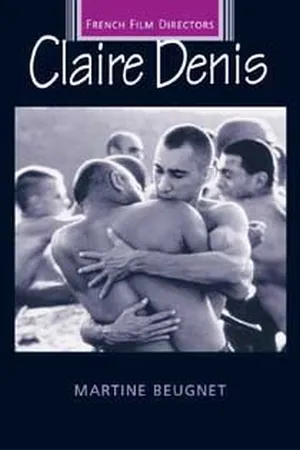
Claire Denis is one of France's most acclaimed and original filmmakers. Since her remarkable debut success with 'Chocolat' (1986), she has produced an impressive series of features which have been intriguing, visually striking, and often highly controversial (including 'Beau Travail' (2000) and 'Trouble Every Day' (2001)).
Beugnet provides a thematic and stylistic framework within which to consider Denis' work, as well as a comprehensive analysis of individual films. She highlights the resonance of Denis' films in relation to ongoing debates about French national identity and culture, and issues of postcolonial identity, alienation and transgression, as well as examining their exploration of the interface between sexuality, desire and sensuality. This is an essential introduction to Denis, and a sophisticated and illuminating study of her work to date.
- 211 pages
- English
- ePUB (mobile friendly)
- Available on iOS & Android
eBook - ePub
Claire Denis
About this book
Information
1
Foreignness and the aesthetics of the unsaid
Cinema, stories and histories
One crucial source to Denis’ initial approach to cinema is a seminal convergence of History and personal history. Explicitly present in her first feature, Chocolat, the director’s early experiences made her sensitive to certain issues and spurred her interest in themes that she continued to explore in subsequent films: oppression and misappropriation, exile and racism, alienation and transgression. Thus, from an early encounter with ‘an established order that, already in my childhood, appeared unfair’ (Lifshitz 1995),1 grew a questioning of the ethics of belonging and appropriation:
En France, je ne me sens pas du tout chez moi. Peut-être parce que je n’ai pas grandi en France. Mais en Afrique, je me sentais étrangère parce qu’on comprend assez bien, quand on est un petit enfant blanc, qu’on est pas de cette terre-là.2 (Denorme and Douin 2001: 21)
Je trouvai moral – je ne peux pas dire autrement – d’expliquer ma place par rapport à l’Afrique, ma place symbolique.3 (Lifshitz 1995)
Claire Denis was born in 1948, the daughter of an administrator of the French colonial services. She spent her childhood in West Africa with her parents and her younger sister, moving country wherever her father’s post required the family to settle. She thus lived on colonial soil during the last ten years of the French rule, as the movements of independence gathered momentum. This feeling of the end of an era is clearly present in Chocolat, voiced in particular by one of the characters, the French administrator of the settlement, who readily admits that the colonial presence is merely continuing on borrowed time. Denis grew up a foreigner, and a representative, albeit, as a young girl, a marginal one, of an oppressive colonial power. Yet, her ‘coming back’ to France, at 14, was a return to a country where she belonged by nationality, but which she did not know at all. She settled with her mother and sister in one of Paris’s newly built suburbs, similar to the ones depicted in US Go Home: an unfinished zone where the expanding urban space met the remains of a vanishing countryside. The director often stressed in her interviews how these early experiences made her consciously and unconsciously receptive to certain debates – to the social and cultural conflicts that destabilise conventional notions of belonging and national identity, the traditional beliefs in progress and in universal common good: ‘J’ai eu envié de parler de la fin de la colonisation. Parce que c’est quelque-chose que ‘J’ai connu, où les choses se delete (sic) un petit peu, où les certitudes s’en vont’ (Lifshitz 1995).4
Denis’ films stand out from the main trends of contemporary French cinema where the treatment of similar issues has tended to be either heavily didactic, or, more frequently, adapted and rendered more palatable through the deforming lens of nostalgia. Indeed, a constant reference to the historical background appears necessary not only to comprehend the complex, often indirect way in which the director’s films, even when set in contemporary times, relate to a past that is inextricably enmeshed with the present, but also to place her work in the context of the French film production as a whole.
The period and circumstances of Denis’ childhood are linked to a series of events that not only precipitated a massive political change, but also actualised a profound shift in the fundaments of Western systems of thought. The advent of the wars of independence and decolonisation undermined the very basis of the universalist ideal of historical progression of which modern France in particular had been a champion. By the same token, it also brought into question the whole structure of binary oppositions on which much of Western identity had been constructed.
In France, ‘crisis’ seems to be the most popular term used to describe this predicament, although malaise must run it a close second ... Pluralism challenges uniformity, relativism challenges truth, hierarchies have been flattened, assimilation has broken down, the margins are at the centre, a sense of history has given way to an undifferentiated present. Faith in the future and progress has dissolved into a multitude of anxieties about self and the world. (Silverman 1999:4–5)
The disappearance of the colonial empires, and the realisation, albeit partial, of what had been involved in the process of colonisation, contributed to further the demise of the traditional ‘grand narratives’5 of human progress. The concept of historical progression had arguably already been rendered obsolete by the revelation of the horror of the Holocaust (how could this unspeakable event be compatible with the concept of a progression of humanity in time?). The decolonisation process further questioned the status of a Western culture that had so far posited itself as the superior model, and made itself the source and the centre of a universal ‘civilising’ project. The former colonies did not simply reject this model, but fought for their political independence and for the affirmation of their own identities.
Historically, the occidental world has tended to define itself and to legitimise its supremacy and aggressive imperialism through a discourse6 of difference primarily based on binary oppositions: Christian versus heathen, male versus female, black versus white, poor versus rich, etc. The colonies had become a crucial part of this process. The very project of imperial conquest rested on the concept of a superior model that should be exported and duplicated, and like other colonial powers, France cast itself as the civilised norm. At the same time, the ‘differences’ between métropole7 and colonies were exploited and exacerbated, and helped to reinforce the feelings of national (and racial) unity and superiority. In its portrayal of the perverse, lingering effects of the colonial ethos on the psyche of the colonisers and of the colonized, Denis’ work, like much of the output originated in the postcolonial debate, is indebted to the writings of the psychoanalyst Frantz Fanon. Fanon was one of the first to investigate in any depth the impact of the internalising process of inferiority that widely affected those who lived in former colonies or had come from these territories to establish themselves in France. Importantly, the psychoanalyst also underlined the likely persistence of this process on the oppressed as well as on the oppressing nations long after the decolonisation.
Cinema contributed greatly to the elaboration of a fantasised empire. During the colonial era, a flurry of films exalted feelings of adventure and exoticism and played a crucial role in the development of a fascination for faraway lands and the foreign Other and their transformation into spectacles (Ezra 2000). Cinema’s ability to construct an apparently ‘authentic’ vision of reality, and its essentially visual quality, turned it into a privileged vector for a discourse of difference. As former colonies regained their independence, often through a bloody process of armed struggle and civil war, the French national identity was forced to redefine itself in completely new terms. Yet, and this partly underpins the significance of the kind of work produced by Denis and a handful of other directors, the coming to terms with decolonisation, the process of ‘mourning’ and of potential reconciliation which should have accompanied the elaboration of a new sense of identity in the former colonies and métropole, was obstructed by denial and censorship. Unsurprisingly, taken the impact of film on mass audiences and its past link with the colonising project, this collective forgetting or blindness (at first, a deliberate, then an internalised process of denial) particularly affected cinema. The few directors who chose to address the issue did so in an indirect fashion, or were mercilessly censored.8 ‘Colonial wars were doomed topics (sujets maudits). French people did not want to be confronted with their past, and amnesia dominated French screens and French history generally until the 1970s.’ (Sherzer 1996: 7). Indeed, even in the face of the contemporary conflicts inherited from it, large parts of the history of the colonisation and of the de-colonisation still remain overlooked, and have almost never been evoked on screen.
After this period of virtual invisibility, the colonial theme came back into fashion in the 1970s with the detailed historical reconstitutions of the rétro trend, and became one of the topics treated by the large-budget productions of heritage cinema (Austin 1996: 28–42). As part of the rétro or heritage genre, a number of films attempted to portray the colonial past with a degree of criticism: ‘With regard to representation of the natives in the films of the 1980s and 1990s, in comparison with those of the 1930s, the casting has changed. It is no longer conceivable to have an Arab or an African played by a white actor. Nor is it any longer acceptable to have non-white characters playing roles of inept, ridiculous or childish individuals’ (Sherzer 1996: 9). But even then, the nostalgia of the former imperial grandeur tends to overshadow potential feelings of collective guilt, and if some of the exploitative aspects of the colonial rule are depicted, greater attention is often granted to the suffering of the defeated colonials (Austin 1996:151). The dominant approach was to continue to exploit the former colonies’ potential as exotic backdrop for the adventures and conflicts of primarily white heroes, thus operating the kind of symbolic reappropriation of the lost territories that Denis sternly refutes:
Quand j’étais jeune et que je lisais La Ferme africaine de Karen Blixen, je m’étouffais de rage. Cette nostalgie pour la terre, cette terre, cette culture, cette ferme... Ce sentiment d’amour était infâme, parce qu’ils ne lui appartenaient pas ... Si je Taime, je me Tapproprie, et je n’en ai pas le droit.9 (Lifshitz 1995)
The nostalgic mood and the renewed fashion for the exotic also signalled a distinctive change in the nature of contemporary discourses of exclusion within the former imperialist countries themselves. Whereas the principle of assimilation (to a Western model) that legitimised the colonial project was based on a seemingly ‘progressive’ idea of a universal good, the postcolonial discourse of discrimination is essentially ‘regressive’. Its driving principle is that of a return to a former state of affairs, before the emergence of multiethnic societies in the West, before a (fantasised)10 unified nation was challenged by the lasting presence of the Other on its soil. Many of Denis’ characters – Jocelyn and Dah in S’en fout la mort, Daïga and Théo in J’ai pas sommeil, for instance – encounter such forms of ‘New Racisms’ (Silverman 1999).
Latent discourses thus mutate but continue to inhabit our spoken and written languages, to influence our strategies of representation, and to inflect the grammar and aesthetics of our cinemas: the way things and people are filmed keep on shaping and informing the vision that is proposed to the spectator. In the 1970s, feminist film theory demonstrated its effect on the representation of gender. The techniques at play in the representation of race in film also came under scrutiny, with their insistence on difference and emphatic presentation of the racial Other as exotic spectacle. Elizabeth Ezra has underlined how cinema combined, very early on, entertainment and a seemingly ethnographic approach: in precisely plotted and composed scenes, the ‘colonial subject’ was, from the start, shown as an exotic ‘type’ (Ezra 2000). Such procedures persist in the cinema of the postcolonial era, combined with subtle strategies of opposition: one of the techniques of the heritage cinema of empire consists in using ‘native’ people as (‘colourful’) setting and backdrop against which the destiny of the (white) heroes unfolds. Such conventions, and the implicit discourse that they carry, are constantly in question in Claire Denis’ films, in her stylistic as well as thematic choices. As we will see, as a historical production, her first feature is in some aspects close to a heritage-type of cinema. Yet even Chocolat is usually set apart, associated with the different approach of a ‘Féminin colonial’ (see Chapter 2) that eschews factual and spectacular reconstructions to present an un-heroic past devoid of embellishments and justifications.
In none of Denis’ subsequent films are faraway locations and a historical mode combined. To paraphrase Lola Young, after Chocolat, Denis’ exploration of cross-racial and cross-cultural tensions leaves the depiction of a ‘then’ and ‘out there’ to concentrate mainly on the portrayal of a contemporary ‘over here’ (Young 1996: 21). The kind of nostalgic overtones that still inhabit the partly autobiographical world of Chocolat reappear in Beau travail, but subsumed by a profound sense of malaise and doubt. In this, her directing trajectory appears to parallel the emergence of an alternative vision first imposed by a beur cinema (beur means Arab in retro slang) and of a ‘cinéma black’, and also reflected in much of the new realism of the 1990s. While the countries that were former colonies continued to produce their own cinema and to propose new cinematic representations of their colonial past, in the 1980s, a number of directors had begun to depict life in a multiethnic France. Black and heur cinemas focused in particular on the ‘second generation’ (young French people born in France of parents who were originally immigrants) growing up in one of the cités, the housing estates established in the 1960s and 1970s in the suburbs of large cities. The cinéma de banlieue (literally, the ‘cinema of the suburbs’, a denomination that includes much of beur and black cinema) tends to depict life amongst largely disenfranchised communities, charting the effect of a fracture sociale (the widening economic and ‘social gap’ that splits French society into classes) partly inherited from the country’s colonial past and initiated in the aftermath of decolonisation. In the 1990s, French cinema seemed to continue its mutation with a renewed focus on social issues: a new realist trend was putting on screen stories of ordinary people and their daily problems shot in unexceptional locations. Denis’ main thematic concerns seem related to these trends, yet the similarities are limited. Denis’ films do not yield to the expository ambitions and didactic messages that have characterised a large part of the cinéma de banlieue for instance. Even though many of her central characters are immigrants or belong to ethnic minorities, they rarely resemble the staple, well-defined characters created by the typical films of the cinéma de banlieue. Most strikingly, it is the comb...
Table of contents
- Cover
- Half Title Page
- Title Page
- Copyright Page
- Contents
- LIST OF PLATES
- SERIES EDITORS’ FOREWORD
- ACKNOWLEDGEMENTS
- Introduction
- 1 Foreignness and the aesthetics of the unsaid
- 2 Screening exile
- 3 The mise en scène of desire: towards a cinema of the senses
- Conclusion
- FILMOGRAPHY
- SELECT BIBLIOGRAPHY
- INDEX
Trusted by 375,005 students
Access to over 1.5 million titles for a fair monthly price.
Study more efficiently using our study tools.
Frequently asked questions
Yes, you can cancel anytime from the Subscription tab in your account settings on the Perlego website. Your subscription will stay active until the end of your current billing period. Learn how to cancel your subscription
No, books cannot be downloaded as external files, such as PDFs, for use outside of Perlego. However, you can download books within the Perlego app for offline reading on mobile or tablet. Learn how to download books offline
We are an online textbook subscription service, where you can get access to an entire online library for less than the price of a single book per month. With over 1.5 million books across 990+ topics, we’ve got you covered! Learn about our mission
Look out for the read-aloud symbol on your next book to see if you can listen to it. The read-aloud tool reads text aloud for you, highlighting the text as it is being read. You can pause it, speed it up and slow it down. Learn more about Read Aloud
Yes! You can use the Perlego app on both iOS and Android devices to read anytime, anywhere — even offline. Perfect for commutes or when you’re on the go.
Please note we cannot support devices running on iOS 13 and Android 7 or earlier. Learn more about using the app
Please note we cannot support devices running on iOS 13 and Android 7 or earlier. Learn more about using the app
Yes, you can access Claire Denis by Martine Beugnet, Diana Holmes, Robert Ingram, Diana Holmes,Robert Ingram in PDF and/or ePUB format, as well as other popular books in Mezzi di comunicazione e arti performative & Film e video. We have over 1.5 million books available in our catalogue for you to explore.