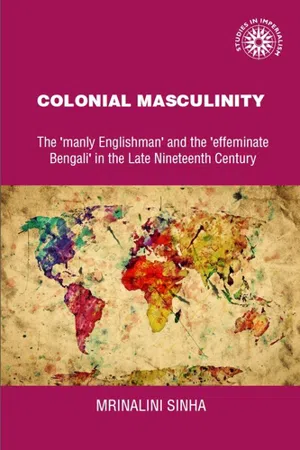
eBook - ePub
Colonial masculinity
The 'manly Englishman' and the 'effeminate Bengali' in the late nineteenth century
- 191 pages
- English
- ePUB (mobile friendly)
- Available on iOS & Android
eBook - ePub
Colonial masculinity
The 'manly Englishman' and the 'effeminate Bengali' in the late nineteenth century
About this book
This book is about the processes and practices through which two differently positioned elites, among the colonisers and the colonised, were constituted respectively as the 'manly Englishman' and the 'effeminate Bengali'. It argues that the emerging dynamics between colonial and nationalist politics in the 1880s and 1890s in India is best captured in the logic of colonial masculinity. The figures of the 'manly Englishman' and the 'effeminate Bengali' were thus constituted in relation to colonial Indian society as well as to some aspects of late nineteenth-century British society. These aspects of late nineteenth-century British society are the emergence of the 'New Woman', the 'remaking of the working class', the legacy of 'internal colonialism', and the anti-feminist backlash of the 1880s and 1890s. A sustained focus on the imperial constitution of colonial masculinity, therefore, serves also to refine the standard historical scholarship on nineteenth-century British masculinity. The book traces the impact of colonial masculinity in four specific controversies: the 'white mutiny' against the Ilbert Bill in 1883, the official government response to the Native Volunteer movement in 1885, the recommendations of the Public Service Commission of 1886, and the Indian opposition to the Age of Consent Bill in 1891. In this book, the author situates the analysis very specifically in the context of an imperial social formation. In doing so, the author examines colonial masculinity not only in the context of social forces within India, but also as framed by and framing political, economic, and ideological shifts in Britain.
Information
On 9 February 1883, the Law Member of the Government of India, C. P. Ilbert, introduced a bill in the Legislative Council to amend the Code of Criminal Procedure of the Indian Penal Code. The Bill, popularly called the Ilbert Bill, proposed to give various classes of native officials in the colonial administrative service limited criminal jurisdiction over European British subjects living in the mofussil, or country towns in India.1 The Ilbert Bill, which was widely interpreted as a challenge to the control European capitalists exercised over sources of raw material and labour in the interiors of India, provoked a ‘white mutiny’ from Anglo-Indian officials and non-officials alike.2 The opposition secured a victory when the Viceroy Lord Ripon was forced into an agreement or ‘concordat’ to get a modified bill passed on 25 January 1884, which undermined the original principle of the Ilbert Bill. Although the new Act accorded native magistrates criminal jurisdiction over European British subjects in the mofussils, the special legal status of European British subjects was preserved. The European British subjects in the mofussils won the right to demand trial by a jury of whom at least half were European British subjects or Americans.
As a crucial moment in the consolidation of a unified Anglo-Indian public opinion in India, the Ilbert Bill controversy has received its share of attention from scholars. Yet while scholars have examined the impact of the Ilbert Bill controversy on the racial polarisation between Anglo-Indians and Indians and on the development of an all-India nationalist sentiment, they have scarcely begun to explore the impact of its intersecting gender and racial ideologies on imperialist and nationalist politics in the second half of the nineteenth century.3 The stereotypes of the ‘manly Englishman’ and the ‘effeminate Bengali babu’ that structured the Ilbert Bill controversy emerged out of, and helped shape, important shifts in racial and gender ideologies that accompanied the political and economic transformations of the imperial social formation in the late nineteenth century. The politics of colonial masculinity in the Ilbert Bill controversy not only reflected the intersection of racial and gender ideologies, but also enabled those hierarchies to be reconfigured in new ways.
Contemporaries readily acknowledged the gender politics in the racial arguments against the Ilbert Bill. According to the Head of Police Intelligence in Bengal, the agitation against the Bill was instigated by the ‘capitalists’ in Bengal, but in order to ‘make the grievance a general one, they raised the cry of danger to European women and so the agitation spread.’4 Opponents of the Bill, moreover, expressed their disdain of native civil servants by likening them to ‘sweet girl graduates from Girton’.5 The gender politics of the Anglo-Indian agitation was no doubt underpinned by a patriarchal construct of womanhood. At the same time, however, the Ilbert Bill controversy also witnessed an impressive and unprecedented mobilisation of white women in India. The contribution of white women in India, the memsahibs as they were popularly called, provoked a mixed admiration from Anglo-Indian men: ‘one circumstance hitherto unexampled in Indian history . . . is that Englishwomen have for the first time thought it necessary to descend into the arena of political controversy’6 The Englishwoman’s Review, one of the leading women’s journals in Britain, was more unequivocal in its praise of the racist agitation against the Ilbert Bill for providing Englishwomen in India an opportunity to prove their ‘interest in politics.7
Such tensions around women’s roles were grist to the mill of an intensified politics of colonial masculinity. For it was precisely the unevenness in the intersection of racial and gender ideologies that gave the politics of colonial masculinity its particular significance in the Ilbert Bill controversy. On the one hand, the agitation against the Ilbert Bill recuperated the challenge of racial equality by rearticulating racial difference in the terms of a pre-given gender hierarchy. On the other, it recuperated the feminist challenge of gender equality by harnessing even a ‘New’ gender ideology to the agenda of racial hierarchy. Indeed, the impact of the Ilbert Bill controversy was not simply to consolidate traditional racial and gender hierarchies. Rather, the true significance of colonial masculinity in the Ilbert Bill controversy was precisely in rearticulating traditional racial and gender hierarchies to preserve imperial interests in a new guise.
At the first, and perhaps most obvious level, the stereotype of ‘effeminacy’ performed important ideological service in the Ilbert Bill controversy: it presented the racial privileges of the Anglo-Indians in more acceptable and naturalised gendered terms. The attempt to rationalise racial hierarchy on a supposedly more natural gender hierarchy was based not on homology but on difference. Sir Lepel Griffin, a senior Anglo-Indian official, in his essay entitled ‘The Place of Bengalis in Politics’ published in 1892 emphasised this difference. He had the following to say of the ‘feminine’ traits shared by Englishwomen and Bengali men:
The characteristics of women which disqualify them for public life and its responsibilities are inherent in their sex and are worthy of honour, for to be womanly is the highest praise for a woman, as to be masculine is her worst reproach, but when men, as the Bengalis are disqualified for political enfranchisement by the possession of essentially feminine characteristics, they must expect to be held in such contempt by stronger and braver races, who have fought for such liberties as they have won or retained.8
According to Griffin, Englishwomen and Bengali men were disqualified from playing an active part in politics because they both possessed ‘feminine’ traits; but whereas ‘feminine’ traits were ‘natural’ for the former and made them the ‘ornaments of life’, for the latter it was ‘unnatural’, and made them the objects of ridicule.
The stereotype of the ‘effeminate Bengali babu’ worked precisely by invoking simultaneously the Victorian British gender ideology and the increasingly embattled status of this ideology: on the one hand, therefore, it invoked the logic of a gender system that associated masculinity with maleness and femininity with femaleness and found in them the basis for the ‘natural’ division of society into male and female spheres; and, on the other, it also invoked the pressures on the classical bourgeois male public sphere from the inclusion of new social actors, like women and the working class.9 For as Griffin points out, the ‘unnaturalness’ of the demands of ‘effeminate babus’ was parallel to the ‘unnaturalness’ of British feminist demands. To quote Griffin once again:
Although it would be both impertinent and paradoxical to compare Englishwomen – the most courageous, charming and beautiful of the daughters of Eve – with Bengali agitators, yet it is a curious fact that the question of admitting Bengalis to political power, occupies in British India, the same place that in England is taken by the question of the extension of the vote to women, both may be advocated on somewhat similar grounds and both may be refused in compliance with the necessities of the same arguments.10
It was this ‘unnaturalness’ that was being invoked in the displacement of the racial politics of the Ilbert Bill on to a different register: the supposedly natural division of the sexes.
The need for such a displacement of racial politics was touched off by a debate on the central contradiction of British colonial policy in India: a racial equality that was both promised and endlessly deferred. Although the Bill was initiated innocuously enough as a minor administrative measure, it quickly became the touchstone of the racial policy of the colonial authorities in India. The measure was designed to overcome certain anomalies in the exercise of criminal jurisdiction following the Code of Criminal Procedure of 1872. The Code of 1872 had brought European British subjects in the mofussils under the jurisdiction of the mofussil courts for the first time; in the past European British subjects in the mofussils had to be taken to the High Courts in the Presidency towns for trial on criminal offences. Since an act of 1869 had previously given natives the right to be appointed as Justices of Peace in the mofussils, the non-official European population in the mofussils were willing to be brought under the mofussil courts only if they were to be tried by European British subjects alone. In exchange for being brought under the jurisdiction of the mofussil courts, the European British subjects were guaranteed that they would be tried only by Justices of Peace who were themselves European British subjects.11 The anomalies in the 1872 Code, however, became apparent as natives in the elite Indian civil service gained enough seniority to be appointed as District Officers in the mofussils. A native District Magistrate or Sessions Judge, for example, could not try a European British subject in the mofussil, but would have to call upon his subordinate, a European Joint Magistrate, to exercise jurisdiction over the case. Moreover, native civilians, who as Presidency Magistrates could exercise jurisdiction over European British subjects in the Presidency towns, would be forced to give up this privilege on promotion as District Officers in mofussil towns.
The need for a change in the 1872 Code had been apparent for some time, but the Government decided to proceed cautiously. Hence Act Ten of 1882, which was meant to review the 1872 Code, proposed no changes. Instead, the Government of India decided to take up the issue in a separate amendment to the Code. The proposal for an amendment had been initiated by a Bengali member of the Indian civil service, Behari Lal Gupta.12 Gupta urged the government to remove the racial disqualification against native members of the senior or ‘covenanted’ branch of the Indian civil service. Gupta’s note of 30 January 1882 was approved by the then Lt.-Governor of Bengal, Sir Ashley Eden, as a ‘matter of general policy’ and ‘administrative convenience.13 The Government of India followed up on Eden’s recommendation by sending Gupta’s proposal for the opinion of other local administrations in India, with the exception of Bengal, whose Lt.-Governor had already approved the proposal. Despite a handful of dissenting opinions from diehard Anglo-Indian officials, there was an ‘overwhelming consensus of opinion’ that it was time to reconsider the special privilege reserved for Anglo-Indians in the mofussils by the Code of 1872.14 The proposal to amend the 1872 Code was sent to Lord Hartington, the Secretary of State in London; Hartington approved the Government of India’s proposal, although he failed to inform the Viceroy of the considerable hostility to the change from some members of his Council, such as Sir Henry Maine.15 The Viceroy subsequently instructed his Legislative Department to draft a bill incorporating Gupta’s proposal; the Bill, now known as the Ilbert Bill, was introduced in the Council on 9 February 1883. Ilbert’s Bill, however, went beyond Gupta’s original proposal in empowering not just natives in the senior or ‘covenanted’ branch of the civil service, but various other classes of native civil servants as well.
The Ilbert Bill became the occasion for one of the most significant mobilisations of Anglo-Indian opinion ever in India, even though the changes it proposed would have a very limited impact for many years. Fordespite the more comprehensive scope of Ilbert’s bill, there were too few Indians of sufficient seniority in the civil service actually to qualify to try European British subjects in the mofussils. The Government of India, moreover, was wi...
Table of contents
- Cover
- Halftitle
- Title Page
- Copyright
- Contents
- General editor's introduction
- Acknowledgements
- Introduction
- 1 Reconfiguring hierarchies: the Ilbert Bill controversy, 1883-84
- 2 Containing crisis: the native volunteer movement, 1885-86
- 3 Competing masculinities: the Public Service Commission, 1886-87
- 4 Potent protests: the Age of Consent controversy, 1891
- Conclusion
- Index
Trusted by 375,005 students
Access to over 1.5 million titles for a fair monthly price.
Study more efficiently using our study tools.
Frequently asked questions
Yes, you can cancel anytime from the Subscription tab in your account settings on the Perlego website. Your subscription will stay active until the end of your current billing period. Learn how to cancel your subscription
No, books cannot be downloaded as external files, such as PDFs, for use outside of Perlego. However, you can download books within the Perlego app for offline reading on mobile or tablet. Learn how to download books offline
Perlego offers two plans: Essential and Complete
- Essential is ideal for learners and professionals who enjoy exploring a wide range of subjects. Access the Essential Library with 800,000+ trusted titles and best-sellers across business, personal growth, and the humanities. Includes unlimited reading time and Standard Read Aloud voice.
- Complete: Perfect for advanced learners and researchers needing full, unrestricted access. Unlock 1.5M+ books across hundreds of subjects, including academic and specialized titles. The Complete Plan also includes advanced features like Premium Read Aloud and Research Assistant.
We are an online textbook subscription service, where you can get access to an entire online library for less than the price of a single book per month. With over 1.5 million books across 990+ topics, we’ve got you covered! Learn about our mission
Look out for the read-aloud symbol on your next book to see if you can listen to it. The read-aloud tool reads text aloud for you, highlighting the text as it is being read. You can pause it, speed it up and slow it down. Learn more about Read Aloud
Yes! You can use the Perlego app on both iOS and Android devices to read anytime, anywhere — even offline. Perfect for commutes or when you’re on the go.
Please note we cannot support devices running on iOS 13 and Android 7 or earlier. Learn more about using the app
Please note we cannot support devices running on iOS 13 and Android 7 or earlier. Learn more about using the app
Yes, you can access Colonial masculinity by Mrinalini Sinha in PDF and/or ePUB format, as well as other popular books in Politics & International Relations & Indian & South Asian History. We have over 1.5 million books available in our catalogue for you to explore.