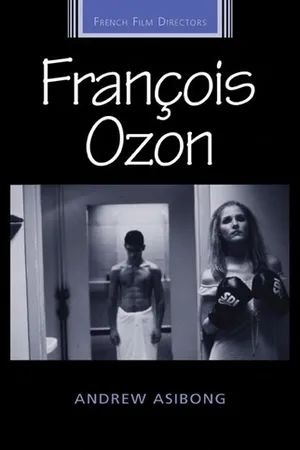
Available in paperback for the first time, this is a full-length study of the films of François Ozon, director of such diverse films as 8 femmes, Swimming Pool, 5x2 and Les amants criminels. Andrew Asibong's passionate and critical analysis focuses on the extent to which Ozon's seemingly light touch never ceases to engage with the fundamentally weighty issue of existential transformation, a transformation that affects both his protagonists and his audiences.
A central question emerges: what is at stake, cinematically, ethically and politically, in Ozon's alternatively utopian and cynical flirtation with the construction and deconstruction of contemporary social relations.
Revealing Ozon as a highly adept 'fan' of a whole range of thought, literature and cinema, Asibong places the precocious French auteur in an intellectual yet highly accessible critical framework, allowing Ozon's importance for a thoroughly postmodern filmgoing generation to be given the attention it deserves.
- 157 pages
- English
- ePUB (mobile friendly)
- Available on iOS & Android
eBook - ePub
François Ozon
About this book
Information
Subtopic
Film & Video1
Desire unlimited: sexualities on the move?
Alongside filmmakers such as Catherine Breillat (Romance, 1999), Virginie Despentes (Baise-moi, 2000), Bruno Dumont (Twentynine Palms, 2003) Christophe Honoré (Ma mère, 2004) and Gaspar Noé (Irréversible, 2002), François Ozon has often been marketed and discussed – his surname serving the purpose particularly well – as one of a new breed of provocative French film directors emerging in the 1990s, all apparently preoccupied with pushing back the boundaries of sexual representation in mainstream cinema.1 And indeed, from the early shorts of the mid-1990s to the ever-more polished features of the 2000s, Ozon’s films often seem to delight in graphic images of unrestrained sexual activity. In Victor (1993) we see the eponymous hero masturbate himself to climax, his semen spurting all over his chest and chin. In Action Vérité (1994) Ozon shows us one teenage girl feel in jest between the legs of another, only to pull out a hand covered in menstrual blood. In Les Amants criminels (1999) the camera focuses on the face of the teenage hero as he is sodomised by a bearded ‘ogre’. In 1998’s Sitcom a candid medium-shot of the naked and erect penis of Stéphane Rideau being pushed between the breasts of Lucía Sánchez is served up unflinchingly for the spectator’s delectation. It is small wonder that some critics have impatiently categorised Ozon as just one more director out to shock with trangressive sex.2 Furthermore, Ozon’s cinema is frequently discussed not as just sexual, but as specifically homosexual. Thus he has been categorised within a second, somewhat artificial set of directors – a putative cinematic ‘family’ of French gay filmmakers that might include Jean Cocteau (Orphée, 1950), Jean Genet, (Un Chant d’amour, 1950) André Téchiné (J’embrasse pas, 1991) and the team of Olivier Ducastel and Jacques Martineau (Ma vraie vie à Rouen, 2002), with the possible inclusion of Cyril Collard (Les Nuits fauves, 1993) as a token bisexual. Ozon’s films, like those of the aforementioned, are shown as a matter of course at international gay and lesbian film festivals, and it is to such community-specific marketing that much of his success in the English-speaking world can be attributed.3 Again, such a ‘ghettoisation’ of Ozon might be said to be not wholly unreasonable. With some notable exceptions, his films make visible images of homoeroticism, trajectories of gay psychological development, and vagaries of gay social experience with both an unabashed frankness and a refreshing casualness. Whether via the shyly fellating male lovers of Scènes de lit (1997), the enthusiastic sodomies of 1995’s La Petite Mort, 1996’s Une Robe d’été, and 2005’s Le Temps qui reste, or the unexpectedly numerous all-star Sapphic couplings of 2002’s 8 femmes, Ozon conveys a world in which same-sex desire is both irrepressible and seemingly ubiquitous.4
While these attempts to approach Ozon’s cinema through specifically sexual matrices are understandable starting points for analysis, they both demand a carefully nuanced application.5 Sexual desire as represented by Ozon is almost always multidimensional and consistently astonishing (even to its own bearer) in its capacity for boundless reinvention. In 2005’s Le Temps qui reste, the protagonist Romain speaks to his avuncular doctor of dreams that frame him as the lover of his own father, of the doctor himself, and, perhaps most intriguingly, of his own self in child form. Later in the film, he will impregnate a casually encountered waitress while her husband kisses and stimulates him.6 Similarly, in 2004’s 5x2, in one of the film’s many brutal expositions of the inscrutability of the central couple’s ‘true’ desires, the clean-cut, apparently heterosexual husband and father Gilles publicly confesses (or invents?) his part in a sex party in the course of which he allegedly joined a married couple on the floor, penetrating the wife while being sodomised by the husband. Far from providing new sexual appellations or diagnoses with which to circumscribe their characters’ behaviours, Ozon’s films seem instead to revel in a more thoroughly generalised blurring of the very contours of desire, a blurring as pronounced in the construction of their female characters as in that of their male ones. In 1997’s Regarde la mer, the first real sign that the rather repressed and exceedingly middle-class English housewife-and-mother protagonist Sasha has started to undergo characteristically Ozonian transformation is when she enters a forest of cruising gay men and proceeds to engage in cunnilingus with a random male figure. Charlotte Rampling’s middle-aged English academic Marie in 2001’s Sous le sable enjoys her one scene of orgasm as she masturbates to the fantasy (visually represented on-screen and thus shared by the spectator) of being caressed by several pairs of smooth male hands. Ozon’s films and their numerous representations of sexual desire are best understood, then, neither as symptoms of specifically French fin de millénaire drives to shock audiences through explicitness, nor as ever-proliferating artefacts from a reassuringly established French gay male subculture. Instead, Ozon, like his American filmmaker contemporary Gregg Araki (born 1959), persistently disrupts his audience’s expectations of what could possibly be meant by coherence of either sexuality or subjectivity. The two filmmakers (and they are clearly not the only ones) arguably belong less to nation-, gender- and sexuality-specific cinematic contexts than to a potentially international tendency, the legacy of intellectual and political struggles emerging from Europe and the Americas from the mid-1960s onwards, towards the constant affirmation of radically unmoored, provisional, and postmodern sexual behaviours, affiliations and identifications.7 If Ozon’s treatment of sex and sexualities does demand to be considered in the light of a specifically French history and culture of transgression, then it is perhaps more fruitful to compare him with a handful of French literary precursors than with his French cinematic contemporaries. Ozon’s films explore ideas around radically ‘unlawful’ sexualities that are often reminiscent of writers like the Marquis de Sade (La Philosophie dans le boudoir, 1794), the Comte de Lautréamont (Les Chants de Maldoror, 1869), and Georges Bataille (Histoire de l’œil, 1928). Whether through the Sadeian trope of a secluded space within which a sexualised ‘evil’ may be enacted (rehearsed, for example, in a film like Regarde la mer), the Lautréamontian motif of a psychotic or fantastical dimension of sexualised being far beyond merely human transgression (as we see in Sitcom), or the Bataillean fascination with the existential implications of eroticised sacrifice (explored in Les Amants criminels), Ozon’s analysis of mutating sexual desire is layered and nuanced in a manner that sharply interrogates the ethics of relation tout court, and certainly moves well beyond the superficiality of mere sexual spectacle.
Sex and death ad nauseam: from Victor (1993) to La Petite Mort (1995)
Ozon’s early films display a remarkable sophistication in their handling of the intersection of sexuality, transgression, death and their combined role in the shaping of the ever-metamorphosing human subject. He made the 13-minute film Victor in 1993, his graduating piece from the prestigious Paris film school FEMIS. Despite its brevity and the institutional context from which it emerged, it can be considered to be the first really polished prototype of Ozon’s entire subsequent corpus of shorts and features, wrestling in witty and confident manner with social, ethical and psychoanalytic themes, character archetypes, and generic concerns that would dominate his films throughout the 1990s and 2000s. Ozon himself is rather dismissive about the piece, describing it as ‘une étape utile mais aussi une sorte de carte de visite … un exercice de style’ (‘a useful stage but in a business-card kind of way … an exercise in style’, Ozon official website, ‘Interviews sur Les Courts-Métrages’). For all this, its plot details, narrative structure and mise-en-scène deserve detailed analysis: the very artificiality and brittleness by which Ozon seems embarrassed (and which would set some critics so strongly against Sitcom) may be precisely the source of its fable-like force. Victor shockingly and pithily asks a series of key, interlinked questions. How does one liberate oneself from one’s parents and develop a truly adult subjectivity? How does one break out of a state of generalised stasis and begin to move forward? How does one discover and ‘own’ an autonomous sexual identity?
The film begins with a montage of black-and-white photographs of the eponymous hero, the baby-faced, post-adolescent Victor (François Genty), captured in stifling family shots, wedged tightly, infantilised in a grotesque manner, between austere-looking, middle-aged parents (Daniel Martinez and Martine Erhel). Elizabethan-style harpsichord music can be heard on the soundtrack. As the various photographs are displayed, we hear the voice of Victor reading out loud what sounds like the beginnings of a suicide note addressed to his ‘chers parents’ (‘dear parents’) and bemoaning his unworthiness as a son, whilst a succession of brief medium shots show him at his desk writing the letter in question. Victor then takes a revolver out of his desk drawer, and inserts it into his mouth. A woman in a maid’s uniform (Isabelle Journeau) is busy in another room of the house, dusting one of the many household statues; outside in the garden an old man (Jean-Jacques Forbin) toils, another white statue behind him. As the maid dusts, humming merrily while she works, a gunshot is heard. However, the subsequent shot, taking us to the source of the bang, via a leisurely pan down the Michelangelo-style fresco of the parents’ bedroom, shows us not Victor’s corpse but rather the cadavers of the parents, freshly killed by their son, who now sucks the long barrel of the gun in anticipation of his own imminent suicide. But before he has a chance to shoot himself in the mouth, he is interrupted by the cries outside the room of the maid, Julie. It is at this point that the film’s title is shown, the word ‘Victor’ displayed in capital white letters in the middle of a gold photograph frame against a black background. The remaining eleven minutes of the film recount the next few days of Victor’s life following the murder of his parents, as he embarks on a journey towards something like acceptance of both the parricide and of himself. It is to the aged gardener that he turns for guidance and reassurance, terrified by the situation he has brought about. Twice babbling a dementedly elliptical version of the horror that has occurred – ‘J’ai un problème avec mes parents … J’ai eu tellement peur de leur faire du mal que j’ai fait une autre chose … mais tellement pire que … !’(‘I have a problem with my parents…I was so afraid of hurting them that I did something else…but so much worse that … !’) – he receives from the old man only the same enigmatic and somewhat platitudinous speech about the necessity of waiting for things to work out for the best.8 Victor is alone – albeit with two dead parents for constant company. He spends his days playing with the cadavers as though they were giant dolls: he combs his mother’s hair as she sits slumped before her mirror; he sniffs his father’s crotch in bed as he barks like a dog; he slurps soup (embarrassedly begging his parents’ pardon) in the dining room with each corpse seated on either side of him.9 A little later we see him lie masturbating to climax in the garden, while the dead parents sit slumped on the garden swings. Meanwhile, the maid Julie is beginning to exercise a new influence on the environment. Surreptitiously watching Victor’s eccentric behaviour with his parents, she is aware of everything that has happened. Having introduced her oafishly virile lover (Laurent La Basse) into the household, she begins to steal, quite openly, the various clothes and valuables of the deceased master and mistress. And when – in the film’s most shockingly disturbing sequence – Victor is assaulted by the (psychotically hallucinated?) reanimated ‘zombie’ figures of the parents, declaring their fury at his continued transgressions and vowing punishment, Julie and the lover take Victor into the bed in which he has already witnessed them copulating a tergo, sandwiching him between their naked bodies in a scene of overwhelmingly intimate, extreme close-ups of flesh, hair, and unidentifiable body parts, out of the mass of which Victor’s large eyes poke.10 The morning after Victor’s sexual initiation, Julie and the lover abruptly leave, driving away in Victor’s parents’ car, adorned in the parents’ expensive clothes, and waving cheerily up at Victor who watches them from a grey, oval-shaped, upstairs window, into which he then slips softly backwards.11 Victor comes down to the garden in his trousers and vest, and sets about burying his parents. The gardener approaches, and Victor hands him the spade, declaring: ‘Ils sont partis’ (‘they’ve gone away’). When the old man begins to address Victor with his (by now) familiar speech of platitudes, Victor silences him with a long, authoritative and intimate hug; the gardener wordlessly reciprocates the gesture. The final frame is a long shot of Victor: alone, still in white vest and black trousers, and smiling to himself, he waits to board the Métro which is just arriving. The credits play out over the barely discernible strains of ‘Sometimes I Feel like a Motherless Child’.12
As a story about a naive young man’s necessary departure from the desecrated family castle, his brutal entrance into the adult world, and the role played in his progress by a well-meaning old man philosopher, Victor in some ways plays like a 1990s cinematic version of Voltaire’s eighteenth-century fairy tale Candide and Flaubert’s nineteenth-century saint’s life La Légende de Saint Julien L’Hospitalier combined. It sets the stage for our understanding of Ozon as an auteur who is clearly fascinated by the ethics, the violence, the mysticism of coming of age, an auteur utterly willing to appropriate the aesthetics of the modern conte, or tale (at the expense of any kind of realism) in order to conduct his ahistorical investigations. Victor may be Ozon’s ‘student film’, then, but it offers us a bold and unambiguous insight into the themes that structure the Ozonian universe. At one level, the film and its fable of parricide can be read as a gruesome joke about the potential horrors of ‘coming out’ as ...
Table of contents
- Cover
- Half Title Page
- Title Page
- Copyright Page
- Contents
- LIST OF PLATES
- SERIES EDITORS’ FOREWORD
- ACKNOWLEDGEMENTS
- Family filmmaker: an introduction to François Ozon
- 1 Desire unlimited: sexualities on the move?
- 2 Master and servant: society, spectacle and sadomasochistic cinema
- 3 Shadow of the spectre: cinema beyond relation?
- 4 Blood, tears and song: genre and the shock of over-stimulation
- A drop in the ocean: concluding remarks
- FILMOGRAPHY
- SELECT BIBLIOGRAPHY
- INDEX
Trusted by 375,005 students
Access to over 1.5 million titles for a fair monthly price.
Study more efficiently using our study tools.
Frequently asked questions
Yes, you can cancel anytime from the Subscription tab in your account settings on the Perlego website. Your subscription will stay active until the end of your current billing period. Learn how to cancel your subscription
No, books cannot be downloaded as external files, such as PDFs, for use outside of Perlego. However, you can download books within the Perlego app for offline reading on mobile or tablet. Learn how to download books offline
Perlego offers two plans: Essential and Complete
- Essential is ideal for learners and professionals who enjoy exploring a wide range of subjects. Access the Essential Library with 800,000+ trusted titles and best-sellers across business, personal growth, and the humanities. Includes unlimited reading time and Standard Read Aloud voice.
- Complete: Perfect for advanced learners and researchers needing full, unrestricted access. Unlock 1.5M+ books across hundreds of subjects, including academic and specialized titles. The Complete Plan also includes advanced features like Premium Read Aloud and Research Assistant.
We are an online textbook subscription service, where you can get access to an entire online library for less than the price of a single book per month. With over 1.5 million books across 990+ topics, we’ve got you covered! Learn about our mission
Look out for the read-aloud symbol on your next book to see if you can listen to it. The read-aloud tool reads text aloud for you, highlighting the text as it is being read. You can pause it, speed it up and slow it down. Learn more about Read Aloud
Yes! You can use the Perlego app on both iOS and Android devices to read anytime, anywhere — even offline. Perfect for commutes or when you’re on the go.
Please note we cannot support devices running on iOS 13 and Android 7 or earlier. Learn more about using the app
Please note we cannot support devices running on iOS 13 and Android 7 or earlier. Learn more about using the app
Yes, you can access François Ozon by Andrew Asibong, Diana Holmes, Robert Ingram, Diana Holmes,Robert Ingram in PDF and/or ePUB format, as well as other popular books in Media & Performing Arts & Film & Video. We have over 1.5 million books available in our catalogue for you to explore.