Plain ugly examines depictions of physically repellent characters in a striking range of early modern literary and visual texts, offering fascinating insights into the ways in which ugliness and deformity were perceived and represented, particularly with regard to gender and the construction of identity.
Available in paperback for the first time, the book focuses closely on English literary culture but also engages with wider European perspectives, drawing on a wide array of primary sources including Italian and other European visual art. Offering illuminating close readings of texts from both high and low culture, it will interest scholars in English literature, cultural studies, women's studies, history and art history, as well as postgraduate and undergraduate students in these disciplines.
As an accessible and absorbing account of the power dynamics informing depictions of ugliness (and beauty) in relation to some of the quirkiest literary and visual material to be found in early modern culture, it will also appeal to a wider audience.
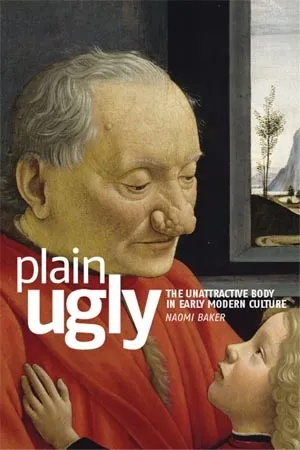
- 260 pages
- English
- ePUB (mobile friendly)
- Available on iOS & Android
eBook - ePub
About this book
Information
1
Theorising ugliness
What is ugliness?
The term ‘ugly’ originates from the Old Norse ugglig, meaning ‘to be feared or dreaded’.1 Early modern English definitions of ugliness frequently focus on its power to disturb the viewer. ‘Foulnesse is Lothsome,’ states John Donne, and Robert Burton similarly defines ugliness by its ability to repulse: ‘we contemn and abhor generally such things as are foul and ugly to behold, account them filthy, but love and covet that which is faire’.2 Ugliness and beauty thus appear to be fixed properties of objects, generating natural and inevitable responses in the viewer. Definitions of ugliness were nevertheless undergoing important changes in early modern England, leading to a proliferation of contradictory statements regarding the nature and implications of unattractive human bodies, which did not, after all, provoke uniform responses in those who viewed or represented them.
Prior to the development of formal aesthetics in the eighteenth century, beauty and its inversions operated within wider moral and transcendent frameworks.3 In classical and medieval thought, the ugly is the morally repellent. Evil is ugly, according to William of Auvergne, thirteenth-century Bishop of Paris, because it ‘repels our mind and arouses aversion … and offends our inner sense with its sight’.4 Reaching beyond the realm of superficial physical appearances, ugliness is sin, set against a beauty defined in terms of virtue. Into the early modern era, ugliness, like beauty, continues to be deployed in abstract terms. ‘When I behold … the amiable countenance of Christ,’ claims Joyce Lewes, one of Foxe’s martyrs, ‘the ugsome face of death doth not greatly trouble me.’5 Milton’s Adam recoils from his first glimpse of mortality with less serenity than Lewes but with an equally assured sense of its ugliness: ‘O sight/Of terror, foul and ugly to behold,/Horrid to think, how horrible to feel!’6 Sinful actions are repeatedly labelled ugly in this era, as are theological perversions. The ‘monstrous error of atheism’, for instance, is said to be ‘most ugly’.7
To be ugly in these contexts is to deviate from a moral ideal. The spiritual and the physical are not clearly distinguished from each other, however, and moralised perceptions of ugliness inevitably shape responses to faces or bodies that are deemed to be less than attractive. Ugly faces, either in the flesh or in literary and visual texts, emblazon moral corruption for all to see. During the Italian Renaissance, and later in sixteenth-and seventeenth-century England, ugliness, like beauty, nevertheless begins to lose its transcendent referents and to be described in more reductively material terms. The Neoplatonist Agnolo Firenzuola’s influential treatise Dialogo delle bellezze delle donne (On the Beauty of Women) (1541, publ. 1548) marks a key shift in theorisations of human beauty in Italy: ‘it is not my intention to speak of beauty of the soul’, states Celso, separating such questions from his interest in quantifying the beauty of the body. Beauty is treated in geometric terms in the text, where it is defined as ‘nothing else but ordered concord, akin to a harmony that arises mysteriously from the composition, union, and conjunction of several diverse and different parts’.8
Potentially limiting ugliness, as well as beauty, to a material rather than a spiritual phenomenon, the early modern era witnesses a fundamental reconfiguration of the relationship between the natural and the ugly. In the medieval era, ugliness tends to be viewed as an unnatural intruder into a fundamentally beautiful universe. This perception persists into the sixteenth and early seventeenth centuries in England, where natural forms are often regarded as by definition beautiful, whatever their eccentricity. As the seventeenth century progresses, however, the material order begins to be reconceptualised as a regular, ordered machine, within which instances of disorder or irregularity cease to be pleasurable displays of nature’s or God’s creative ingenuity and become instead repellent physical aberrations.9 The ugly, for a certain section of the intellectual elite at least, shifts from a metaphysical distortion of God’s creation to a material irregularity generated by a blindly impersonal universe. While unpleasant, ugliness understood in such terms is not morally or spiritually legible. No longer necessarily viewed as purposive signs, distorted physical features, like other natural aberrations, become merely ‘skin-deep’, a term emerging for the first time in the early seventeenth century.10
The seventeenth century therefore witnesses significant changes in the theorisation of ugliness, the main themes of which I explore in this chapter. It will soon become apparent that the term ‘ugly’ is being used in many different ways in the discussions considered here. Rather than attempting to impose a watertight account of ugliness, a term that never achieves a single, agreed-upon meaning in this era, I aim to give some indication of the divergent concepts of ugliness circulating at this time. Speaking in broad terms, it is possible to trace a historical narrative in the development of the use and representation of ugliness. What is perhaps even more interesting, however, is the manner in which seemingly incompatible concepts of ugliness coexist in early modern texts from all levels of the social strata. Key changes are under way in this era, but much confusion and disparity of outlook remains. Illustrating the contradictory perspectives on ugliness characteristic of the moment, I turn now to a central question to which no one could provide a definitive answer: is ugliness an objective property or a subjective perception?
Is ugliness in the eye of the beholder?
In the medieval era, ugliness, like beauty, was held to be an objective property. Things are not beautiful because they please, but ‘please because they are beautiful’, stated Augustine.11 The vital role of the perceiving subject in the recognition of beauty or deformity was noted, particularly by Thomas Aquinas, but beauty and ugliness were nevertheless understood to be intrinsic qualities of objects.12 By the eighteenth century, however, beauty and ugliness were being defined as subjective perceptions. The first English treatise explicitly dedicated to aesthetic issues, Francis Hutcheson’s An Inquiry into the Original of our Ideas of Beauty and Virtue (1725), defines beauty in seemingly subjective terms, as an ‘idea raised in us’. This ‘idea’ is nevertheless provoked by the properties of objects, namely ‘uniformity amidst variety’. Beauty and ugliness thus remain fixed qualities, generating necessary responses: ‘Who was ever pleased with an inequality of heights in windows of the same range, or dissimilar shapes of them? With unequal legs or arms, eyes or cheeks in a mistress?’ That which lacks proportion ‘never fails to pass for an imperfection, and want of beauty … as when the eyes are not exactly like, or one arm or leg is a little shorter or smaller than its fellow’.13 Physical ugliness, defined here as disproportion, invariably generates pain and revulsion. By the mid-eighteenth century David Hume nevertheless states that it is ‘certain, that beauty and deformity, no more than sweet and bitter, are not qualities in objects, but belong entirely to the sentiment … . One person may even perceive deformity, where another is sensible of beauty.’ The properties of the object are not irrelevant (‘some particular forms or qualities … are calculated to please, and others to displease’) but beauty and ugliness are now subjective perceptions, firmly located in the eye of the beholder.14
In the seventeenth century, questions regarding the potentially subjective or relative nature of beauty and ugliness surface repeatedly, suggesting that the issue generates some anxiety. The topic is often treated humorously. Wittily defending his choice of an ugly wife, for example, the speaker of Henry King’s ‘The Defence’ (1664) emphasises the primacy of the viewer in deciding what is attractive:
Nor can’st discern where her form lyes,
Unless thou saw’st her with my eyes …
If lik’t by me, tis I alone
Can make a beauty where was none;
For rated in my fancie, she
Is so as she appears to me.15
The perverse nature of this poem, constructed in the classical rhetorical tradition of paradoxical praise, nevertheless undermines its argument: beauty is in the eye of the beholder, states the speaker, but this claim is made in order to justify the self-evidently preposterous suggestion that ugliness is preferable to beauty. Including the reader in the joke through the assumption of a shared aesthetic standard, the apparent recognition of the subjectivity of beauty ironically reinforces the idea that beauty, and ugliness, are objective, universally discernible properties.
One of the conversants in Firenzuola’s On the Beauty of Women toys with the idea that ‘everyone has his own opinion’ of beauty: ‘some like dark-skinned women, and others fair-skinned ones. When it comes to us women, it is the same as at the cloth market, where one sells even the rough wool cloth and inexpensive floss silk.’ While less ‘valuable’ women may still have some worth in the sexual economy, however, their plainness remains a self-evident quality. Celso, the voice of masculine reason in the dialogue, insists that beauty and ugliness are objective properties, whatever the variety of response to them may be. ‘Tommaso likes his Nora beyond all measure,’ he admits, but ‘she is still as ugly as can be.’16 His subsequent elaboration of the geometrically quantifiable nature of feminine beauty gives detailed expression to the Renaissance emphasis on beauty as proportion, emphasising its status as a property of the object rather than a construction of the perceiver.
Elsewhere, however, the potential subjectivity of beauty and ugliness is taken more seriously. To Thomas Hobbes, ‘beautiful’ and ‘ugly’ are labels that we apply to entities that we either desire or loathe in accordance with our self-interest, rather than the nature of the objects themselves:
the constitution of a mans Body is in continuall mutation; it is impossible that all the same things should always cause in him the same Appetites, and Aversions: much lesse can all men consent, in the Desire of almost any one and the same Object.
But whatsoever is the object of any man’s Appetite or Desire; that is it, which he for his part calleth Good: and the object of his Hate and Aversion, Evill; and of his Contempt, Vile and Inconsiderable. For these words of Good, Evill, and Contemptible, are ever used with relation to the person that useth them: There being nothing simply and absolutely so; nor any common Rule of Good and Evill, to be taken from the nature of the objects themselves; but from the Person of the man (where there is no Commonwealth;) or, (in a Commonwealth) from the Person that representeth it; or from an Arbitrator or Judge.17
Neoplatonic paradigms also potentially encouraged the perception that judgements of sensory beauty are matters of fleshly appetite, making it unsurprising that tastes vary from person to person. The Italian Neoplatonist Thomasso Buoni argues in Problemes of Beautie (1606) that we perceive objects to be beautiful not solely because of the properties that they possess, but as a result of our own bodily disposition:
corporall Beauty is not onely placed in the due proportion, or site, or quantitie, or quality of the members, but much more in the appetite, which by reason of the diversitie of the complection where it resideth, willeth and desireth diversely.
The process of taking pleasure in material beauty is seen here to be primarily physical, governed by ‘the diversitie of mens complections’, which ‘breeds a diversitie in their desires; wherby they judge diversly of things present, & follow those which doe best agree with their constitutions’. ‘The Appettite doth accommodate it selfe to the temperature of the body,’ states Buoni, a ‘temperature’ which is evidently determined by social status:
for we see that as the country Swaine desireth grosse meates, such as agree best with the grossnesse of his nature, labours & education, as Onions, Leekes, Garlike, Beefe, Bacon, and such like: and these meates to him are sweete, and savory. So we see that men fitting themselves in their customes and carriages to their bodily temperatures, do ever desire to converse with their like, and therefore no marvell if the same happen in the election of Beauty.
In this treatise, then, cultural differences in ideas of beauty have a sociobiological origin. Our bodies suffer from a form of narcissism:
And therefore to the eye of the Moore, the blacke, or tawny countenance of his Moorish damosell pleaseth best, to the eye of another, a colour as white as the Lilly, or the driven snowe, to another the colour neither simply white, nor black, but that well medled Beauty betwixt them both … for an absolute Beauty carieth away the bell. ...
Table of contents
- Cover
- Half Title Page
- Title Page
- Copyright Page
- Contents
- List of illustrations
- Acknowledgements
- Introduction: ugly subjects in early modern England
- 1 Theorising ugliness
- 2 ‘Charactered in my brow’: deciphering ugly faces
- 3 Opening the Silenus: gendering the ugly subject
- 4 ‘Sight of her is a vomit’: abject bodies and Burton’s The Anatomy of Melancholy
- 5 ‘To make love to a deformity’: praising ugliness
- 6 Sacrificing beauty: defeatured women
- Notes
- Bibliography
- Index
Trusted by 375,005 students
Access to over 1.5 million titles for a fair monthly price.
Study more efficiently using our study tools.
Frequently asked questions
Yes, you can cancel anytime from the Subscription tab in your account settings on the Perlego website. Your subscription will stay active until the end of your current billing period. Learn how to cancel your subscription
No, books cannot be downloaded as external files, such as PDFs, for use outside of Perlego. However, you can download books within the Perlego app for offline reading on mobile or tablet. Learn how to download books offline
Perlego offers two plans: Essential and Complete
- Essential is ideal for learners and professionals who enjoy exploring a wide range of subjects. Access the Essential Library with 800,000+ trusted titles and best-sellers across business, personal growth, and the humanities. Includes unlimited reading time and Standard Read Aloud voice.
- Complete: Perfect for advanced learners and researchers needing full, unrestricted access. Unlock 1.5M+ books across hundreds of subjects, including academic and specialized titles. The Complete Plan also includes advanced features like Premium Read Aloud and Research Assistant.
We are an online textbook subscription service, where you can get access to an entire online library for less than the price of a single book per month. With over 1.5 million books across 990+ topics, we’ve got you covered! Learn about our mission
Look out for the read-aloud symbol on your next book to see if you can listen to it. The read-aloud tool reads text aloud for you, highlighting the text as it is being read. You can pause it, speed it up and slow it down. Learn more about Read Aloud
Yes! You can use the Perlego app on both iOS and Android devices to read anytime, anywhere — even offline. Perfect for commutes or when you’re on the go.
Please note we cannot support devices running on iOS 13 and Android 7 or earlier. Learn more about using the app
Please note we cannot support devices running on iOS 13 and Android 7 or earlier. Learn more about using the app
Yes, you can access Plain ugly by Naomi Baker in PDF and/or ePUB format, as well as other popular books in Literature & Social History. We have over 1.5 million books available in our catalogue for you to explore.