
- 352 pages
- English
- ePUB (mobile friendly)
- Available on iOS & Android
eBook - ePub
About this book
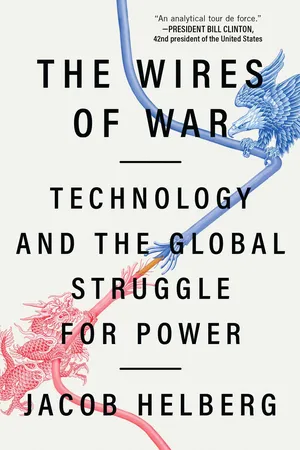
From the former news policy lead at Google, an “informative and often harrowing wake-up call” (Publishers Weekly) that explains the high-stakes global cyberwar brewing between Western democracies and the authoritarian regimes of China and Russia that could potentially crush democracy.
From 2016 to 2020, Jacob Helberg led Google’s global internal product policy efforts to combat disinformation and foreign interference. During this time, he found himself in the midst of what can only be described as a quickly escalating two-front technology cold war between democracy and autocracy.
On the front-end, we’re fighting to control the software—applications, news information, social media platforms, and more—of what we see on the screens of our computers, tablets, and phones, a clash which started out primarily with Russia but now increasingly includes China and Iran. Even more ominously, we’re also engaged in a hidden back-end battle—largely with China—to control the internet’s hardware, which includes devices like cellular phones, satellites, fiber-optic cables, and 5G networks.
This tech-fueled war will shape the world’s balance of power for the coming century as autocracies exploit 21st-century methods to redivide the world into 20th-century-style spheres of influence. Without a firm partnership with the government, Silicon Valley is unable to protect democracy from the autocrats looking to sabotage it from Beijing to Moscow and Tehran. Helberg offers “unnervingly convincing evidence that time is running out in the ‘gray war’ with the enemies of freedom” (Kirkus Reviews) which could affect every meaningful aspect of our lives, including our economy, our infrastructure, our national security, and ultimately, our national sovereignty.
From 2016 to 2020, Jacob Helberg led Google’s global internal product policy efforts to combat disinformation and foreign interference. During this time, he found himself in the midst of what can only be described as a quickly escalating two-front technology cold war between democracy and autocracy.
On the front-end, we’re fighting to control the software—applications, news information, social media platforms, and more—of what we see on the screens of our computers, tablets, and phones, a clash which started out primarily with Russia but now increasingly includes China and Iran. Even more ominously, we’re also engaged in a hidden back-end battle—largely with China—to control the internet’s hardware, which includes devices like cellular phones, satellites, fiber-optic cables, and 5G networks.
This tech-fueled war will shape the world’s balance of power for the coming century as autocracies exploit 21st-century methods to redivide the world into 20th-century-style spheres of influence. Without a firm partnership with the government, Silicon Valley is unable to protect democracy from the autocrats looking to sabotage it from Beijing to Moscow and Tehran. Helberg offers “unnervingly convincing evidence that time is running out in the ‘gray war’ with the enemies of freedom” (Kirkus Reviews) which could affect every meaningful aspect of our lives, including our economy, our infrastructure, our national security, and ultimately, our national sovereignty.
Frequently asked questions
Yes, you can cancel anytime from the Subscription tab in your account settings on the Perlego website. Your subscription will stay active until the end of your current billing period. Learn how to cancel your subscription.
At the moment all of our mobile-responsive ePub books are available to download via the app. Most of our PDFs are also available to download and we're working on making the final remaining ones downloadable now. Learn more here.
Perlego offers two plans: Essential and Complete
- Essential is ideal for learners and professionals who enjoy exploring a wide range of subjects. Access the Essential Library with 800,000+ trusted titles and best-sellers across business, personal growth, and the humanities. Includes unlimited reading time and Standard Read Aloud voice.
- Complete: Perfect for advanced learners and researchers needing full, unrestricted access. Unlock 1.4M+ books across hundreds of subjects, including academic and specialized titles. The Complete Plan also includes advanced features like Premium Read Aloud and Research Assistant.
We are an online textbook subscription service, where you can get access to an entire online library for less than the price of a single book per month. With over 1 million books across 1000+ topics, weâve got you covered! Learn more here.
Look out for the read-aloud symbol on your next book to see if you can listen to it. The read-aloud tool reads text aloud for you, highlighting the text as it is being read. You can pause it, speed it up and slow it down. Learn more here.
Yes! You can use the Perlego app on both iOS or Android devices to read anytime, anywhere â even offline. Perfect for commutes or when youâre on the go.
Please note we cannot support devices running on iOS 13 and Android 7 or earlier. Learn more about using the app.
Yes, you can access The Wires of War by Jacob Helberg in PDF and/or ePUB format, as well as other popular books in Computer Science & Cyber Security. We have over one million books available in our catalogue for you to explore.
Information
Chapter 1 THE ORIGINS OF THE GRAY WAR
The night before my first day at Google, I was too excited to sleep. That morning, fortified by several cups of coffee, I left my house in San Franciscoâs Glen Park neighborhood and hopped on the Google bus to Mountain View.
At around 6:00, I walked into the storied Googleplex, the sprawling campus of low-slung glass-and-brick buildings that make up the companyâs main headquarters. Google was the quintessential Silicon Valley start-up. Stanford PhD students Larry Page and Sergey Brin had incorporated the company in 1998, after working out of the garage of Susan Wojcicki (now YouTubeâs CEO). By the time I joined, nearly two decades later, Google had grown into one of the most iconic companies on the planet. There were more than 60,000 Googlers working around the world, on everything from perfecting search engines to testing self-driving cars.1 Those products and services brought in an astonishing $90 billion in annual revenue.2 Within a year Google would briefly dethrone Apple as the most valuable brand in the world.3
Google had become the kind of company every scrappy start-up sought to unseat. Yet as I began my new job, nothing about Google seemed boring or bureaucratic. Arrayed around an interior courtyard were buildings housing core functions like news and search, as well as teams working on cutting-edge products like AI and machine learning. Brightly colored bikes that Googlers used to pedal across campus leaned against towering palm trees. Outside, food trucks and benches offered a place to enjoy a bite to eat. Inside, conference rooms shared space with ânap podsâ for late-night coding sessions and micro-kitchens stocked with snacks and LaCroix. âCampusâ was an apt description. Starting at Google didnât feel like joining a big corporation; it felt like going back to college.
It quickly became clear, however, that the job would hardly be all fun and games. As it turned out, I had walked through the doors of the Googleplex and into a firestorm of controversy.
By sheer coincidence, I became a Googler the day before Donald Trump was elected president. The night of November 8, I watched the election returns with a small group at the offices of a friendâs tech firm. The pundits had predicted a slam dunk election for Hillary. Like most people who took Nate Silverâs projections as gospel, I believed them. Peter Thiel was just about the Valleyâs lone voice predictingâand championingâTrumpâs success.
But as state after state unexpectedly went red for Trump, I became more and more concerned. I kept telling myself that Hillary could still win. I was still clinging to that slender hope at 11:40 p.m., when CNN flashed the banner headline âClinton Calls Trump to Concede Election.â4
Most of my friends watched in disbelief. One person began crying. Others started drinkingâheavily. Shortly thereafter, I went home. âOmg,â I texted Keith. For the 65 million Americans who had voted for Hillary, the election was a rude shock. The tech industry has long prided itself on being made up of immigrants, and many of them woke up on November 9 genuinely concerned that they and their children would no longer be welcome in the United States.
Before long, Silicon Valley had another reason to feel shocked. From the pages of the Washington Post to the presidentâs Twitter feed, we had begun hearing a new termââfake news.â The Trump administration embraced and popularized it, but the term was not a new oneâas far back as 1672, King Charles II issued a proclamation âTo Restrain the Spreading of False News.â5 In more recent years, the media had taken to using âfake newsâ to describe the stream of wholly false stories pumped out online by Macedonian teenagers, such as the absurd claim that Pope Francis had endorsed Trump.6
In the aftermath of the election, pundits and technologists grappled with whether these bogus news articles had impacted the results. Responding to these criticisms, Facebook founder and CEO Mark Zuckerberg dismissed âthe idea that fake news on Facebook⌠influenced the election in any wayâ as âa pretty crazy idea.â7
But around the water coolers and micro-kitchens of Silicon Valley, the chatter grew. What was the deal with fake news? And had we unwittingly helped it spread, too?
As Googleâs global news policy lead, I spent a lot of time thinking about what Googlers call the âten blue links.â When you enter a search termâbe it âelection 2020,â âDallas Cowboys,â or âweather in ChicagoââGoogleâs algorithms instantaneously serve up a list of the ten links most likely to provide the information you want. Googleâs business model centers on its ability to identify your target in that first page of linksâif not in the first link itself. But as simple as that may sound, parsing huge masses of data turns out to be incredibly complicated.
If and when an algorithm serves up inaccurate information, search results can range from humorous and obviously incorrect to inaccurate but subtly believable and potentially more consequential. But whoâs to determine what is âaccurateâ information and what isnât? Thatâs why Googleâs algorithms are designed explicitly to prevent anyone from putting a finger on the scale. Those ten blue links that pop up on your screen are the result of billions of bits of data, with algorithms making informed guesses about which websites will be most responsive to each individual query.
But, of course, there are exceptions. And that was my jobâto deal with the exceptions.
Take child pornography. Every decent human wants to protect children from sexual exploitation. Google doesnât have the ability to take down websites featuring child pornographyâthatâs a job for the governmentâbut the company can use its tools to prevent those sites from popping up in a Google search. As policy advisor, my role was to help Googleâs engineers figure out exactly what to scrub from Googleâs curated search and news features as well as what might be distasteful but should not be scrubbed. You wouldnât want, say, a charity that valiantly fights sexual exploitation to be hidden from the ten blue links because Googleâs algorithm noted the phrase âchild pornographyâ on their homepage. So the team I belonged to at Google crafted the companyâs policies to sort what information should be hidden and what should remain.
In 2015, for instance, Google established a policy that allows revenge porn victims to have unauthorized pictures of themselves scrubbed from any search results.8 Similarly, when a trove of medical records in India was hacked in 2017, our team at Google responded by making sure that links with sensitive personal information would never show up among our recommended links. For example, we didnât want a Google search to reveal someoneâs medical historyâsuch as whether they were HIV-positive.
These challenges kept my job interesting. As new kinds of data come online, tech companies are constantly working to ensure that users can access the most useful information while balancing issues like freedom of speech, the right to privacy, and the demands of national security. Which brings us to the unique challenge presented by Russia and fake news.
In the weeks after the election, few of my fellow technologists and I worried that disinformation was a major problem on our platforms. But we wanted to understand moreâand as the newest policy advisor, this was something I needed to grapple with.
Google has a number of discrete news productsâfrom the Google News tab on your web browser, to the news feed you see when you swipe down on your Android phone, to the audio news you hear if you ask the Google Assistant, âOkay, Google, read me the news.â To most consumers, these products probably seem like different features. Yet each one is made possible by an unseen team of designers, engineers, data scientists, and marketing professionals. Unlike the organic ten blue links, which are meant to be a reflection of the web, news features are more tightly curated and subject to stricter policies for content that Google labels or designates as ânews.â And each of these products, potentially, was a fissure into which Moscow might have inserted its perverse propaganda.
Digging deeperâconsulting with cybersecurity experts and diving into treatises from academics and strategists grappling with the rise of authoritarianismâI started to grasp the contours of the problem. I studied the growing sophistication of Putinâs propaganda efforts, the vulnerability of the tech industryâs supply chains, and Chinaâs deliberate, decades-long effort to digitally encircle the globe and make the world safe for autocracy.
As virulent as the epidemic of fake news had been in 2016, that wasnât the half of it. This was the phenomenon I had glimpsed during the 2016 election but hadnât fully appreciated. Whatâs more, I came to understand that this was only one front in a broader battle of hackers and spies, from St. Petersburg to Pudong to Pyongyang, that had been ragingâin one form or anotherâfor decades.
I found all these revelations so disturbing that I had trouble sleeping. As I tossed and turned, beset by thoughts of Russian troll farms, Macedonian teenagers building fake news empires, and Chinese conglomerates taking over European networks, the same question kept running through my head.
How did we end up here?
Innovating on the ARPANET
The answer has a lot to do with a science fiction listserv in the earliest days of the Internet. On October 29, 1969, researchers at the Stanford Research Institute connected a computer on Stanfordâs campus to another computer at UCLA. The building where it happened stands about a mile from my office on Stanfordâs sprawling campus. It doesnât look especially noteworthy. But there, the researchersâfunded by the Defense Departmentâs Advanced Research Projects Agency (ARPA)âsent a message over telephone lines. Unlike a telephone call, however, this new technology broke the data down into fragmentsâcalled âpacketsââeach of which took the quickest possible path to its destination before being reassembled at the second computer.
The Internet was born.
Hunched over their twinned terminals, the ARPA researchers watched, entranced, as the letters âL-Oâ appeared on the screen. But before the word âLOGINâ could be completed, the nascent system crashed. âFittingly,â the authors P. W. Singer and Emerson Brooking wryly observe, âthe first message in internet history was a miscommunication.â9 In fact, these earliest machines were so finicky that they came with voice headsets so that users could verify that their messages were transmitted correctly.10
Despite these limitations, this âinternetâ grew rapidly. A few weeks after that first Stanford-UCLA test, a computer in Santa Barbara joined the network, then one in Utah. Within two years, the network linked fifteen universities together.11 In 1973, a London university and a Norwegian seismic laboratory became the Internetâs first international connections.12 In honor of its Pentagon patron, this new network was called ARPANET.
Email, explains the Internet historian Johnny Ryan, âwas a completely unplanned addition to the ARPANET.â13 These messagesâaddressed to individuals using the â@â symbol as a shortcutâlargely consisted of researchers contacting one another about sharing computing power. Yet in a development that woul...
Table of contents
- Cover
- Title Page
- Dedication
- Prologue
- Introduction: In the Heart of the Empire
- Chapter 1: The Origins of the Gray War
- Chapter 2: The Software War on the Front-End of Your Screen
- Chapter 3: The Hardware War on the Back-End of Your Device
- Chapter 4: The Future of National Sovereignty Is Tech, Not Troops
- Chapter 5: The Hill and the Valley
- Chapter 6: Winning the Gray War
- Chapter 7: A âSputnikâ Moment
- Epilogue
- Acknowledgments
- About the Author
- Notes
- Index
- Copyright