Does Jesus’ call to love our enemies mean that we should remain silent in the face of injustice?
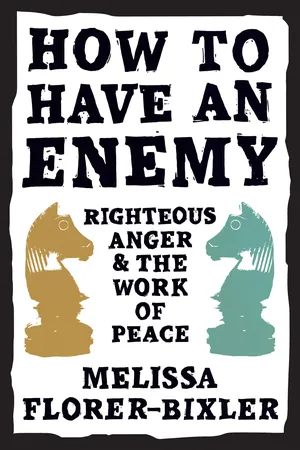
Jesus called us to love our enemies. But to befriend an enemy, we first have to acknowledge their existence, understand who they are, and recognize the ways they are acting in opposition to God’s good news. In How to Have an Enemy: Righteous Anger and the Work of Peace, Melissa Florer-Bixler looks closely at what the Bible says about enemies—who they are, what they do, and how Jesus and his followers responded to them. The result is a theology that allows us to name our enemies as a form of truth-telling about ourselves, our communities, and the histories in which our lives are embedded. Only then can we grapple with the power of the acts of destruction carried out by our enemies, and invite them to lay down their enmity, opening a path for healing, reconciliation, and unity.
Jesus named and confronted his enemies as an essential part to loving them. In this provocative book, Florer-Bixler calls us to do the same.
- 250 pages
- English
- ePUB (mobile friendly)
- Available on iOS & Android
eBook - ePub
About this book
Information
Topic
Theology & ReligionSubtopic
Christian Ministry—one—
Who Is My Enemy?

The World War I Christmas Day truce is a fabled moment in the history of enemies. The 2004 film Joyeux Noel is one of many depictions of the brief armistice between the German, French, and Scottish soldiers that took place on Christmas Day in the middle of the war. On screen men laid down their weapons to play football and sing carols on Christmas morning. It’s a story that is told over and over from pulpits and in storybooks to remind us how face-to-face contact—how knowing one another—can bring peace to enemies. “To die tomorrow,” says one of the actor soldiers in Joyeux Noel, “is even more absurd than dying yesterday.”1
In the myth of the Christmas Day truce, it is the soldiers who devise the armistice, eager to thwart officers who can’t see the pointlessness of the war. Once the truce ends and the commanding officers take control of the situation, the soldiers who laughed and smoked cigars with their enemies refuse to pick up their guns again. The army is forced to move new troops to the front lines and the defecting soldiers are punished. Despite the costs enmity gives way to friendship, and war has no place in the hearts of soldiers who experienced the miracle of the Christmas Day truce.
— — —
I hear people evoke the power of the Christmas Day ceasefire in today’s divided political climate, where I am told polarization both in and outside the church walls is at a new and unique zenith in history. People of goodwill lament this stratification, the widening gap between ideological positions, with no middle ground for negotiation. I hear these people mourn that we’ve hardened into camps, often described as “left” and “right,” and that these allegiances set our primary identities. We can no longer understand one another.
In this way of addressing conflict and division, it is Christ, not our politics, that gives us hope. If we knew each other, if we reached across the political divide toward our unity in Jesus, we could stamp out our false enmity. Early in my pastorate, I served churches that participated in a communion service on Election day. At noon, after going to the polling station to vote, we would gather to share the Lord’s Supper. The organization that promoted this service encouraged churches to embrace our unity in Jesus. No matter whom we supported in the voting booth, we left behind political identities at the door of the church. Here before the table of Christ, we were one and Jesus was Lord.
What I couldn’t see at the time, what I learned after sustained formation in the work of anti-oppression, was that these churches—primarily upper-middle class and white—would thrive no matter who was elected to national office. At the end of the day we were largely unaffected by the outcome. This was not the case for others for whom “politics” would determine the quality of their children’s schools; their community’s access to food, transportation, clean water, and jobs; and whether they would gain citizenship, earn a living wage, or receive health care. What kind of unity did we have if we were not united around their welfare, if we did not see their thriving as our own thriving?
It turns out this kind of unity—the kind that was achieved in ritual but not replicated in life—was a myth. We keep these myths alive because they offer the convenience of personal transformation over the difficult and costly work of excavating the deep roots that feed conflicts between enemies. These roots must be pulled up before we can begin to talk of reconciliation or unity. We declare “Jesus is Lord” by ripping out the systems of death and destruction that dominate our lives, and by planting something new in their place.
As it turns out the Christmas Day ceasefire of World War I was not an epiphany of anti-war resistance often portrayed in popular culture. Officers, not soldiers, planned the truce in advance. The soldiers who participated were not punished for participating. While the truce is often portrayed as a secret, meant to hide the possibilities of peace from the public, records show information about the day was widely available. But most significant is that the men who participated in the truce readily picked up their weapons on December 26. They returned to battle against the soldiers they’d met the previous day.
The truce was significant for the men involved and many wrote home to share with loved one about the momentous relief the ceasefire provided. Soldiers were able to rebuild the trenches. The men buried their dead. Some ventured out to meet enemy soldiers and to learn more about them.2 This was likely one spark among many in building resistance to war. But the truth of this moment is complicated. Empathy, friendship, and kindness are powerful forces. But so is war. It would take more than an encounter with the enemy to unravel the entrenched political drama that led to a world at arms. There are few easy solutions to working out enmity.
Rather than idealizing a single moment of empathy, I’m struck by the stories of German citizens and soldiers who committed themselves to organized and often dangerous acts of rebellion against the imperialist war that embroiled the world. One of those moments came in October of 1918, when German naval soldiers were commanded to fire on the British in a last attempt to stem the tide of the war. Five times in a row they refused to obey the order. One thousand soldiers were arrested as a result.3 Over the course of the war socialists and Christian pacifists resisted. They were a significant force in ending the Great War as they engaged in sustained and costly action. Ordinary people organized to interrogate the economic, political, and social powers of imperialism.4
— — —
We are invested in the myth of instantaneous friendship across enemy lines as a cure to our social ills because it offers a simple explanation for the troubles we face today. The trouble, according to this theory, is that we have divided the world into “us and them.” Once we divide up the world in this way—into friends and enemies—we are destined for binary thinking that leads to intractable conflict. To make matters worse, the only way to sustain our identity in these “tribes” is to believe in our rightness and with equal ferocity in the wrongness of the other. To believe we are correct over and against others is the height of self-righteousness. This failure to disassociate our faith from our political lives is called tribalism. We can remedy tribalism with open-mindedness to the complicated nature of individual human beings; we can listen across the divides to see what we can create in a new space outside “politics as usual.”
The language of tribalism, as well as the fears it communicates, contains its own genealogy. Rowan Williams reminds us of the sobering roots of this language: “The very word ‘tribalism’ tells a story, about the demeaning or marginalising of cultures that we call ‘tribal.’”5 In the era of colonial expansion, certain kinds of behavior and beliefs were deemed normative by European settlers. Other ways of being, thinking, acting, and relating were interesting or novel but ultimately “doomed and deviant.”6 The rational, enlightened group—those with the gold and guns—would ensure the extinction of those who would not conform.
“Tribalism,” writes Williams, describes ways of life that are “aberrations from the norm.”7 Colonizers deemed the people they encountered on their journeys of empire expansion as lacking the moral and ethical skills to govern themselves. Eventually these white settlers would force upon Indigenous peoples a universal set of values that they deemed superior, established in the rational and scientific. European colonization determined and policed the boundaries of acceptable difference in economics, family, religion, and education.
European settlers implemented their social order through the sword and the gun. The “taming” of tribalism was devastating for the survival of Indigenous peoples and their cultures. Native boarding schools set their purpose on “killing the Indian” to force into existence a new citizen, one who would contribute to the economic and political vibrancy of the colonized nation. This Enlightenment rationality was, they claimed, universal. Non-Europeans had the choice to conform or be destroyed. “Genocide,” writes Williams, “can wear the dress of benign progressivism, as well as that of murderous violence.”8
Who determines what is reasonable difference and what causes rupture? Who defines the center of our identity, one that pushes aside questions that are considered divisive politics by some but are life or death to others? Who is this Jesus around whom we center our identity? These are not pedantic questions. They are questions that, when we fail to ask them, invite well-reasoned and thoughtful destruction of those at the margins of power.
— — —
The work of the church is not to unify as a way to negate difference or to overcome political commitments. Instead, we are called to enfold our lives into the gospel, our whole lives. The good news of Jesus Christ is only good news when it proclaims that we will overcome enmity by aligning ourselves with others who reject the principalities and powers of the old age, knowing this will set us all free.
It is easier and more convenient to reduce our conflicts to misunderstandings between individuals or quarrels that we can overcome by establishing relationships or by gaining new information. Framing enmity as an issue solely between individuals, rather than dependent upon systemic and coercive power, is popular in and outside the church. In the United States, police departments host events built on this premise. In my city officers meet at McDonald’s, a favored youth hangout. Officers sit at tables and hand out one-dollar gift certificates. They share soda and ice cream with patrons. They hand out yellow sheriff badge stickers to children. Most of the time these events happen in historically Black neighborhoods in Raleigh, where tensions between police and civilians run high.
The theory at work behind these events is that relationships will mitigate community tensions with the police. If people knew each other, the theory goes, if they sat down and heard each other’s stories, heard from a different perspective, they would be changed. The anger, hatred, and frustration would dissolve into compassion because the two conflicting parties encountered the humanity of one another. The next time police and young people met, under duress, the situation would more likely resolve in a positive way because of the relationship established prior.
We are told this is the moral compass that guides police-community relations, and people apply this form of conflict resolution globally. Relationship holds the power to prevent violence. But it is a force both limited and complicated. When I hear that police show up at McDonald’s to meet Black youth, I have no doubt that Black parents and caregivers are giving their kids “the talk,” a reality of Black childhood, to balance out these encounters.
“I’ll never forget there was a time—the kids wanted to go to the park,” Kenya Young told a radio host about giving her three Black sons “the talk”:
I remember the kids asking to go to the park and the laundry list of what I had to tell them: “Don’t wear your hood. Don’t put your hands in your pocket. If you get stopped, don’t run. Put your hands up. Don’t make a lot of moves. Tell them your mother works for NPR.” I mean, it just went on and on.9
Young’s instructions to her sons remind us that empathic moments of personal engagement with police are dangerous for Black children. Instead, caregivers and trusted adults explain that the police have an implicit bias against Black people, especially Black men and boys. “The truth of the matter is no matter what we do, what job we get, what college we go to, what education we have, what level we are, how much money, what car,” Young explains, “anything that you think may change even a little bit about how people see you, there are still people that are only going to see the skin color.”10 In their encounters, police will treat her Black children differently than their white peers, often assuming they are older and more aggressive. On the shoulder of a dark highway, it doesn’t matter if they met once at a McDonald’s.
“The talk” does not erase the humanity of a police officer. Instead, Black parents share it as a tool for survival. Often missing in the schools of conflict resolution that depend on empathy as their primary tool is an accurate assessment of power. The assumption that all our struggles boil down to misunderstanding negates that parties in conflict do not come with equal access to power over their lives. The attempt to resolve conflict with interpersonal strategies like empathy often disregards how coercion and force shape the lives of enemies.
We see this power inequity in policing. And we need a new culture, not relationships, to address this inequity. Those of us doing the work of police abolition—the collective movement toward a world freed from the structures of a coercive force called the police—believe officers are doing precisely the work they are expected to do. Police officers may take up this role thinking they keep people safe, that they support the wholeness of the community. They think they stop bad people from hurting good people. In reality the problem with policing is not a few bad officers who need retraining but policing itself.
Police are given permission to enact violence in order to keep in place a form of life that the state determines to be good. We often think of police as a presence to uphold the law. But the law exists within the larger account of the kind of society we expect police to maintain. A country where white supremacy runs in the roots will produce white supremacist outcomes. Over and over, throughout the history of the United States, the interpretation and enforcement of laws benefit some (white people) at the expense of others (everyone else).
The Movement for Black Lives that calls to defund the police is not about hatred for police, hatred for orderly social life, or hatred for safety. It is a matter of changing the way that we attend to the system at the center of human conflict. Rather than focusing on training individual officers, the call of abolitionists is to leave behind the logic of policing itself. Holding events where citizens get to know the police does not produce the structural change needed to keep Kenya Young’s children—and all Black children—safe from police encounters. Interpersonal connection is an unhelpful distraction. In the hands of police it is propaganda. This propaganda, in the form of goodwill gestures by police and humorous videos, plays on feelings of empathy in order to sidetrack the documented, systemic racism and violence of policing in the United States.
— — —
Power separates difference from enmity. I use the language of enemies in this book to describe a relationship between people, one that recognizes how a person uses their power, actively or passively, to harm or dominate another. When there are enemies, one is i...
Table of contents
- Front Cover
- Title Page
- Copyright Page
- Contents
- Foreword
- Gratitude as Preface
- 1: Who Is My Enemy?
- 2: Making Room for Enemies
- 3: Praying for Enemies
- 4: Shared Anger and Forgiveness
- 5: Mary’s Politics
- 6: Love Your Enemies
- 7: Undoing Family
- 8: Know Your Enemy
- 9: Jesus Draws the Line
- 10: Becoming Enemies to Mammon
- 11: Whiteness and the Enemy
- 12: The End of Enemies
- A Sermonic Epilogue
- Notes
- The Author
Trusted by 375,005 students
Access to over 1.5 million titles for a fair monthly price.
Study more efficiently using our study tools.
Frequently asked questions
Yes, you can cancel anytime from the Subscription tab in your account settings on the Perlego website. Your subscription will stay active until the end of your current billing period. Learn how to cancel your subscription
No, books cannot be downloaded as external files, such as PDFs, for use outside of Perlego. However, you can download books within the Perlego app for offline reading on mobile or tablet. Learn how to download books offline
Perlego offers two plans: Essential and Complete
- Essential is ideal for learners and professionals who enjoy exploring a wide range of subjects. Access the Essential Library with 800,000+ trusted titles and best-sellers across business, personal growth, and the humanities. Includes unlimited reading time and Standard Read Aloud voice.
- Complete: Perfect for advanced learners and researchers needing full, unrestricted access. Unlock 1.5M+ books across hundreds of subjects, including academic and specialized titles. The Complete Plan also includes advanced features like Premium Read Aloud and Research Assistant.
We are an online textbook subscription service, where you can get access to an entire online library for less than the price of a single book per month. With over 1.5 million books across 990+ topics, we’ve got you covered! Learn about our mission
Look out for the read-aloud symbol on your next book to see if you can listen to it. The read-aloud tool reads text aloud for you, highlighting the text as it is being read. You can pause it, speed it up and slow it down. Learn more about Read Aloud
Yes! You can use the Perlego app on both iOS and Android devices to read anytime, anywhere — even offline. Perfect for commutes or when you’re on the go.
Please note we cannot support devices running on iOS 13 and Android 7 or earlier. Learn more about using the app
Please note we cannot support devices running on iOS 13 and Android 7 or earlier. Learn more about using the app
Yes, you can access How to Have an Enemy by Melissa Florer-Bixler in PDF and/or ePUB format, as well as other popular books in Theology & Religion & Christian Ministry. We have over 1.5 million books available in our catalogue for you to explore.