CHAPTER 1
“The World’s Greatest Housing Cooperative”
Building a New City, 1965–1968
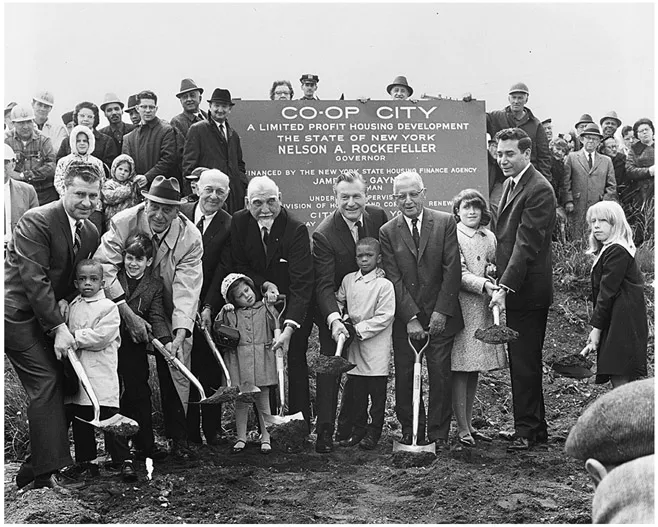
On May 14, 1966, a group of New York City and State luminaries gathered in a swamp in the northeast corner of the Bronx to celebrate the groundbreaking of what Governor Nelson Rockefeller termed “the world’s greatest housing cooperative.”1 Rockefeller, Bronx borough president Herman Badillo, labor leader Harry Van Arsdale, and the management of the United Housing Foundation, including Abraham Kazan, Jacob Potofsky, and Harold Ostroff, attended. George Meaney, president of the AFL-CIO, who was recuperating from recent surgery, sent a taped message of congratulations.2 President Lyndon Johnson heralded Co-op City as “a significant development in the efforts to improve the quality of our national life.”3 The New York Times thanked Co-op City’s founders for providing a “new lesson in creative unionism for social progress.”4 Using his customary bluntly colorful language, Robert Moses slammed the critics of the project: “Anybody with good vision, an abacus and a command of simple English can tell you that rehabilitation of existing decayed, scrofulous, rat-infested tenements is a salve, not a cure, a gesture not a confrontation.”5 Co-op City was, Moses proclaimed, a “name to conjure with.”6 A commemorative photo immortalized the smiling VIPs, shovels in hand, surrounded by a mixed-race group of children. They had much to smile about.
For the UHF, Co-op City was a chance to build “the most beautiful instant city in the history of civilization; 60,000 people in one community at one time . . . a cooperative community.”7 Co-op City was three times larger than the UHF’s Rochdale Village, which had been completed one year earlier. When finished, Co-op City would be a “city within the city” roughly the size of Santa Barbara, California, or Laredo, Texas.8 For Rockefeller and Moses, Co-op City offered the chance to make a significant dent in New York’s crisis of affordable housing, as well as its burgeoning social crisis. For its future residents, it offered spacious apartments with hardwood floors, views of the surrounding city, and modern amenities like central air conditioning. As Rockefeller, Moses, and Kazan celebrated their triumph, they could not have realized that this project would be the last of its kind, nor that Co-op City would find itself bedeviled by financial and social issues. Co-op City was the apotheosis of a model of urban planning that emphasized a partnership between labor and the state to create large-scale development projects. It was an approach that would not survive much longer than this cool May morning.9
FIGURE 2. Co-op City groundbreaking ceremony, with a smiling Governor Nelson Rockefeller at center of photo, 1966. Amalgamated Clothing Workers of America Records, Kheel Center, Cornell University. Photograph by Sam Reiss.
Just a sign of the headwinds that Co-op City would face had already become apparent in the planning process itself. The project’s plans met a hostile reception both within the New York City Planning Commission (CPC) and among outside critics. Many of these criticisms focused on the aesthetics of the development—especially its reliance on the “tower in a park” model, and the UHF’s lack of interest in emphasizing street life in the development. Other critiques stressed the transportation issues generated by its remote location—there was no subway line that reached Co-op City, and planned bus connections appeared inadequate. Finally, a few planners and housing activists complained that the UHF’s stated intent to serve only a middle-class public would both fail to impact the city’s affordable-housing crisis and would render the development itself too economically and ethnically homogeneous.
After Co-op City won approval, with a few aesthetic modifications to mollify its critics, it would face still more problems. The loudest concern of Co-op City’s critics, namely that no organic community would develop in the sterile high-rises, would prove to be entirely overblown. However, bigger storms were on the horizon. First, the development would be under near constant financial strain, generated by the combination of rising interest rates on Co-op City’s massive mortgage and inflation in the prices of the goods and services needed to build the development. Second, in a troubling sign, on the same day that a front page article in the New York Times announced the contract signed between the UHF and New York City for the construction of Co-op City, another article on the front page noted the 52 percent rise in crime in New York’s subways and a 9 percent rise in crime for the city was a whole.10 The four years between the signing of the contract and occupancy would be eventful and troubling ones for urban America. The Co-op City that opened to residents in December 1968 did so in a very different New York from the one its founders envisioned in January 1965.
For centuries, the site that would later become Co-op City had been occupied by Native Americans, who dug for oysters and clams in the marshy ground and caught fish along its creeks.11 The first contact with Europeans came when Dutch settlers arrived and bought this territory in 1643, along with much of what would become Westchester County, for axes, knives, and beads that were worth less than $9,000 in today’s money. The Dutch named this new territory Vredeland, or Freeland. Shortly after the arrival of the Dutch, the English widow Anne Hutchinson, who had fled religious persecution in the Massachusetts Bay Colony and settled nearby, was killed by Native Americans.12 Twenty years after this inauspicious start, the king of England deeded a large tract of the North Bronx, including present-day Co-op City and Pelham Bay, to Sir Thomas Pell, which Pell, in turn, allotted to ten families.
By the early 1900s, the land was occupied by a small number of people, who were mostly involved in fishing. During the first half of the twentieth century, developers drew up a variety of plans for projects to occupy this area. In the 1920s, a racetrack was considered; in the 1930s, an airport was proposed.13 However, the first major development to actually occupy the site was the Freedomland amusement park, which was owned by Webb & Knapp, a real estate company controlled by William Zeckendorf, a prominent and well-connected developer. Freedomland, which was designed by a former Disney associate, C. V. Woods, and devoted to displaying the panorama of US history, opened in 1960. It featured such historical themes as Chicago at the time of the great fire, San Francisco at the time of the earthquake, a section representing a Civil War battlefield, and another attraction that represented the mining towns of the Southwest.14
The park was hated by journalists and intellectuals, including Walter Muir Whitehill, who decried its “veneer of pseudo history.”15 After some initial popularity, it appears that much of the public agreed. Anticipated first-year attendance was cut by two-thirds, and by 1964 Freedomland was forced into bankruptcy. Its owners had sold their stock to Webb & Knapp in lieu of rent, and so when Freedomland closed, Webb & Knapp found itself in serious financial trouble.16 Zeckendorf approached the UHF in June 1964 with a proposal: the UHF could purchase 415 acres of land, including the site of Freedomland as well as the surrounding marshes, for use as a housing development.17 However, even before he could make the sale, Zeckendorf himself went bankrupt, and ownership passed to the Teamsters’ Pension Fund, which had invested in the project. The Teamsters had little use for a troubled parcel of swampland in the northeast Bronx and were desperate to find a buyer.18
At this very moment, the UHF was looking for land for a development to follow up on its recently completed Rochdale Village cooperative. The UHF’s original plan for its next project had been for a fifty-five-hundred-unit complex in an area bounded by Delancey, Allen, Pitt, and Houston Streets on the Lower East Side. This plan had foundered, because of opposition from the five thousand residents of the area who would have faced relocation. The city was still smarting from the fight over the Lower Manhattan Expressway three years earlier, and it refused to authorize a project that would result in such large-scale displacement.19 Impressed by the opportunities offered by the Freedomland tract’s size and the fact that there were no residents there who have to be relocated, the UHF enthusiastically began to draw up plans, which initially featured twenty thousand apartments and accompanying facilities.20
According to the UHF’s vice president George Schechter, Robert Moses “was the marriage broker” who arranged the sale of the Freedomland site and its surrounding marshes to the UHF.21 After receiving assurances from Mayor Robert Wagner that the city was willing to assist the project, the UHF signed a contract in January 1965 to purchase this parcel of land to create the Co-op City housing development. By this point, the plan for the development was 25 percent smaller than originally discussed, owing to resistance from the city regarding the size that the UHF initially planned.22 The project had been scaled down in another way as well. The UHF’s architect, Hermann Jessor, originally considered incorporating the swampy ground of the site into his plan by creating a “miniature Venice.” The costs for such an ambitious plan, however, proved prohibitive.23 Instead, like UHF’s previous developments, the project consisted of high-rise towers grouped into a number of superblocks and connected by a central green space, with a waterfront park planned for the Hutchinson River shoreline. Even if scaled down from twenty thousand apartments, Co-op City was still massive. With a planned 15,372 apartments in a combination of 35 high-rise towers and 236 town house apartments, the number of apartments planned for Co-op City was larger than the number of apartments (15,061) constructed by the UHF in all its previous projects combined. In addition to housing, the original plans called for three shopping centers, each with fifty thousand square feet of retail space, an “Educational Park” (containing four elementary schools, two intermediate schools, and a high school), a fifth elementary school not on the Educational Park grounds, a firehouse, a police station, community centers, and a branch of the New York Public Library. The development would also boast its own air conditioning and power plants.24 Once it was completed, UHF officials claimed, Co-op City would be the largest planned development on the planet.25
In February 1965, the UHF applied to the New York City Board of Estimate, then the body responsible for budgetary and land-use decisions, for approval of the project, along with a thirty-year, 50 percent local tax abatement.26 At the time, the UHF believed that cooperators would pay a modest down payment of $450 per room and then monthly carrying charges of between $22 and $23 per room, which would cover both mortgage service and operating expenses. The $10 million cost of utility improvements and street construction necessary for the development would be shared by the city and the UHF, with the city bearing the responsibility for approximately 70 percent of the cost, and the UHF shouldering the remaining 30 percent, although the details of this arrangement were left to be worked out later.27
Co-op City would also enjoy a 50 percent city tax abatement for its first thirty years of existence.28 On July 14, 1965, the UHF signed a $250.9 million mortgage through the New York State Housing Finance Agency (HFA) for the construction of the property.29 Concerns about the lack of amenities and infrastructure for the “Freedom-land Tract Housing Development” began shortly after the project was first proposed in August 1964. In a memo, the City Planning Commission Division of Public Improvements noted that it would be necessary to establish bus connections to the nearby Dyre Avenue subway station (the current No. 5 train) and the Pelham Bay subway station (the current No. 6 train).30 Two months later, in October 1964, the CPC noted just how difficult and necessary it would be to connect Co-op City’s future residents to the subway system. Co-op City was expected to have little in the way of local jobs, and 90 percent of the wage earners in the cooperative were expected to commute elsewhere in the Bronx or Manhattan via public transit. However, the nearest subway line, the IRT Seventh Avenue–Dyre Avenue Line, was a half mile from the nearest portion of the site. Moreover, to get there required crossing over Interstate 95. Not only that, but this train and the nearby Pelham Bay Line were already over capacity. Adding another twenty thousand commuters, as planners assumed, would significantly tax these already stressed resources.31 On this point, if on no other, the CPC and the UHF were in complete agreement.32 Even Moses stated in his speech at Co-op City’s groundbreaking, “I wish I could honestly say Co-op City had entirely adequate approaches and transportation. A subway extension is not in the foreseeable future.”33
If all parties believed that Co-op City’s dearth of public transportation was a significant problem, the UHF fiercely objected to every other critique leveled by architects and urban planners. There was much for the UHF to rebut, as Co-op City f...