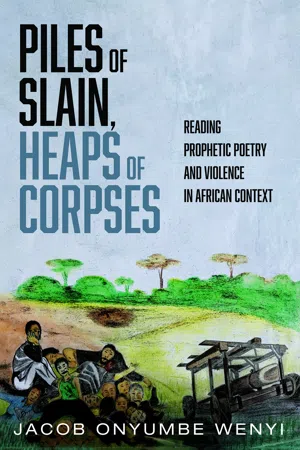
eBook - ePub
Piles of Slain, Heaps of Corpses
Reading Prophetic Poetry and Violence in African Context
- 224 pages
- English
- ePUB (mobile friendly)
- Available on iOS & Android
eBook - ePub
Piles of Slain, Heaps of Corpses
Reading Prophetic Poetry and Violence in African Context
About this book
Piles of Slain, Heaps of Corpses reads the violence in the book of Nahum against the background of the war in the Democratic Republic of the Congo and tries to show how this violent book can be therapeutic and transformative for wounded communities. Here Jacob Onyumbe views Nahum through four scholarly lenses: poetic analysis, study of Assyrian iconography related to eighth- and seventh-century Judah, ethnographic research among survivors of war in the Democratic Republic of the Congo, and modern studies on the impact of war trauma on communities of survivors. He argues that Nahum uses lyric poetry so as to evoke in seventh-century BCE Judahite audiences the memory of war and destruction at the hands of the Assyrians. The prophet uses poetry to evoke (rather than narrate) in order to bring comfort to his audience by revealing the powerful presence of God in the conditions of traumatic violence. Viewed thus, the book of Nahum cannot be dismissed (as has commonly been the case among both scholars and general readers) as irrelevant or merely vindictive. On the contrary, this book--with its depiction of a vengeful God and repulsive war scenes--is essential, especially for traumatized communities.
Trusted by 375,005 students
Access to over 1.5 million titles for a fair monthly price.
Study more efficiently using our study tools.
Information
Topic
Theology & ReligionSubtopic
Biblical Studies1
Tripolar Contextual Biblical Hermeneutics of Reconciliation
Interesting readings abound in the New Testament Society of South Africa (e.g., the 1988 Conference Papers collected in Neotestamentica 22), but outside the gate stand the angry youth asking why they should read the Bible at all.1
Introduction
In his 2011 Post-Synodal Apostolic Exhortation, Africae Munus, Pope Benedict XVI, echoing the wishes and the concerns of African Catholic bishops, urged African Christians to reflect on the plagues of war and violence that have destroyed the African continent and to recognize that they are “called, in the name of Jesus, to live reconciliation between individuals and communities and to promote peace and justice in truth for all.”2 In the same document, Benedict XVI warns against “withdrawal or evasion present in a theological and spiritual speculation which could serve as an escape from concrete historical responsibility”3 and calls “for transforming theology into pastoral care, namely into a very concrete pastoral ministry in which the great perspectives found in sacred Scripture and Tradition find application in the activity of bishops and priests in specific times and places.”4 The African continent then needs to reflect on war, violence, healing, and reconciliation and to imagine a theological methodology that grounds theological reflections and biblical interpretations on the realities of ordinary Africans living in contexts of war and violence. The contribution of African biblical scholars should consist in finding methods of connecting the biblical texts to African contexts in a way that brings healing to deeply divided communities and wounded individuals.
In this chapter, I reflect on the model of biblical interpretation that I find suitable to the context of war trauma in the DRC. What does a survivor of war trauma mean when she says, “I understand this text” or “this text makes sense to me?” Even though I address some general questions about African contextual biblical hermeneutics, I focus on the particular biblical hermeneutics that tries to respond to questions raised by war and its consequences. I propose that the context of violence and deep divisions demands a model of biblical hermeneutics that puts reconciliation at the center of biblical interpretation and promises to provide divided Christian communities with a resource to help them come to term with the legacy of wars and violence. This biblical hermeneutics of reconciliation falls under the larger umbrella of African contextual biblical interpretations, which take the living realities of the readers as the starting point of biblical exegesis.5 This hermeneutics is not a single methodology, but a conversation between a number of methodologies that help me make sense of biblical texts within my context, a context of divisions and war trauma. I follow the recent contextual hermeneutics developed by African scholars, while also making use of European and North American methodologies of literary analysis, historical criticism, and modern trauma studies.
Methodological discussions about biblical interpretation in Sub-Saharan Africa have, for the most part, taken for granted the importance of the context of the reader for the interpretation of biblical texts.6 Scholars carry out their study of the Bible with the assumption that the way one reads the Bible has repercussions on the life of the community in which the reader lives and also that the life experiences of the reader influence the way one reads and makes sense of biblical texts. Of course, the fact that Sub-Saharan biblical interpreters share this assumption about the importance of the context of the reader for biblical interpretation neither means that they operate with one unified hermeneutical ideology nor does it suggest that they are unanimous about the way one negotiates the relationship between the biblical text and the context of the reader. Readers emphasize different things when it comes to the goal of biblical interpretation and to how one relates the text to the context. Various readers work with “ideo-theological orientations”7 that focus on enculturating the message of the Bible in African contexts; others focus on the theme of liberation, while still others focus on reconstruction or on the status of women and children.8 In addition, not every African scholar believes that the Bible is on the side of believers to help them live flourishing lives: some African scholars actually suspect that the Bible might hold views that can impede the flourishing of communities and individuals.9 Nonetheless, whether they suspect the Bible or believe that it has the power to transform communities, African scholars have not ignored the role of the Bible (for good or for ill) in African societies.
This question of the connection between the biblical text and the context of the reader—both the social and the theological contexts—has been of interest to two South African scholars, Jonathan A. Draper and Gerald O. West. Working within the framework of liberation hermeneutics, they assume that it is important to find a way of relating the Bible to the realities of believers. They have lamented the lack of explicit theoretical reflections on the relationship between the biblical text and the context of the reader among African scholars.10 That has led them to develop the project of “tripolar” biblical hermeneutics. A tripolar biblical hermeneutics engages the pole of the African context, the pole of the biblical text, and the pole of the ideo-theological orientation o...
Table of contents
- Title Page
- Foreword
- Acknowledgements
- Abbreviations
- Introduction
- Chapter 1: Tripolar Contextual Biblical Hermeneutics of Reconciliation
- Chapter 2: War, Traumatic Violence, and Congolese Collective Memory
- Chapter 3: On the Genre, the Form, and the Poetics of the Book of Nahum
- Chapter 4: The Historical Context of the Vision of Nahum
- Chapter 5: Imaging God amid Chaos
- Chapter 6: The Destruction of Nineveh and Judah’s Memories of War
- Chapter 7: Reflections on the Way to Appropriation of Nahum in the DRC
- Bibliography
Frequently asked questions
Yes, you can cancel anytime from the Subscription tab in your account settings on the Perlego website. Your subscription will stay active until the end of your current billing period. Learn how to cancel your subscription
No, books cannot be downloaded as external files, such as PDFs, for use outside of Perlego. However, you can download books within the Perlego app for offline reading on mobile or tablet. Learn how to download books offline
Perlego offers two plans: Essential and Complete
- Essential is ideal for learners and professionals who enjoy exploring a wide range of subjects. Access the Essential Library with 800,000+ trusted titles and best-sellers across business, personal growth, and the humanities. Includes unlimited reading time and Standard Read Aloud voice.
- Complete: Perfect for advanced learners and researchers needing full, unrestricted access. Unlock 1.5M+ books across hundreds of subjects, including academic and specialized titles. The Complete Plan also includes advanced features like Premium Read Aloud and Research Assistant.
We are an online textbook subscription service, where you can get access to an entire online library for less than the price of a single book per month. With over 1.5 million books across 990+ topics, we’ve got you covered! Learn about our mission
Look out for the read-aloud symbol on your next book to see if you can listen to it. The read-aloud tool reads text aloud for you, highlighting the text as it is being read. You can pause it, speed it up and slow it down. Learn more about Read Aloud
Yes! You can use the Perlego app on both iOS and Android devices to read anytime, anywhere — even offline. Perfect for commutes or when you’re on the go.
Please note we cannot support devices running on iOS 13 and Android 7 or earlier. Learn more about using the app
Please note we cannot support devices running on iOS 13 and Android 7 or earlier. Learn more about using the app
Yes, you can access Piles of Slain, Heaps of Corpses by Jacob Onyumbe Wenyi in PDF and/or ePUB format, as well as other popular books in Theology & Religion & Biblical Studies. We have over 1.5 million books available in our catalogue for you to explore.