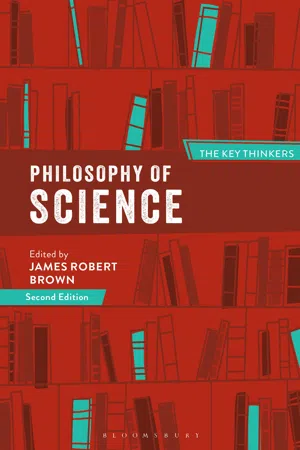
From the 19th century the philosophy of science has been shaped by a group of influential figures. Who were they? Why do they matter? This introduction brings to life the most influential thinkers in the philosophy of science, uncovering how the field has developed over the last 200 years.
Taking up the subject from the time when some philosophers began to think of themselves not just as philosophers but as philosophers of science, a team of leading contemporary philosophers explain, criticize and honour the giants. Now updated and revised throughout, the second edition includes:
· Easy-to-follow overviews of pivotal thinkers including John Stuart Mill, Rudolf Carnap, Thomas Kuhn, Karl Popper, and many more
· Coverage of central issues such as experience and necessity, logical empiricism, falsifiability, paradigms, the sociology of science, realism, and feminist critiques
· An afterword looking ahead to emerging research trends
· Study questions and further reading lists at the end of each chapter
Philosophy of Science: The Key Thinkers demonstrates how the ideas and arguments of these figures laid the foundations of our understanding of modern science.
- 288 pages
- English
- ePUB (mobile friendly)
- Available on iOS & Android
eBook - ePub
Philosophy of Science: The Key Thinkers
About this book
Information
1
Experience and necessity
The Mill–Whewell debate
Laura J. Snyder
But a still greater cause of satisfaction to me from receiving your note is that it gives me the opportunity on which, without impertinent intrusion, I may express to you how strongly I have felt drawn to you by what I have heard of your sentiments respecting the American struggle, now drawing to a close, between liberty and slavery, and between legal government and a rebellion without justification or excuse. No question of our time has been such a touchstone of men – has so tested their sterling qualities of mind and heart, as this one: and I shall all my life feel united by a sort of special tie with those, whether personally known to me or not, who have been faithful when so many were faithless.1
On his seventy-first birthday, the last he would live to see, William Whewell received his only letter from John Stuart Mill. The two men had been engaged for decades in a debate conducted in the pages of their respective books, essays and reviews – a debate so vitriolic that Mill refused even to meet his antagonist, although Mill’s closest friend, James Garth Marshall, had become Whewell’s brother-in-law. Mill was finally moved to correspond with Whewell by learning that Whewell, then Master of Trinity College, Cambridge, had barred the Times from the Master’s Lodge because of its support of the pro-slavery Southern states in the Civil War raging in America. Mill was delighted to hear that his opponent agreed with his conviction that the anti-slavery forces in the North should be supported by the British public.
It is fitting, and not coincidental, that Mill would be motivated to write to Whewell after finding out that Whewell shared his position on the most pressing moral and political issue of the age. Today, the controversy between these two exemplars of Victorian polymathy is known by philosophers primarily for its concern with issues in the philosophy of science. Indeed, it could plausibly be contended that the Whewell–Mill debate on scientific method is one of the first robust confrontations between antagonists on the topics of induction and confirmation. However, as I have argued at length in Reforming Philosophy: A Victorian Debate on Science and Society, the debate between Whewell and Mill crucially concerned not only science but also moral philosophy, economics and political thought – and, moreover, their controversy on scientific reasoning cannot fully be understood without situating this controversy within a broader disagreement on these other issues. Thus, examining the Mill–Whewell debate has value not only for the history of philosophy of science but also for the study of the ways in which scientific discussions are frequently enmeshed with political and social values, whether or not that connection is explicitly stated or recognized by its participants.
The debaters2
William Whewell (1794–1866) was the eldest son of a master carpenter in Lancashire, in the north of England. Although it was expected that he would eventually take over his father’s business, his prodigious intellectual talents were discovered by the headmaster of the local grammar school, who convinced his father to allow Whewell to attend the school. Whewell later won a scholarship to attend Cambridge. He ‘went up’ to the University in 1812, and, professionally speaking, never left. Over the course of his long career Whewell was a lecturer in mathematics, a professor of mineralogy and a professor of moral philosophy. In 1841 he was appointed Master of Trinity College, a position he held until his death twenty-five years later. Whewell engaged in his own scientific research, winning a gold medal from the Royal Society for organizing and conducting an international research project on the tides. He invented the word ‘scientist’, as well as numerous other new terms, including ion, cathode and electrode in electricity research and uniformitarianism, catastrophism, Eocene and Miocene in geology. His greatest contributions to science, however, may have been made by his writings on the history and philosophy of science and his role as teacher, mentor and friend to a generation of men who made the most important scientific discoveries of the day, including Michael Faraday, Charles Darwin, James Clerk Maxwell, James David Forbes, John Herschel and others. In addition to his works on mathematics and natural science, Whewell wrote about economics, theology, morality, architecture and international law, translated Plato and German literature and composed poetry.
John Stuart Mill (1806–1873) was the son of the philosopher James Mill and a protégé of his father’s friend Jeremy Bentham. His early history as a child prodigy is well known: Greek at three, Latin at eight and so on. This was followed by his equally famous nervous breakdown as a young man, triggered in part just because of the strain of his father’s and Bentham’s expectations for him, and in part by his realization that he could not fully accept their utilitarian view of moral and political philosophy. In particular, he felt that both his father and Bentham ignored the importance of educating people both intellectually and morally, in order to create cultivated beings worthy of a democratic political system. Before the political system could be reformed, Mill came to believe, there had to be a ‘complete renovation of the human mind’ (or, as he put it with less reticence in a draft of his Autobiography, the ‘uncultivated herd’).3 Although Mill is one of the canonical authors studied at university today, he never attended any school nor held any university post. Instead, he worked at the East India Office with his father, taking over his father’s position when James Mill died. In later years he served a term in Parliament. Mill’s works spanned logic, moral philosophy, economics, politics and the classics.
The debate: Reforming philosophy
Both Mill and Whewell believed that in order to bring about needed reforms in the social and political realm, it was necessary to revamp philosophy. In his Autobiography, Mill noted that ‘from the winter of 1821, when I first read Bentham . . . I had what might truly be called an object in life; to be a reformer of the world’.4 Later, in one of his essays on Tocqueville, Mill explained that ‘economic and social changes, though among the greatest, are not the only forces which shape the course of our species; ideas are not always the mere signs and effects of social circumstances, they are themselves a power in history.’5 And, more simply, in a letter to a friend, he wrote: ‘There never was a time when ideas went for more in human affairs than they do now.’6
Whewell similarly felt that reforming philosophy was necessary for changing the world. In one letter, Whewell told a close friend, ‘We are no longer young men. . . . I have yet to make out my case by reforming the philosophy of the age, which I am going to set about in reality. I dare say you laugh at my conceit, but you and I are friends too old and intimate I hope for me to mind that.’7 Later, to another friend, he insisted, ‘I believe we want such [new philosophical] systems more than anything else, because at the root of all improved national life must be a steady conviction of the reason, and the reason cannot acquiesce in what is not coherent, that is, systematic.’8
Thus, both Mill and Whewell agreed that society needed reforming and that a new political and social system could be created by refashioning philosophical systems. But disagreements over what the reformed society should look like, and how philosophy ought to be renovated to bring about this new social order, led to a long and very fruitful debate between them covering science, morality, politics and economics. It might seem surprising to find science on this list. Mill and Whewell both believed that a new philosophy of science could be employed for the purpose of transforming society. Mill was particularly explicit in noting that his philosophy of science – and, especially, his epistemology – was designed for this purpose. Mill stated this quite clearly in his Autobiography:
The notion that truths external to the mind may be known by intuition or consciousness, independently of observations and experience, is, I am persuaded, in these times, the great intellectual support of false doctrines and bad institutions. . . . There never was such an instrument devised for consecrating all deep seated prejudices. And the chief strength of this false philosophy in morals, politics and religion, lies in the appeal which it is accustomed to make to the evidence of mathematics and of the cognate branches of physical science. To expel it from these, is to drive it from its stronghold. . . . In attempting to clear up the real nature of the evidence of mathematical and physical truths, the ‘System of Logic’ met the intuition philosophers on grounds on which they had previously been deemed unassailable.9
Mill designed his epistemology and philosophy of science expressly for the purpose of serving his political ends. In particular, he wanted to purge philosophy of intuitionism, which he considered the greatest threat to the types of reforms he wanted to see instituted. He believed that intuitionism supported the status quo; it allowed people to argue that what they deeply believed to be true must be true, that systems which had always existed must always exist. Thus, in order to understand his position and his debate with Whewell, we must recognize this motivation. Mill’s intentions were clear in his own time; Leslie Stephen reported, somewhat surprisingly perhaps to twenty-first-century philosophers of science, that the System of Logic became ‘a kind of sacred book for students who claimed to be genuine liberals’ and was considered ‘the most important manifesto of Utilitarian philosophy’.10 In a letter to Theodor Gomperz, Mill wrote, ‘[You] have rightly judged that, to give the cultivators of physical science the theory of their own operations, was but a small part of the object of the book [System of Logic].’11
Whewell, too, believed that a proper epistemology and scientific method could improve society. As a student at Cambridge, he joined his close friends John Herschel, Richard Jones and Charles Babbage in a Philosophical Breakfast Club, which met on Sunday mornings after the compulsory chapel service to discuss the need for a new revolution in science.12 This revolution was to be inspired mainly by the writings of Francis Bacon, the seven...
Table of contents
- Cover
- Half-Title
- Series
- Title
- Contents
- List of Figures
- Contributors
- Preface to the second edition
- Acknowledgements
- Introduction
- 1 Experience and necessity: The Mill–Whewell debate
- 2 Conventionalism: Poincaré, Duhem, Reichenbach
- 3 The Vienna Circle: Moritz Schlick, Otto Neurath and Rudolf Carnap
- 4 Carl G. Hempel: Logical empiricist
- 5 Anti-inductivism as world view: The philosophy of Karl Popper
- 6 Historical approaches: Kuhn, Lakatos and Feyerabend
- 7 The contingency of the causal nexus: Ghazali and modern science
- 8 Sociology of science: Bloor, Collins, Latour
- 9 One cannot be just a little bit realist: Putnam and van Fraassen
- 10 Beyond theories: Cartwright and Hacking
- 11 Feminist critiques: Harding and Longino
- Afterword
- Index
- Copyright
Trusted by 375,005 students
Access to over 1.5 million titles for a fair monthly price.
Study more efficiently using our study tools.
Frequently asked questions
Yes, you can cancel anytime from the Subscription tab in your account settings on the Perlego website. Your subscription will stay active until the end of your current billing period. Learn how to cancel your subscription
No, books cannot be downloaded as external files, such as PDFs, for use outside of Perlego. However, you can download books within the Perlego app for offline reading on mobile or tablet. Learn how to download books offline
Perlego offers two plans: Essential and Complete
- Essential is ideal for learners and professionals who enjoy exploring a wide range of subjects. Access the Essential Library with 800,000+ trusted titles and best-sellers across business, personal growth, and the humanities. Includes unlimited reading time and Standard Read Aloud voice.
- Complete: Perfect for advanced learners and researchers needing full, unrestricted access. Unlock 1.5M+ books across hundreds of subjects, including academic and specialized titles. The Complete Plan also includes advanced features like Premium Read Aloud and Research Assistant.
We are an online textbook subscription service, where you can get access to an entire online library for less than the price of a single book per month. With over 1.5 million books across 990+ topics, we’ve got you covered! Learn about our mission
Look out for the read-aloud symbol on your next book to see if you can listen to it. The read-aloud tool reads text aloud for you, highlighting the text as it is being read. You can pause it, speed it up and slow it down. Learn more about Read Aloud
Yes! You can use the Perlego app on both iOS and Android devices to read anytime, anywhere — even offline. Perfect for commutes or when you’re on the go.
Please note we cannot support devices running on iOS 13 and Android 7 or earlier. Learn more about using the app
Please note we cannot support devices running on iOS 13 and Android 7 or earlier. Learn more about using the app
Yes, you can access Philosophy of Science: The Key Thinkers by James Robert Brown in PDF and/or ePUB format, as well as other popular books in Philosophy & Analytic Philosophy. We have over 1.5 million books available in our catalogue for you to explore.