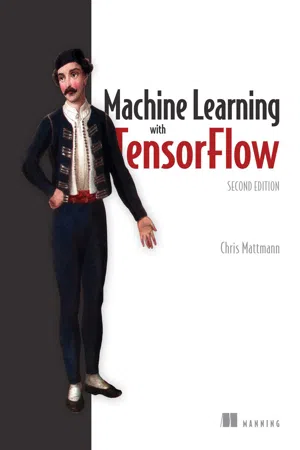
Updated with new code, new projects, and new chapters, Machine Learning with TensorFlow, Second Edition gives readers a solid foundation in machine-learning concepts and the TensorFlow library.
Summary
Updated with new code, new projects, and new chapters, Machine Learning with TensorFlow, Second Edition gives readers a solid foundation in machine-learning concepts and the TensorFlow library. Written by NASA JPL Deputy CTO and Principal Data Scientist Chris Mattmann, all examples are accompanied by downloadable Jupyter Notebooks for a hands-on experience coding TensorFlow with Python. New and revised content expands coverage of core machine learning algorithms, and advancements in neural networks such as VGG-Face facial identification classifiers and deep speech classifiers.
About the technology
Supercharge your data analysis with machine learning! ML algorithms automatically improve as they process data, so results get better over time. You don’t have to be a mathematician to use ML: Tools like Google’s TensorFlow library help with complex calculations so you can focus on getting the answers you need.
About the book
Machine Learning with TensorFlow, Second Edition is a fully revised guide to building machine learning models using Python and TensorFlow. You’ll apply core ML concepts to real-world challenges, such as sentiment analysis, text classification, and image recognition. Hands-on examples illustrate neural network techniques for deep speech processing, facial identification, and auto-encoding with CIFAR-10.
What's inside
Machine Learning with TensorFlow
Choosing the best ML approaches
Visualizing algorithms with TensorBoard
Sharing results with collaborators
Running models in Docker
About the reader
Requires intermediate Python skills and knowledge of general algebraic concepts like vectors and matrices. Examples use the super-stable 1.15.x branch of TensorFlow and TensorFlow 2.x.
About the author
Chris Mattmann is the Division Manager of the Artificial Intelligence, Analytics, and Innovation Organization at NASA Jet Propulsion Lab. The first edition of this book was written by Nishant Shukla with Kenneth Fricklas.
Table of Contents
PART 1 - YOUR MACHINE-LEARNING RIG
1 A machine-learning odyssey
2 TensorFlow essentials
PART 2 - CORE LEARNING ALGORITHMS
3 Linear regression and beyond
4 Using regression for call-center volume prediction
5 A gentle introduction to classification
6 Sentiment classification: Large movie-review dataset
7 Automatically clustering data
8 Inferring user activity from Android accelerometer data
9 Hidden Markov models
10 Part-of-speech tagging and word-sense disambiguation
PART 3 - THE NEURAL NETWORK PARADIGM
11 A peek into autoencoders
12 Applying autoencoders: The CIFAR-10 image dataset
13 Reinforcement learning
14 Convolutional neural networks
15 Building a real-world CNN: VGG-Face ad VGG-Face Lite
16 Recurrent neural networks
17 LSTMs and automatic speech recognition
18 Sequence-to-sequence models for chatbots
19 Utility landscape
- 456 pages
- English
- ePUB (mobile friendly)
- Available on iOS & Android
eBook - ePub
Machine Learning with TensorFlow, Second Edition
Table of contents
- Machine Learning with TensorFlow, 2e
- Copyright
- dedication
- Praise for the First Edition
- front matter
- contents
- Part 1 Your machine-learning rig
- 1 A machine-learning odyssey
- 2 TensorFlow essentials
- Part 2 Core learning algorithms
- 3 Linear regression and beyond
- 4 Using regression for call-center volume prediction
- 5 A gentle introduction to classification
- 6 Sentiment classification: Large movie-review dataset
- 7 Automatically clustering data
- 8 Inferring user activity from Android accelerometer data
- 9 Hidden Markov models
- 10 Part-of-speech tagging and word-sense disambiguation
- Part 3 The neural network paradigm
- 11 A peek into autoencoders
- 12 Applying autoencoders: The CIFAR-10 image dataset
- 13 Reinforcement learning
- 14 Convolutional neural networks
- 15 Building a real-world CNN: VGG -Face and VGG -Face Lite
- 16 Recurrent neural networks
- 17 LSTMs and automatic speech recognition
- 18 Sequence-to-sequence models for chatbots
- 19 Utility landscape
- appendix Installation instructions
- index
Trusted by 375,005 students
Access to over 1.5 million titles for a fair monthly price.
Study more efficiently using our study tools.