Summary
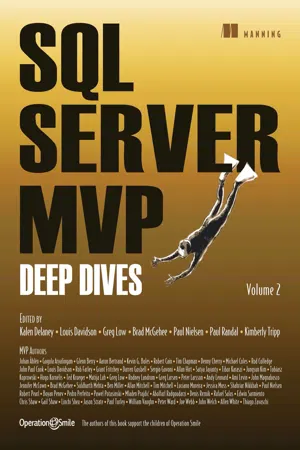
SQL Server MVP Deep Dives, Volume 2 is a unique book that lets you learn from the best in the business - 64 SQL Server MVPs offer completely new content in this second volume on topics ranging from testing and policy management to integration services, reporting, and performance optimization techniques...and more.
About this Book
To become an MVP requires deep knowledge and impressive skill. Together, the 64 MVPs who wrote this book bring about 1,000 years of experience in SQL Server administration, development, training, and design. This incredible book captures their expertise and passion in 60 concise, hand-picked chapters and offers valuable insights for readers of all levels.
SQL Server MVP Deep Dives, Volume 2 picks up where the first volume leaves off, with completely new content on topics ranging from testing and policy management to integration services, reporting, and performance optimization. The chapters fall into five parts: Architecture and Design, Database Administration, Database Development, Performance Tuning and Optimization, and Business Intelligence.
What's Inside
Discovering servers with PowerShell
Using regular expressions in SSMS
Tuning the Transaction Log for OLTP
Optimizing SSIS for dimensional data
Real-time BI and much more
Manning Publications and the authors of this book support the children of Operation Smile, an international children's medical charity that performs free reconstructive surgery for children suffering from facial deformities such as cleft lips and cleft palates by mobilizing medical volunteers who provide education and training programs to local doctors on the latest surgical techniques.
===============================================
Table of Contents
PART 1 ARCHITECTURE Edited by Louis Davidson
PART 2 DATABASE ADMINISTRATION Edited by Paul Randal and Kimberly Tripp
PART 3 DATABASE DEVELOPMENT Edited by Paul Nielsen
PART 4 PERFORMANCE TUNING AND OPTIMIZATION Edited by Brad M. McGehee
PART 5 BUSINESS INTELLIGENCE Edited by Greg Low
eBook - ePub
SQL Server MVP Deep Dives, Volume 2
- 688 pages
- English
- ePUB (mobile friendly)
- Available on iOS & Android
eBook - ePub
SQL Server MVP Deep Dives, Volume 2
About this book
Information
Table of contents
- Copyright
- Dedication
- Brief Table of Contents
- Table of Contents
- MVP authors and their chapters
- Preface
- Acknowledgments
- About Operation Smile
- About this book
- About the Editors
- About SQL Server MVPs
- Part 1. Architecture
- Chapter 1. Where are my keys?
- Chapter 2. “Yes, we are all individuals” A look at uniqueness in the world of SQL
- Chapter 3. Architectural growth pains
- Chapter 4. Characteristics of a great relational database
- Chapter 5. Storage design considerations
- Chapter 6. Generalization: the key to a well-designed schema
- Part 2. Database administration
- Chapter 7. Increasing availability through testing
- Chapter 8. Page restores
- Chapter 9. Capacity planning
- Chapter 10. Discovering your servers with PowerShell and SMO
- Chapter 11. Will the real Mr. Smith please stand up?
- Chapter 12. Build your own SQL Server 2008 performance dashboard
- Chapter 13. SQL Server cost recovery
- Chapter 14. Best practice compliance with Policy-Based Management
- Chapter 15. Using SQL Server Management Studio to the fullest
- Chapter 16. Multiserver management and Utility Explorer—best tools for the DBA
- Chapter 17. Top 10 SQL Server admin student misconceptions
- Chapter 18. High availability of SQL Server in the context of Service Level Agreements
- Part 3. Database development
- Chapter 19. T-SQL: bad habits to kick
- Chapter 20. Death by UDF
- Chapter 21. Using regular expressions in SSMS
- Chapter 22. SQL Server Denali: what’s coming next in T-SQL
- Chapter 23. Creating your own data type
- Chapter 24. Extracting data with regular expressions
- Chapter 25. Relational division
- Chapter 26. SQL FILESTREAM: to BLOB or not to BLOB
- Chapter 27. Writing unit tests for Transact-SQL
- Chapter 28. Getting asynchronous with Service Broker
- Chapter 29. Effective use of HierarchyId
- Chapter 30. Let Service Broker help you scale your application
- Part 4. Performance tuning and optimization
- Chapter 31. Hardware 201: selecting and sizing database server hardware
- Chapter 32. Parameter sniffing: your best friend... except when it isn’t
- Chapter 33. Investigating the plan cache
- Chapter 34. What are you waiting for? An introduction to waits and queues
- Chapter 35. You see sets, and I see loops
- Chapter 36. Performance-tuning the transaction log for OLTP workloads
- Chapter 37. Strategies for unraveling tangled code
- Chapter 38. Using PAL to analyze SQL Server performance
- Chapter 39. Tuning JDBC for SQL Server
- Part 5. Business intelligence
- Chapter 40. Creating a formal Reporting Services report part library
- Chapter 41. Improving report layout and visualization
- Chapter 42. Developing sharable managed code expressions in SSRS
- Chapter 43. Designing reports with custom MDX queries
- Chapter 44. Building a scale-out Reporting Services farm
- Chapter 45. Creating SSRS reports from SSAS
- Chapter 46. Optimizing SSIS for dimensional data loads
- Chapter 47. SSIS configurations management
- Chapter 48. Exploring different types of enumerators in the SSIS Foreach Loop container
- Chapter 49. Late-arriving dimensions in SSIS
- Chapter 50. Why automate tasks with SSIS?
- Chapter 51. Extending SSIS using the Script component
- Chapter 52. ETL design checklist
- Chapter 53. Autogenerating SSAS cubes
- Chapter 54. Scripting SSAS databases – AMO and PowerShell, Better Together
- Chapter 55. Managing context in MDX
- Chapter 56. Using time intelligence functions in PowerPivot
- Chapter 57. Easy BI with Silverlight PivotViewer
- Chapter 58. Excel as a BI frontend tool
- Chapter 59. Real-time BI with StreamInsight
- Chapter 60. BI solution development design considerations
- Index
- List of Figures
- List of Tables
- List of Listings
Trusted by 375,005 students
Access to over 1.5 million titles for a fair monthly price.
Study more efficiently using our study tools.
Frequently asked questions
Yes, you can cancel anytime from the Subscription tab in your account settings on the Perlego website. Your subscription will stay active until the end of your current billing period. Learn how to cancel your subscription
No, books cannot be downloaded as external files, such as PDFs, for use outside of Perlego. However, you can download books within the Perlego app for offline reading on mobile or tablet. Learn how to download books offline
Perlego offers two plans: Essential and Complete
- Essential is ideal for learners and professionals who enjoy exploring a wide range of subjects. Access the Essential Library with 800,000+ trusted titles and best-sellers across business, personal growth, and the humanities. Includes unlimited reading time and Standard Read Aloud voice.
- Complete: Perfect for advanced learners and researchers needing full, unrestricted access. Unlock 1.5M+ books across hundreds of subjects, including academic and specialized titles. The Complete Plan also includes advanced features like Premium Read Aloud and Research Assistant.
We are an online textbook subscription service, where you can get access to an entire online library for less than the price of a single book per month. With over 1.5 million books across 990+ topics, we’ve got you covered! Learn about our mission
Look out for the read-aloud symbol on your next book to see if you can listen to it. The read-aloud tool reads text aloud for you, highlighting the text as it is being read. You can pause it, speed it up and slow it down. Learn more about Read Aloud
Yes! You can use the Perlego app on both iOS and Android devices to read anytime, anywhere — even offline. Perfect for commutes or when you’re on the go.
Please note we cannot support devices running on iOS 13 and Android 7 or earlier. Learn more about using the app
Please note we cannot support devices running on iOS 13 and Android 7 or earlier. Learn more about using the app
Yes, you can access SQL Server MVP Deep Dives, Volume 2 by Paul S. Randal,Kimberly Tripp,Paul Nielsen,Kalen Delaney in PDF and/or ePUB format, as well as other popular books in Computer Science & Databases. We have over 1.5 million books available in our catalogue for you to explore.