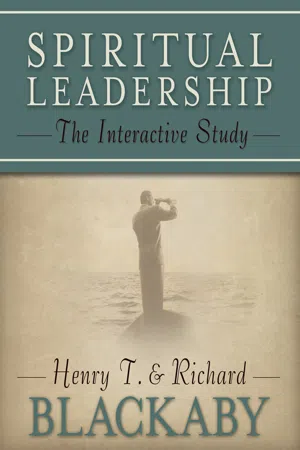
Next to his Experiencing God classic, Spiritual Leadership is one of Henry Blackaby's most highly regarded and best-selling books to date, encouraging leaders in business and church to follow God's design for success. Now, the companion interactive study personalizes the experience of learning the ways in which God develops, guides, and empowers spiritual leaders.
- 230 pages
- English
- ePUB (mobile friendly)
- Available on iOS & Android
eBook - ePub
Spiritual Leadership
About this book
Trusted by 375,005 students
Access to over 1.5 million titles for a fair monthly price.
Study more efficiently using our study tools.
Information
Topic
Theology & ReligionSubtopic
ReligionCHAPTER ONE

The Leader's Challenge
Leadership: The Challenge
Leadership. Everyone experiences it, or the lack of it, in daily life. Successful leaders find satisfaction in making a difference in their world. Struggling leaders agonize in the knowledge that others resent them and blame them for their organizations' failures. Discouraged, these Christian leaders carry the added burden that they are failing not only their people but also their Lord. Is there any hope for leaders who are not experiencing fulfillment and reaching the potential God intended for them? If anything can revolutionize today's Christian leaders, it is when Christians understand God's design for spiritual leadership.
Questions
Do you see yourself as a leader? Why or why not?
What leaders have personally impacted you either positively or negatively? In what ways?
What leadership roles have you been assigned? Were they frustrating or fulfilling roles? Why?
Today's Leadership Pressures
Today leaders have unprecedented opportunities to impact their organizations. However, the new millennium also brings significant challenges. Technology's unrelenting advance has made communication both a blessing and a curse. Faxes, e-mail, cell phones, and videoconferencing provide instant access to leaders. In times past people wrote letters to their leader and waited weeks for an answer. Such delayed responses were accepted as a matter of course. Leaders could take time to ponder decisions and to consult with advisors before offering thoughtful replies. Technology has radically changed the dynamics of communication. The moment an e-mail is sent, an immediate response is possible (and therefore expected).
Yesterday's leaders had certain times in their day when they could retreat to review their situation and make appropriate decisions. Technology makes today's leaders constantly and instantly accessible. The pressure to make rapid decisions and to maintain constant communication can intimidate the most proficient leader.
Yesterday's leaders had fewer decisions to make. The Information Age has inundated leaders with new data that must be processed as rapidly as possible. Leaders wanting to improve their skills and expand their knowledge have limitless opportunities to enhance their leadership abilities. But where does one begin? Which book do you read next? Which seminar is indispensable? Which management trend vociferously advocated now will be passé tomorrow?
Perhaps the most prevalent modern myth is that technology creates more time for leaders. While modern communication tools are heralded as time-saving devices, in reality these instruments become major information highways inundating leaders with an endless stream of data to which they feel pressured to respond immediately. Gordon Sullivan and Michael Harper suggest that the defining characteristic of the Information Age is not speed but the “compression of time.”1 There is less time for leaders to respond to events than there used to be.
Questions
What are the three most intense pressures you currently face as a leader?
How has technology impacted you as a leader?
How do you filter through the important, urgent, and unimportant information you receive each day?
Our world craves good leaders. Effective leadership is the answer for every challenge society faces. Whether it's in politics, religion, business, education, or law, the universally expressed need is for leaders who will rise to meet the challenges that overwhelm modern organizations. The problem is not a shortage of willing leaders. The problem is an increasingly skeptical view among followers as to whether these people can truly steer them to their goals. Warren Bennis warned, “At the heart of America is a vacuum into which self-anointed saviors have rushed.”2 People know intuitively that claiming to be a leader or holding a leadership position does not make someone a leader. People are warily looking for leaders they can trust.
Leadership: In Politics
The political scene is perhaps the most public arena where people have expressed their distrust of leaders. These are not easy times to be a leader. The world's complexity increases at exponential speed. Political alliances are in constant flux. Threats of nuclear and biological terrorism are a real and frightening possibility. A severe downturn in the global economy can devastate a nation overnight. Violence is pandemic. Indiscretions make international headlines overnight. Social mores, previously taken for granted, are publicly ridiculed. Nothing shocks us anymore. Modern society has deteriorated until we have “forgotten how to blush” (Jer. 6:15; 8:12).
Such daunting political and social realities have us searching frantically for men and women we can trust to address a multitude of societal and political ills. People are weary of politicians who make promises they are either unwilling or unable to keep. Society longs for statesmen, but it gets politicians. Statesmen are leaders who uphold what is right regardless of the popularity of the position. Statesmen speak out to achieve good for their people, not to win votes. Statesmen promote the general good rather than regional or personal self-interest. Politicians may win elections; nevertheless, future generations could deride them for their lack of character and their ineffective leadership. If there were ever a time that called for statesmen rather than politicians, it is now.
Questions
Is it harder to be a politician or a statesman? Why?
Who are today's statesmen, and how do they differ from politicians?
Leadership: In Business
The business world cries out for leaders as fervently as the political world. The dearth of leaders has caused effective corporate leaders to be wooed by other organizations. Technology continues to revolutionize the way people do business. The global economy has mushroomed. National economies have become integrated to the point that a financial meltdown in Asia can have instant, stunning repercussions on businesses in North America. Diversity is the pervasive characteristic of the North American workforce. Employees represent numerous ethnic groups. More and more people are trading in their desks for laptops so they can work at home or while on the road. Job sharing is common. Charles Handy observes, “The challenge for tomorrow's leaders is to manage an organization that is not there in any sense in which we are used to.”3
Yesterday's workplace was a specific location where employees gathered for eight hours a day. Most jobs were performed for one reason—a paycheck. Personal fulfillment, though a factor, was secondary. That has changed. Today's workplace is a forum for people to express themselves. They want to invest their efforts into something that contributes to society. People no longer choose jobs based merely on salary and benefits. They seek companies with corporate values that match their personal values. Daniel Goleman suggests: “Except for the financially desperate, people do not work for money alone. What also fuels their passion for work is a larger sense of purpose or passion. Given the opportunity, people gravitate to what gives them meaning, to what engages to the fullest their commitment, talent, energy, and skill.”4 For this reason many embark on multiple careers. Robert Greenleaf reflects on this shift in employee focus: “All work exists as much for the enrichment of the life of the worker as it does for the service of the one who pays for it.”5 Consequently, employees expect much more from their leaders than they did in years past.
The complex and critical issues facing today's marketplace only exacerbate the need for effective leaders. Modern business leaders are expected to peer into the turbulent economic future and make the necessary adjustments to avoid disaster for their companies. Today's leaders have to mold productive, cohesive teams out of the most diverse workforce in history. Leaders must gain new skills continually and adjust to dizzying daily changes in the business world. Is it any wonder that companies are desperate for someone to lead them into an uncertain future? Is it surprising that the salaries of CEOs have risen astronomically in comparison to the wages of laborers?
Questions
Besides the paycheck, why do you continue working where you do?
If you are currently in a leadership position at your workplace, how do you provide meaning and significance to those you lead?
Leadership: In the Church
Like every other segment of society, the religious community has not escaped the leadership drought. Jesus warned his followers about false prophets who would rise up to lead many astray (Matt. 24:11). Who could have anticipated the plethora of would-be spiritual leaders who have flooded the airwaves and descended upon churches with their books and their theories, clamoring for followers? People long for spiritual leaders who can make positive changes in their lives!
Society at large is displaying widespread and growing interest in spiritual issues. Amazingly, at a time of renewed societal interest in spiritual things, many churches and denominations are plateauing or declining. According to George Barna, “the American church is dying due to a lack of strong leadership. In this time of unprecedented opportunity and plentiful resources, the church is actually losing influence. The primary reason is the lack of leadership. Nothing is more important than leadership.”6
Questions
What are the leadership needs of today's churches?
How have they changed in the last fifty years?
Why are there not more effective leaders in churches today?
Leadership: Secular or Spiritual?
This issue of leadership holds a deeper dimension for Christians: Is Christian leadership the same thing as secular leadership? Modern bookstores have capitalized on the chronic thirst for leadership. They stock shelves with books written by leaders who have been successful in business, sports, politics, or any other field and who have detailed their success.
This raises a significant question for Christian leaders: Do leadership principles found in secular writing and seminars apply to God's kingdom? In times past churches focused on the Great Commission. Today's churches adopt mission statements. In earlier times churches spoke of building fellowship. Contemporary Christian leaders assemble teams and lead their people through team-building exercises. Today's churches use state-of-the-art marketing techniques to reach their communities. Pastors act more like CEOs than shepherds. The pastor's office is located in the executive suite, next to the boardroom where the leadership team meets. Is this adoption of secular leadership methodology a sorely needed improvement for churches? Or is it a violation of biblical principles? Many church leaders claim these innovations have resulted in dramatic growth in their congregations. Other Christian leaders decry such approaches as blatant theological and biblical compromise.
The trend toward a CEO model of ministry has changed the churches' evaluations of effective leadership. The pastor's ability is measured in terms of people, dollars, and buildings. The more of each, the more successful the pastor. Christian organizations seem willing to overlook significant character flaws, and even moral lapses, as long as their leader continues to produce.
It is critical to examine contemporary leadership principles in light of scriptural truth. Many leadership principles currently being espoused are, in fact, biblical principles that have been commanded by God throughout history. For example, secular writers on leadership insist on integrity as an essential characteristic for modern leaders. The Bible has maintained that as a leadership standard for over three millennia.
Paradoxically, concurrent with the churches' discovery of popular leadership axioms, secular pundits have been embracing the timeless truths of Christianity. Why this shift to Christian principles? Leadership authorities find that doing business in a Christian manner, regardless of whether one is a practicing Christian, is good for business. Today's leadership gurus are writing books that appear almost Christian. Book titles such as Jesus CEO, Management Lessons of Jesus, Servant Leadership, Love and Profit, Leading with Soul, and Encouraging the Heart sound like they ought to be shelved in a Christian college, not in the office of a corporate CEO.
The Christian tenor of these books goes beyond their titles. It is common to read in secular leadership books that companies should make covenants with their people, that business leaders should love their people, that managers should be servant leaders, that leaders should show their feelings to their employees, that business leaders must have integrity, that leaders must tell the truth, and interestingly, that leaders must strive for a higher purpose than merely making a profit. These principles appear to be more in keeping with the Sermon on the Mount than with the Harvard Business School. Incredibly, as secular writers are embracing Christian teachings with the fervency of first-century Christians, Christian leaders are inadvertently jettisoning many of those same truths in an effort to become more contemporary!
Questions
What are some of the differences between secular and biblical leadership?
Are you following secular or biblical leadership principles? How will you justify your answer?
God or King?
The willingness of God's people to barter their spiritual birthright for the benefit of contemporary secular thinking is not unique to this generation. During Samuel's time the Israelites were a small, insignificant nation in the midst of international superpowers. They were content to have Samuel as their spiritual guide and God as their king. But as Samuel grew old, his ungodly sons abused their leadership positions. The Israelites compared themselves to neighboring nations and envied their powerful armies, their magnificent cities, and the glory of their monarchies. Rather than trusting in God to win their battles, to direct their economy, and to establish laws for their land, the Israelites wanted to be like the other nations with a king who would do all this for them. They took their request to Samuel. In response, Samuel gave them God's appraisal of where this pursuit for a king would lead them. He said:
“This is what the king who will reign over you will do: He will take your sons and make them serve with his chariots and horses, and they will run in front of his chariots. Some he will assign to be commanders of thousands and commanders of fifties, and others to plow his ground and reap his harvest, and still others to make weapons of war and equipment for his chariots. He will take your daughters to be perfumers and cooks and bakers. He will take the best of your fields and vineyards and olive groves and give them to his attendants. He will take a tenth of your grain and of your vintage and give it to his officials and attendants. Your menservants and maidservants and the best of your cattle and donkeys he will take for his own use. He will take a tenth of your flocks, and you yourselves will become his slaves. When that day comes, you will cry out for relief from the king you have chosen, and the LORD will not answer you in that day.”
But the people refused to listen to Samuel. “No!” they said. “We want a king over us. Then we will be like all the other nations, with a king to lead us and to go out before us and fight our battles.”
When Samuel heard all that the people said, he repeated it before the LORD. The LORD answered, “Listen to them and give them a king.” (1 Sam. 8:11–22 NIV)
The world measured a kingdom's success by its grand palaces and magnificent armies. The glittering...
Table of contents
- Cover
- Half title Page
- Full title Page
- Copyright Page
- Dedication
- Table of Contents
- chapter 1
- chapter 2
- chapter 3
- chapter 4
- chapter 5
- chapter 6
- chapter 7
- chapter 8
- chapter 9
- chapter 10
- chapter 11
- Notes
- About The Authors
Frequently asked questions
Yes, you can cancel anytime from the Subscription tab in your account settings on the Perlego website. Your subscription will stay active until the end of your current billing period. Learn how to cancel your subscription
No, books cannot be downloaded as external files, such as PDFs, for use outside of Perlego. However, you can download books within the Perlego app for offline reading on mobile or tablet. Learn how to download books offline
Perlego offers two plans: Essential and Complete
- Essential is ideal for learners and professionals who enjoy exploring a wide range of subjects. Access the Essential Library with 800,000+ trusted titles and best-sellers across business, personal growth, and the humanities. Includes unlimited reading time and Standard Read Aloud voice.
- Complete: Perfect for advanced learners and researchers needing full, unrestricted access. Unlock 1.5M+ books across hundreds of subjects, including academic and specialized titles. The Complete Plan also includes advanced features like Premium Read Aloud and Research Assistant.
We are an online textbook subscription service, where you can get access to an entire online library for less than the price of a single book per month. With over 1.5 million books across 990+ topics, we’ve got you covered! Learn about our mission
Look out for the read-aloud symbol on your next book to see if you can listen to it. The read-aloud tool reads text aloud for you, highlighting the text as it is being read. You can pause it, speed it up and slow it down. Learn more about Read Aloud
Yes! You can use the Perlego app on both iOS and Android devices to read anytime, anywhere — even offline. Perfect for commutes or when you’re on the go.
Please note we cannot support devices running on iOS 13 and Android 7 or earlier. Learn more about using the app
Please note we cannot support devices running on iOS 13 and Android 7 or earlier. Learn more about using the app
Yes, you can access Spiritual Leadership by Henry T. Blackaby,Richard Blackaby in PDF and/or ePUB format, as well as other popular books in Theology & Religion & Religion. We have over 1.5 million books available in our catalogue for you to explore.