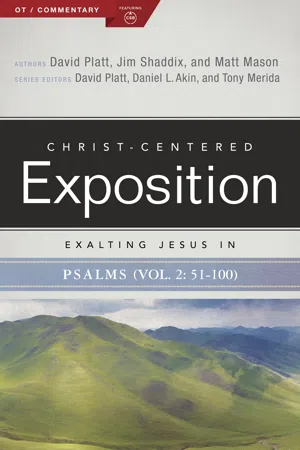
Exalting Jesus in Psalms, Volume 2, Psalms 51-100 is part of the Christ-Centered Exposition Commentary series. Edited by David Platt, Daniel L. Akin, and Tony Merida, this commentary series, to include 47 volumes when complete, takes a Christ-centered approach to expositing each book of the Bible. Rather than a verse-by-verse approach, the authors have crafted chapters that explain and apply key passages in their assigned Bible books.
Readers will learn to see Christ in all aspects of Scripture, and they will be encouraged by the devotional nature of each exposition presented as sermons and divided into chapters that conclude with a “Reflect & Discuss” section, making this series ideal for small group study, personal devotion, and even sermon preparation. It’s not academic but rather presents an easy reading, practical and friendly commentary.
The authors of Exalting Jesus in Psalms, Volume 2, Psalms 51-100 are Matt Mason, David Platt, and Jim Shaddix.
- 300 pages
- English
- ePUB (mobile friendly)
- Available on iOS & Android
eBook - ePub
Exalting Jesus in Psalms 51-100
About this book
Information
Topic
Theology & ReligionSubtopic
Biblical CommentaryPsalms 51–100
The Confession of Man and the Compassion of God
Psalm 51
Main Idea: Sin is an infinitely serious offense against God, but by his grace and mercy we can be forgiven and restored to God through honest and humble confession.
I. Sin Is Serious.
A. Sin is offensive.
1. Sin defies God.
2. Sin destroys man.
B. Sin is comprehensive.
C. Sin is pervasive.
1. Sin appears so subtly.
2. Sin harms so deeply.
3. Sin controls so quickly.
4. Sin devastates so painfully.
II. God Is Gracious.
A. His cleansing is costly.
B. His forgiveness is free.
III. Confession Is the Connection.
A. Confession involves honesty.
B. Confession involves humility.
IV. Restoration Is the Result.
A. God re-creates our heart.
B. God reestablishes our joy.
C. We walk with him.
D. We witness for him.
E. We worship him.
Psalm 51 is one of the most well-known, humbling, convicting, and encouraging psalms in the whole Bible. In the words of Charles Spurgeon, “Such a psalm may be wept over, absorbed into the soul, and exhaled again in devotion; but, commented on—ah! where is he who having attempted it can do other than blush at his defeat?” (Spurgeon on the Psalms, 3). As we make our way through this psalm, we should do so humbly, pondering its meaning along the way and allowing its truth to penetrate our hearts.
In order to understand what this psalm is saying and how it applies to our lives, we need to start by reading its superscription. The events of 2 Samuel 11:1–12:23, instrumental for understanding the psalm’s message, are the psalm’s historical background. Apart from this story of David’s sin, we won’t feel the weight of Psalm 51.
David committed adultery with Bathsheba then arranged for her husband to be put to death. This tragic story is not merely there to provide historical information. We have much to learn in our own lives and in the church by looking not only at the triumphs but also at the failures of those who have gone before us. These failures should serve as a warning. Thankfully, we can also learn from David’s response to his failure in Psalm 51.
Amid the various ways this psalm teaches and shapes us, there are four simple yet significant truths we need to grasp.
Sin Is Serious
David uses words like “rebellion” (vv. 1,3), “guilt” (vv. 2,5,9), and “evil” (v. 4) throughout this psalm, reminding us that sin is offensive. The word rebellion, sometimes translated as “transgression” (ESV), refers to going against divine law. We see the nature of sin here in two ways.
First, sin defies God (v. 4). We may think the most serious consequence of our sin is the harm we bring to someone else—a spouse, children, parents, or friends. In our narcissistic age, we may even think the worst consequence of our sin is what happens to us. But that’s not a biblical view of sin.
The worst consequence—and the primary problem—of our sin is that we have defied the infinitely holy God of the universe. Think about the transition that has come about in David at this point: he has gone from asking, “How do I cover up my sin?” to “How could I do this to God?” This is the place we all need to come to. We need to see our sin for what it is—outright defiance of God himself.
In addition to defying God, sin destroys man. The effect of David’s sin with Bathsheba carried beyond David to the murder of Uriah, which also means a wife lost her husband. And, tragically, the child of David and Bathsheba died in the process. Never underestimate the power of sin in your life to cause pain in others’ lives.
Sin is comprehensive. David doesn’t just say he messed up a few times. No, he has a much more comprehensive understanding of sin. He knows sin goes back to the moment he was born (v. 5). That’s not a reference to an immoral relationship David’s mother had, nor is it a reference to the specific circumstances surrounding David’s birth. It’s a reference to the reality that affects every one of us from the moment we are born. We are born into sin. We are born with hearts that are prone to defy God and destroy others. I’ve seen in my youngest children a nature that is sweet, cute, and cuddly at one moment and in the next defiant and uncontrollable. This is true of all of us—we don’t just occasionally sin. We are comprehensive sinners, possessing a nature that is prone to disobey.
Sin is pervasive (v. 3). Like David, we too can say “my sin is always before me” (v. 3). Even in my best deeds and on my best days, when I am doing what would seem to be the most noble things, I am still prone to do those things for selfish reasons. Even in my clearest displays of Christlike actions on the outside, I can harbor some of the most evil thoughts on the inside. I am a sinner, through and through.
David’s life is a reminder that sin appears so subtly. It all started with a walk outside and a glance across the roof. This is why Jesus says in Matthew 5:29, “If your right eye causes you to sin, gouge it out and throw it away. For it is better that you lose one of the parts of your body than for your whole body to be thrown into hell.” Jesus’s words may at first sound extreme, but they make sense given the consequences of sin. If David only knew the disastrous effects that would spring from this glance—a glance that would wreck the rest of his life—if only he had the chance to do it all over again, he would have preferred to gouge out his own eye. That’s the point of what Jesus is saying: take radical measures to guard yourself against pervasive sin that appears so subtly.
Also, sin harms so deeply. A lustful look leads to adultery, adultery to lying, lying to murder, and murder to the death of a child. And beyond this episode, David’s oldest son, Amnon, repeats the sin of his father, except he rapes his half sister. We’re reminded that sin controls so quickly. David’s sin permeated his household throughout the rest of 2 Samuel. Within two years his son Absalom murdered his brother Amnon and rebelled against his father (see 2 Sam 13–15). Sin devastates so painfully. David’s reign as king eventually ends with strife between the men of Judah in the south and the men of Israel in the north, strife that would one day lead to a divided kingdom. This devastation started with one look on one day, and it resulted in David’s crying out because his joy was gone and his bones had been “crushed” (v. 8).
Psalm 51 reminds us of the gravity of sin. You and I may think our sin is small, but it is extremely serious. What we perceive to be the slightest sin is infinitely serious before God. It’s a defiance of God, and it destroys you and others. That is not an overstatement; recall that, according to Genesis 3, sin and death entered the world through one sin. A piece of fruit was eaten, and condemnation came to all men (see Rom 5:12-21). All the effects of sin in the world—murders and rapes and holocausts and world wars and slavery and sex trafficking and thousands of other evils—trace back to that one sin in the garden.
We see the seriousness of sin throughout Scripture. To take a small snapshot, Numbers 14–16 recounts several instances of God’s judgment against sin. God’s people sinned at the edge of the promised land in Numbers 14, and God said that none of them (except Joshua and Caleb) would see the land that he swore to give to their fathers (Num 14:22-23). Then, in the next chapter, we read of the following incident:
While the Israelites were in the wilderness, they found a man gathering wood on the Sabbath day. Those who found him gathering wood brought him to Moses, Aaron, and the entire community. They placed him in custody because it had not been decided what should be done to him. Then the Lord told Moses, “The man is to be put to death. The entire community is to stone him outside the camp.” So the entire community brought him outside the camp and stoned him to death, as the Lord had commanded Moses. (Num 15:32-36)
Stoned for picking up sticks on the Sabbath! Finally, in Numbers 16, Korah and others rebelled against Moses, and ultimately against God. This rebellion elicited the following reaction from God:
Just as he finished speaking all these words, the ground beneath them split open. The earth opened its mouth and swallowed them and their households, all Korah’s people, and all th...
Table of contents
- Acknowledgments
- Series Introduction
- Psalms 51–100
- Works Cited
- Scripture Index
Trusted by 375,005 students
Access to over 1.5 million titles for a fair monthly price.
Study more efficiently using our study tools.
Frequently asked questions
Yes, you can cancel anytime from the Subscription tab in your account settings on the Perlego website. Your subscription will stay active until the end of your current billing period. Learn how to cancel your subscription
No, books cannot be downloaded as external files, such as PDFs, for use outside of Perlego. However, you can download books within the Perlego app for offline reading on mobile or tablet. Learn how to download books offline
Perlego offers two plans: Essential and Complete
- Essential is ideal for learners and professionals who enjoy exploring a wide range of subjects. Access the Essential Library with 800,000+ trusted titles and best-sellers across business, personal growth, and the humanities. Includes unlimited reading time and Standard Read Aloud voice.
- Complete: Perfect for advanced learners and researchers needing full, unrestricted access. Unlock 1.5M+ books across hundreds of subjects, including academic and specialized titles. The Complete Plan also includes advanced features like Premium Read Aloud and Research Assistant.
We are an online textbook subscription service, where you can get access to an entire online library for less than the price of a single book per month. With over 1.5 million books across 990+ topics, we’ve got you covered! Learn about our mission
Look out for the read-aloud symbol on your next book to see if you can listen to it. The read-aloud tool reads text aloud for you, highlighting the text as it is being read. You can pause it, speed it up and slow it down. Learn more about Read Aloud
Yes! You can use the Perlego app on both iOS and Android devices to read anytime, anywhere — even offline. Perfect for commutes or when you’re on the go.
Please note we cannot support devices running on iOS 13 and Android 7 or earlier. Learn more about using the app
Please note we cannot support devices running on iOS 13 and Android 7 or earlier. Learn more about using the app
Yes, you can access Exalting Jesus in Psalms 51-100 by David Platt,Matt Mason,Jim Shaddix in PDF and/or ePUB format, as well as other popular books in Theology & Religion & Biblical Commentary. We have over 1.5 million books available in our catalogue for you to explore.