Edited by David Platt, Daniel L. Akin, and Tony Merida, this new commentary series, projected to be 48 volumes, takes a Christ-centered approach to expositing each book of the Bible. Rather than a verse-by-verse approach, the authors have crafted chapters that explain and apply key passages in their assigned Bible books. Readers will learn to see Christ in all aspects of Scripture, and they will be encouraged by the devotional nature of each exposition.
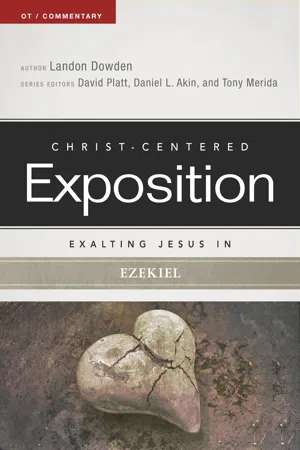
- 288 pages
- English
- ePUB (mobile friendly)
- Available on iOS & Android
eBook - ePub
Exalting Jesus in Ezekiel
About this book
Information
Topic
Theology & ReligionSubtopic
Biblical CommentaryEzekiel
God’s Glory and Discipline
Ezekiel 1:1-28
Main Idea: Even in discipline God does not abandon His people but sustains them for the sake of His glory.
I. God Always Has a Purpose for Disciplining His Children (1:1-2).
A. God’s discipline of His children is never arbitrary but always deserved.
B. God’s discipline of His children is always a means of grace.
II. God Always Provides When Disciplining His Children (1:3).
A. His prophet
B. His word
C. His hand
III. God Is Always Present Through the Disciplining of His Children (1:4-28).
A. What does Ezekiel see and hear?
B. Why does Ezekiel see this vision?
C. What can we see?
1. God is holy and rightly judges sin.
2. God knows everything and is everywhere.
3. God is sovereign and unique.
4. God is glorious and merciful.
D. Ezekiel’s reaction and ours
Prior to my being asked to write a commentary on Ezekiel, I honestly had not spent a lot of time in this book. Also prior to Platt, Akin, and Merida’s asking me to write a commentary on Ezekiel, I considered these men my friends. But I digress. As I prepared to lead the people I have the privilege of pastoring through a sermon series on Ezekiel, I found that three of my favorite pastors had neither recorded nor published any sermons on Ezekiel and a fourth pastor has only five sermons from Ezekiel on his church website. I won’t reveal their names so as not to incriminate them for avoiding such a great text. I learned that rabbis had discouraged their students from teaching through Ezekiel before the age of 30, but my suspicion is they were scared God might ask them to do some of the things He asked Ezekiel to do. Imagine if you were Ezekiel’s neighbor! Despite the lack of preaching frequency in Ezekiel, this book has much to say to contemporary audiences about God’s glory, God’s discipline, God’s sovereignty, God’s judgment, God’s mercy, God’s faithfulness, and God’s restoration. The value of preaching through Ezekiel can even be seen from its opening chapter.
Have you ever felt like your ability to sin is greater than God’s ability to save? Have you ever felt like you have overextended your sin limit on God’s daily mercies? Have you ever felt like “I’ve done it now” and your sin is going to cause God to finally say, “I’m done with you! I quit”? Or perhaps you have felt like God has abandoned you in your sin and left you alone to experience the full consequences of your rebellion. If you have ever had any or all of these feelings, then Ezekiel is the word from the Lord you need to hear.
God will not tolerate the sin of His people, but it is also true that He will not abandon them. The gospel reminds us why: God will not leave us because He left His Son; God will not abandon us because He abandoned His Son; God will not forsake us because He forsook His Son; and God will not condemn us because He condemned His Son. Even in the midst of the worst consequences due to our sin, God still offers a word of hope and restoration. The ultimate fulfillment may never occur in this life, but it will occur. The way God chose to remind His people in Ezekiel’s day that He would not forsake them was to give them a magnificent vision of Himself.
God Always Has a Purpose for Disciplining His Children
Ezekiel 1:1-2
The book opens with Ezekiel and other Israelites living as exiles in Babylon. Daniel and those with him were most likely deported to Babylon in 605 BC, while Ezekiel was most likely exiled in 597 BC (House and Mitchell, Survey, 220). We do not know the exact city Ezekiel lived in while in Babylon, but some see Tel-Abib as a possibility. We are informed in the opening verses that Ezekiel and the others have been in exile for five years. On this particular day, Ezekiel is by the Chebar canal.
He begins by letting us know that in the thirtieth year, in the fourth month, on the fifth day of the month, he was among the exiles by the Chebar canal and the heavens were opened and he saw visions of God. The date appears permanently etched in Ezekiel’s memory. For many of us, it might be similar to asking, “Where were you when the Challenger shuttle exploded?” or “Where were you when the towers fell in New York?” For me August stands out because this is the day my parents separated and a few years later it was the same date on which one of my good friends was drowned. We all have dates and experiences that are seared into our memories. In Ezekiel’s case there is no doubt why he remembered so many details surrounding the vision he was given. God was going to reveal Himself in a way Ezekiel could have never imagined in his wildest dreams.
What about you? Can you remember a day when God spoke to you when you were least expecting it? Perhaps you were not even speaking to Him, but He captured your attention. Ezekiel is a reminder that God can do extraordinary things on what seems to be ordinary days. The day of the first vision had such an impact on Ezekiel that he never forgot it but could pinpoint specifically when it occurred and where he was. Where he was is a good question. Why was he in Babylon?
God’s Discipline of His Children Is Never Arbitrary but Always Deserved
God’s people were in Babylon because God was disciplining them for their sin. None were innocent and nothing was arbitrary. From 2 Kings 24 we learn that God used Nebuchadnezzar to come against and conquer His people because of the rebellion and all the evil their leaders had done in His sight (2 Kgs 24:9). God is holy. He reigns for His glory and our good. All of our sin is a rejection of His reign and an assertion of our own. The length of the exile would be 70 years. Many of those exiled would die in Babylon, and others would be born there. Imagine a father having to explain to his son why he was born in Babylon instead of Judah. Always remember: it may be my sin, but it is always our consequences. Sin always has a cost. For God’s people exile would be a heavy price to pay.
If you want to know how the Israelites were feeling during this exile, then all you have to do is read Psalm 137. In this psalm we learn that God’s people wept when they remembered Zion and they hung up their musical instruments because they didn’t feel like singing anymore. They were separated from the temple and its sacrificial system. But more importantly, they were cut off from God’s presence—at least, that is what they thought. If God was in the temple and the temple was in Jerusalem, then how could they meet with Him? For Israel it was a period of deep mourning. Whether their mourning was from proper or improper motives remains to be seen. What about us? When God disciplines us, do we mourn because we’ve been caught or because we have grieved Him? All of God’s discipline is grace to us.
God’s Discipline of His Children Is Always a Means of Grace
Amazingly, God does not abandon the children He disciplines but instead sustains and sanctifies them through it. Jeremiah 24 is a record of God’s purpose for the Babylonian exile. Listen to what He says about those He sent away to the land of the Chaldeans:
I will keep My eyes on them for their good and will return them to this land. I will build them up and not demolish them; I will plant them and not uproot them. I will give them a heart to know Me, that I am Yahweh. They will be My people, and I will be their God because they will return to Me with all th...
Table of contents
- Acknowledgments
- God’s Glory and Discipline 1:1-28
- Ezekiel’s Commissioning and Ours 2:1–3:27
- When God Is Against You 4:1–5:17
- When Our Promiscuous Hearts Grieve God’s Heart 6:1–7:27
- Ichabod: When Elvis Is Not the Only One to Leave the Building 8:1–11:25
- Our Response to God and His Word 12:1–13:23
- Idolatry Leads to Uselessness 14:1–15:8
- The Gospel According to Ezekiel 16:1-63; 23:1-46
- Riddle Me This 17:1-24
- Turn and Live: God’s Justice and Our Responsibility 18:1-32
- Weeping for Those Who Lead Us 19:1-14
- Like Fathers, like Sons . . . but Not Forever 20:1-44
- God’s Fire and God’s Sword 20:45–22:12
- Judgment, Sacrifice, and a Glimmer of Hope 24:1-27
- The Nations Will Know That I Am Yahweh 25:1–32:32
- The Watchmen of Our City 33:1-33
- Our Great Shepherd-King 34:1-31; 22:6-31
- Regeneration: How and Why God Saves His People 35:1–36:38
- Alive and United 37:1-28
- When Bad News Is Good News 38:1–39:29
- The Lord Is There 40:1–48:35
- Works Cited
- Scripture Index
Trusted by 375,005 students
Access to over 1.5 million titles for a fair monthly price.
Study more efficiently using our study tools.
Frequently asked questions
Yes, you can cancel anytime from the Subscription tab in your account settings on the Perlego website. Your subscription will stay active until the end of your current billing period. Learn how to cancel your subscription
No, books cannot be downloaded as external files, such as PDFs, for use outside of Perlego. However, you can download books within the Perlego app for offline reading on mobile or tablet. Learn how to download books offline
Perlego offers two plans: Essential and Complete
- Essential is ideal for learners and professionals who enjoy exploring a wide range of subjects. Access the Essential Library with 800,000+ trusted titles and best-sellers across business, personal growth, and the humanities. Includes unlimited reading time and Standard Read Aloud voice.
- Complete: Perfect for advanced learners and researchers needing full, unrestricted access. Unlock 1.5M+ books across hundreds of subjects, including academic and specialized titles. The Complete Plan also includes advanced features like Premium Read Aloud and Research Assistant.
We are an online textbook subscription service, where you can get access to an entire online library for less than the price of a single book per month. With over 1.5 million books across 990+ topics, we’ve got you covered! Learn about our mission
Look out for the read-aloud symbol on your next book to see if you can listen to it. The read-aloud tool reads text aloud for you, highlighting the text as it is being read. You can pause it, speed it up and slow it down. Learn more about Read Aloud
Yes! You can use the Perlego app on both iOS and Android devices to read anytime, anywhere — even offline. Perfect for commutes or when you’re on the go.
Please note we cannot support devices running on iOS 13 and Android 7 or earlier. Learn more about using the app
Please note we cannot support devices running on iOS 13 and Android 7 or earlier. Learn more about using the app
Yes, you can access Exalting Jesus in Ezekiel by Landon Dowden in PDF and/or ePUB format, as well as other popular books in Theology & Religion & Biblical Commentary. We have over 1.5 million books available in our catalogue for you to explore.