In a 2011 State of the City Address, the mayor of pastor and author Mark Hearn's city said there were fifty-seven languages spoken at the local high school.
Hearn left asking himself, How should our church respond? This question led to a movement that brought First Baptist Duluth to reflecting its surrounding community. This journey was captured in Pastor Hearn's first book, Technicolor: Inspiring Your Church to Embrace Multicultural Ministry
Now, nearly five years after Technicolor, members of his congregation discuss the joys, struggles, and triumphs of being a part of a multi-ethnic church- providing a glimpse of the nature of a church that reflects its community.
eBook - ePub
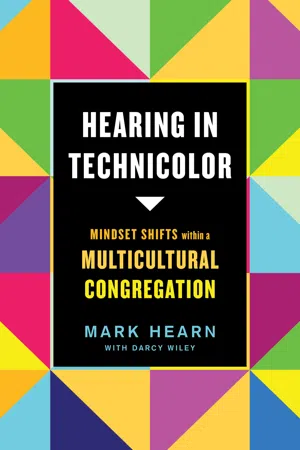
Hearing in Technicolor
Mindset Shifts within a Multicultural Ministry
- 240 pages
- English
- ePUB (mobile friendly)
- Available on iOS & Android
eBook - ePub
About this book
Information
Topic
Theology & ReligionSubtopic
Christian ChurchSection One
Legacies
Observation | Apprehension | Exhortation
Repetition | Realization | Integration
Stabilization | Appreciation | Multiplication
Chapter One
A Compelling Reason
Observation | Apprehension | Exhortation
Remember the days of old; consider the years of past generations. Ask your father, and he will tell you, your elders, and they will teach you. (Deuteronomy 32:7)
When we want to know God’s will, there are three things which always concur: the inward impulse, the Word of God, and the trend of circumstances. Never act until these three things agree. (F. B. Meyer)
One of the great joys of pastoring a multicultural church is learning the diverse traditions that our people adhere to from their homeland. When Pastor Abioye Tela brought his family from Nigeria to Atlanta in June of 2017 to begin his doctorate degree and ministry internship with our multicultural congregation, a contingency from our church welcomed them at the airport. We had strategically thought about what our new neighbors might like to eat for their first meal in America. Our sizable group decided to stop at Kentucky Fried Chicken for dinner before making the hour trip from the airport to Duluth. After all, chicken is the universal food! (One year, I had actually eaten Kentucky Fried Chicken in four different countries!) Abioye told our staff that the difference between Americans and Africans is that Americans eat rice with their chicken and Africans eat chicken with their rice.
The Telas would be living at our home for their first two weeks in the country. The church had secured an apartment for them, but it would not be available until the first of the month. We entered our driveway and welcomed our African friends as our houseguests. Due to the length of their travel, the entire family was off to bed rather quickly. But the next morning, as Glenda and I announced that breakfast was served and that our guests could come whenever they were ready, Pastor Abioye and his wife Joke’s (pronounced Joe-Kay) young children, Aanu and Anjola, bounced down the stairs like typical five- and seven-year-olds. Immediately, Pastor Abioye appeared with Joke and instructed the children in their native Yoruba. Before I knew it, the children were lying at our feet with their faces to the ground, totally prostrate before Glenda and me. Abioye and Joke then walked toward us and each bowed down and touched our feet. Abioye explained that it is the custom in his country to honor one’s elders in such a way. This display of homage is not saved for special ceremonies but is carried out daily in their home culture. Age is of such value in their background that “elder” would be defined as anyone older than yourself, even if only by one day. As I encouraged the Telas to return to their feet, I told them that this would not be expected by elder people in their new location. However, the heart behind the gesture has formed a lasting impression on me.
I was taught by my parents the biblical principle of respect for my elders. During my nearly forty years of pastoral ministry and in every aspect of my life, I have attempted to honor this admonition. Now, I am becoming one of the “elders.” At times, people overlook or dismiss the aged population in a community, but I have seen God work in a great way among my church’s longest-tenured members. The first section of this book is to share the incredible story of transition among this group that I commonly refer to as our legacy members. Every person in this group has been at the church for a minimum of twenty years. These amazing people have offered wisdom, perspective, and stability in the midst of a dramatically changing environment.
When I get the opportunity to share our church’s technicolor story in conferences or consultation settings, the one question that always arises is: “How did you keep your senior adults engaged during the transition?” Many are surprised to learn that this remarkable generation, rich in leadership capacity and experience, are among the captains of change in our church. However, this group has lived long enough to know that not ALL change is good. And change for the sake of change is not something you’ll see them seeking out. But this generation is looking for compelling reasons that warrant change. This is their discovery of those compelling reasons.
Step One: Observation
One would have to be living in a bubble not to recognize the national change that has happened in America. We are living in an increasingly diverse society. Demographer William Frey reports that there is unprecedented ethnic and cultural change that is transforming the United States. Frey estimates that, according to current growth patterns, the United States will be “majority-minority” by the year 2050 (meaning that no one group will comprise 50 percent of the population). The fastest growth rates in minority groups are with Asians (102%), Hispanics (121%), and those that identify with two or more ethnicities (191%). Frey refers to these three groups as the “new minorities” that are reshaping the face of America.3 In the 2010 census, Duluth had already arrived at “majority-minority” status. Duluth Mayor Nancy Harris realizes that our county is a generation ahead of the national curve. “The way Gwinnett County looks now is the way the entire United States is predicted to look by the year 2050,”4 Harris says. When speaking to other government leaders, Harris notices an increasing interest in how our city is handling diversity, promoting unity, and creating workable solutions.
The changing demographic of America has resulted in churches that lack stability. Church growth expert Thom Rainer says, “Several thousand churches are closing each year. The pace will accelerate unless our congregations make some dramatic changes.”5 What changes need to be made to stop this statistical slide? Rainer says that one such change is for the church to adequately reflect the ethnic, racial, and socioeconomic makeup of the community. Churches where the members drive in from neighboring areas likely know little about the spiritual needs of the church’s community.
Our legacy members have not only seen national change but have experienced nearby change in the city of Atlanta. In 1966, there were 166 Southern Baptist churches inside the Atlanta perimeter. Of those 166, there are only 31 churches that still exist today. In the ’70s, ’80s, and ’90s, inner city neighborhoods changed, and many White church members moved to the suburbs in predominantly homogeneous communities. As church members moved to the outskirts, many left their inner-city church pews empty, leaving the remaining members with the responsibility of keeping up the building, programs, and local ministries with depleted tithes and offerings. Some churches kept their suburban attendees but eventually felt the pull to move to the areas that their current membership now called home. The historic First Baptist Church of Atlanta is one of those, relocating from their church facilities in the heart of the city to their current site just outside the perimeter in 1997. Bell South Corporation bought the downtown property with the thought of preserving it as a cultural center housing the city’s symphony orchestra, but talks came to nothing and they ended up leveling the historic structure to put an office building in its place.
Wilbur Brooks remembers growing up as a small-town Georgia boy hungry for God’s Word. Week after week he’d turn the knob on his radio ever so slightly to tune in to a favorite broadcast out of Baptist Tabernacle in downtown Atlanta. Soon, a familiar voice would come through the fabric-covered speakers, and the rich, resonant tone of Morgan Blake’s voice would hit the airwaves. Morgan was a men’s Bible teacher at the Baptist Tabernacle and hosted a businessmen’s Bible study in downtown Atlanta that regularly attracted more than one hundred key leaders of the city. Wilbur turned up the volume on the radio and sat down to open his Bible and be discipled through the ministry of this long-established church that burgeoned with more than three thousand members in the 1950s. Wilbur grew in his faith through the thriving outreach of that Atlanta church. But sadly, he would, one day, turn the dial to that same place on the radio and hear nothing but static.
By the 1980s, the “white flight” phenomenon had whittled the Baptist Tabernacle down to five hundred members. The changes left the church with dwindling resources that forced it to discontinue its wide-reaching programs in the congregation and the community. In 1994, the church went from decline to death when the mere one hundred remaining members voted to sell the building to House of Blues and cease to exist as a congregation. Today, the historic building is owned by another live performance and venue operating company. Wilbur is now in his nineties and is the only remaining World War II veteran at First Baptist Duluth. He is still active in our church and teaches the eldest senior adult Sunday school class. His class represents decades of wisdom from legacy members’ life with Christ. “The Baptist Tabernacle is now a nightclub. That’s what happens when you don’t reflect the community,” Wilbur laments. “I have seen things change in downtown Atlanta, and if we want to maintain our church here, we’re going to have to change, and we’re going to have to see our congregation reflect the same makeup as the community.”
Our legacy members had not only observed national change and lived through the nearby change of the city of Atlanta, but they were now being confronted with the personal nature of neighborhood change. First Baptist Duluth reaped the benefit of the evacuating Baptists from downtown churches. Urban Atlanta’s pattern of church decline had brought rising attendance to churches in many of the surrounding municipalities, including ours. By the mid-’90s, First Baptist Duluth was being recognized as one of the fastest-growing churches in the suburbs. One of the church’s longest-tenured staff members, Keith Murdock, came to serve in 1997 during the zenith of growth for the fellowship. Pastor Keith was brought to Duluth to render expertise in establishing two worship services and two Sunday schools in order to accommodate the rapid growth. The senior pastor at the time, Dave Parker, had come to Duluth after long-term service as a missionary in Zambia with the International Mission Board. Members of First Baptist Duluth easily caught his vision for international and local missions and gave more than $500,000 a year to mission causes. The church was also engaged in funding church planting in Atlanta and around the world with gifts of $80,000 a year. First Baptist Duluth was a healthy, vibrant, catalytic church in the suburbs. Growing numbers indicated a thriving church. Yet no one realized just how delicate the statistics were under the surface.
The population of the county continued to grow, but all of a sudden, the church itself stalled in its numbers, dropping eighty to ninety people a year in attendance. The church leadership hadn’t changed. The church programming that had previously met the needs of the membership had continued. But observation of the sanctuary and classrooms left an eerie sense of loss, as if half the people were out of town on vacation every week. Perplexed, Senior Pastor Dave Parker asked Keith to form a task force to figure out the cause behind these unexpected changes.
No one understood it at the time, but the church’s health was entirely dependent upon the migration patterns of the White middle-class majority that made up the congregation. The young families who had moved to Duluth for its attractive schools and neighborhoods were now getting eyes for towns to the north where they could get larger, newer, and nicer houses. The starter homes they left behind were beginning to be occupied by people from a variety of different ethnicities. International interest in the area had surged after Atlanta hosted the 1996 Olympics. Duluth was about to become one of the most rapidly diversifying areas of the country.
First Baptist Duluth, a missional church with a heart for ministry, was now itself losing numbers. The church sought out a consultant from the denomination to lead them in ascertaining next steps in their new normal. One day, the consultant brought in a stack of charts and graphs and a laptop with some fancy demographic software that enabled him to compare and contrast the characteristics of the people inside the church with the people living in the surrounding radius of the neighborhoods. Keith remembers the tension in the room when the demographer said, “You’re in the exact wrong place to be. The people who are easy for you to reach have moved north of you. Nobody who is easy for you to reach lives around you.” This conclusion was based upon the “homogeneous unit principle” that postulates that people are more likely to attend a church where they do not have to cross a racial, linguistic, or class barrier. In other words, the prospect of maintaining a ministry presence in Duluth would require the difficult task of learning how to share the gospel across these barriers. Things were changing. The trend in church decline had not stopped with urban Atlanta. Our community grew in numbers while many long-established churches declined. The consultant warned, “I know of no other church with your kind of demographics that survived. The only question that you must ask yourself is not if you’re going to move, but when you are going to move. Your members are already leaving . . .”
The seismic demographic shift had reached the suburbs. Tom Jones, a retired Southern Baptist missionary to Kenya, relocated to the Duluth area. The Joneses purchased their home in 1997 while on an extended furlough. They went back to the mission field and then later returned to their chosen retirement spot in 2006. Upon his return, he observed the incredible change that had taken place in less than a decade. “Our house was located in a cul-de-sac with a total of fifteen homes. When we bought the house in 1997, the entire neighborhood was Anglo. When we returned in 2006, only five of the fifteen homes were occupied by Anglo families. The houses on both sides of ours were occupied by families from India. (Interestingly, our daughter and son-in-law were serving as missionaries in India at the time.) Across the street was an African American family. There were also several Korean families among us. I asked myself the question: ‘What is the local church going to do to reach this community?’”
Not only had the demographic shift reached our suburban neighborhoods, but so had the trend of church closings. Each year, additional fellowships would close their doors or sell their facilities to another congregation. Some relocated, others merely ceased to exist. First Baptist Duluth leaders observed this trend move up the Interstate 85 corridor into the northern suburbs like a plague. Life-and-death choices were now affecting our nearest neighboring churches. One of First Baptist Duluth’s longest-tenured members is Charles Summerour, who has been affiliated with the church the entirety of his seventy years of life. Charles is a local historian who has observed, firsthand, the changes in the community and in the church. Charles said, “Look at the history of this area. You start south of us and there is church closing after church closing. And I’m not talking about just any churches, but ‘First’ Baptist Churches! Until the church just six miles from our church closed . . .” This trend of church closure seemed to be headed directly toward us.
Founded in 1886, our church was well over a hundred ye...
Table of contents
- Foreword by Dr. Noe Garcia
- Introduction: Hearing in Technicolor
- Section One: Legacies
- Section Two: Languages
- Section Three: Leaders
- Conclusion: Be Opened by Darcy Wiley
- Notes
Trusted by 375,005 students
Access to over 1.5 million titles for a fair monthly price.
Study more efficiently using our study tools.
Frequently asked questions
Yes, you can cancel anytime from the Subscription tab in your account settings on the Perlego website. Your subscription will stay active until the end of your current billing period. Learn how to cancel your subscription
No, books cannot be downloaded as external files, such as PDFs, for use outside of Perlego. However, you can download books within the Perlego app for offline reading on mobile or tablet. Learn how to download books offline
Perlego offers two plans: Essential and Complete
- Essential is ideal for learners and professionals who enjoy exploring a wide range of subjects. Access the Essential Library with 800,000+ trusted titles and best-sellers across business, personal growth, and the humanities. Includes unlimited reading time and Standard Read Aloud voice.
- Complete: Perfect for advanced learners and researchers needing full, unrestricted access. Unlock 1.5M+ books across hundreds of subjects, including academic and specialized titles. The Complete Plan also includes advanced features like Premium Read Aloud and Research Assistant.
We are an online textbook subscription service, where you can get access to an entire online library for less than the price of a single book per month. With over 1.5 million books across 990+ topics, we’ve got you covered! Learn about our mission
Look out for the read-aloud symbol on your next book to see if you can listen to it. The read-aloud tool reads text aloud for you, highlighting the text as it is being read. You can pause it, speed it up and slow it down. Learn more about Read Aloud
Yes! You can use the Perlego app on both iOS and Android devices to read anytime, anywhere — even offline. Perfect for commutes or when you’re on the go.
Please note we cannot support devices running on iOS 13 and Android 7 or earlier. Learn more about using the app
Please note we cannot support devices running on iOS 13 and Android 7 or earlier. Learn more about using the app
Yes, you can access Hearing in Technicolor by Mark Hearn,Darcy Wiley in PDF and/or ePUB format, as well as other popular books in Theology & Religion & Christian Church. We have over 1.5 million books available in our catalogue for you to explore.