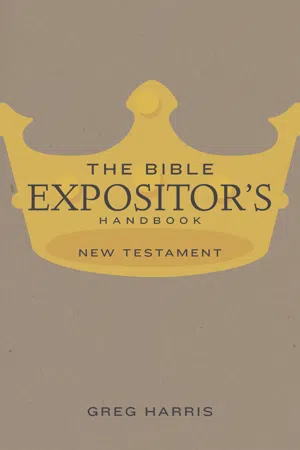
Using the Bible as the original textbook, Greg Harris shows readers the continuity and cohesiveness of God's Word.The Bible Expositor's Handbook: New Testamentpicks up where the Old Testament edition ended.Rather than jumping into Matthew, where our New Testament begins, Harris instead looks to Luke 24 where Jesus taught througheverybook of the Old Testament, showing truths that were either already fulfilled by him or would be in the future. This unique approach enables the reader to have a greater confidence is what God's Word teaches, and a greater love and appreciation for our Lord Jesus Christ.
- 208 pages
- English
- ePUB (mobile friendly)
- Available on iOS & Android
eBook - ePub
About this book
Information
Topic
Theology & ReligionSubtopic
Christian MinistryChapter 1We've Been Expecting You
About forty years ago, when I was in my early twenties, I taught eighth grade English in a public school for four years in Garner, North Carolina. I had either just gotten saved or else was saved earlier and then did the prodigal son route throughout college. I will find out when I get to heaven exactly when I was saved. Still, even at this early part of my Christian walk, I had a keen desire to know what the Bible said and what it meant. In a time before the Internet existed and without many other resources available now, two other teachers and I sat in a circle, started in Matthew 1:1, and made our way through a few verses. With each verse, we told the others, "This is what this verse means to me." We were the blind leading the blind, and fortunately no recordings were made of our well-intended folly. We each had the King James Version for our Bible and had to work through all the "begats" in Matthew 1 (e.g., v. 2 "Abraham begat Isaac"). We only met a few times. As before, our motives were good, but our methodology was woefully lacking. We will tie this in in a moment, but let's consider one core truth for our study: "This is what this verse means to me" is totally irrelevant to biblical truth; however, "This is what God means by this verse"—if understood accurately (2 Tim 2:15)—is eternally important.
Fast-forward two decades later to a time when I was blessed to teach three years at a pastors' conference in Kenya that included more than two hundred attendees. Many of the pastors had walked for days to come and study the Bible; for most of them, it was the only training they would receive that year. Also, many of the pastors only had a pocketsize Gideons New Testament. The conference provided Bibles for the pastors who needed them, and what a delight to watch some of the pastors read Genesis 1 for the first time.
We three well-intended teachers who did their Bible study starting in Matthew 1 actually—by default—did what many of the Kenyan pastors did and many well-meaning Christians today still do: anyone who begins a study of the Bible in Matthew 1 will be just as lacking as we were because of three irreplaceable doctrinal truths. First, if we begin in Matthew 1, we do not begin where Jesus did previously in John 5:45-46 ("For if you believed Moses, you would believe me, because he wrote about me," CSB). Second, later on the day of His resurrection, Jesus revealed to the two road-to-Emmaus disciples, in Luke 24:25-27, the importance of the Old Testament in its witness of Him:
And He said to them, "O foolish men and slow of heart to believe in all that the prophets have spoken! Was it not necessary for the Christ to suffer these things and to enter into His glory?" Then beginning with Moses and with all the prophets, He explained to them the things concerning Himself in all the Scriptures.
As He would likewise do with the assembled apostles, in Luke 24:44-47:
Now He said to them, "These are My words which I spoke to you while I was still with you, that all things which are written about Me in the Law of Moses and the Prophets and the Psalms must be fulfilled." Then He opened their minds to understand the Scriptures, and He said to them, "Thus it is written, that the Christ would suffer and rise again from the dead the third day, and that repentance for forgiveness of sins would be proclaimed in His name to all the nations, beginning from Jerusalem."
If we begin studying the Bible in Matthew 1, (1) we do not start where Jesus started, and (2) we do not know or mark any of the tremendously important Old Testament prophetic truths in reference to the Person and work of who the Messiah would be or the scriptural qualifications and requirements that the Messiah must fulfill if He is to truly qualify as God's Messiah. So, our final irreplaceable doctrinal truth connects with this: (3) we do not know of any previous promises and prophecies that God had given for the Jewish people and ultimately that they effect the entire world—as well as anyone ever born. If we begin our study in Matthew 1, we do not know that we are starting—at the very least—in midstory, oblivious to many of the doctrinal truths God has already revealed, especially as seen in His covenants that He made and many divine prophecies contained within and beyond these verses.
Further, the noble Berean believers are often cited—for good reason—as using the proper mode of investigating the teaching of others. In Acts 17:11 "The people [of Berea] were of more noble character than those in Thessalonica, since they received the word with eagerness and examined the Scriptures daily to see if these things were so" (CSB). The Scriptures they were examining were the Old Testament Scriptures, which began setting forth the story of Jesus and the covenant faithfulness of God. The New Testament would flesh out and fulfill much of the story of Jesus—and, as we will clearly see in Scripture—so many more precise promises and prophecies still remain to be fulfilled on this side of the cross.
The Stirring Up by Way or Reminder and Transitioning to the New Testament
When Peter was just about to die, he wrote 2 Peter, using a large part of it to counter the teachings of false teachers. Peter protectively wrote to certain churches in Asia Minor in 2 Peter 1:12-15:
Therefore, I will always be ready to remind you of these things, even though you already know them, and have been established in the truth which is present with you. I consider it right, as long as I am in this earthly dwelling, to stir you up by way of reminder, knowing that the laying aside of my earthly dwelling is imminent, as also our Lord Jesus Christ has made clear to me. And I will also be diligent that at any time after my departure you will be able to call these things to mind.
The same will be true for us.
Ideally, before we start the next part of our study, everyone has read The Bible Expositor's Handbook—Old Testament, where—in the space of only fifteen chapters—I tried to set forth a logical progression that feeds into the New Testament and this initial chapter in The Bible Expositor's Handbook—New Testament. I know, however, this is not the case. So, if you are able, read the Old Testament edition first, and if you are not able to do that, at least read the Scripture verses we covered. Ideally you should do this first because, as we saw, starting your study of the Bible anywhere in the New Testament is starting midstory and is removed from many of the promises and prophecies of God, especially as He showed in His covenants.
For those who have read The Bible Expositor's Handbook—Old Testament, let me do a brief walk-through or review (1) to stir us up by way of remembrance and (2) to allow others who have not or will not read what we have studied to grasp at least some of the content of the biblical truths from the irreplaceable point of beginning.
The Bible Expositor's Handbook—Old Testament
Chapter 1: So You Want to Be an Expositor?
In this chapter we learned, first, that the starting point for becoming an expositor of God's Word is God Himself, and there are no shortcuts to becoming a seasoned expositor. It takes time and effort to "grow in the grace and knowledge of our Lord and Savior Jesus Christ" (2 Pet 3:18). Without being overtly mystical about this, if you think you will ever outgrow this initial core concept that being a disciple means being a person who is ultimately taught by God, you will not have any true ministry resulting from your walk with Him. Second, we learned that one should not go to God's Word for a sermon or a teaching outline; we go to God's Word for truth. From the truth found in God's Word emerge expository sermons and teachings. Third, two additional truths from this initial chapter are interconnected. (1) Your expository preaching or teaching will only be as good as your expository study, or lack thereof. (2) Expository preaching is much more than "expository calendaring." You can go through the text of a biblical book in sequential order and still not necessarily be handling God's Word accurately. So even employing the tried-and-true process of (1) observation of a text, (2) interpretation of the text, and (3) application from the text will not necessarily by itself involve rightly dividing the Word of God.
Chapter 2: The Old Testament Is the Story of Jesus
In this chapter we learned the core essential truths for how God wants His Old Testament to be read. First, it is clear from passages such as John 5:45-47; Luke 24:27, 44; Acts 2:22-23; and 1 Peter 1:17-20 that the Old Testament presents many eternal doctrinal truths—not merely life-lesson applications. Second, and more specifically, it was shown that long before the first sin occurred, the Godhead had already determined the divine plan—singular—of salvation. And long before the first sinners appeared in Genesis 3, a Savior—singular—was already in the mind of God. Genesis 3:15 promised that One will come and crush the head of Satan, and the Old Testament is the beginning of that blessed, unfolding story. Third, we learned that the Old Testament is the story of Jesus—not "was the story"—because so much of it remains yet to be fulfilled by the same God who has already fulfilled the first part with His holy precision.
Chapter 3: Why Are There So Many Different Interpretations of the Bible?
How one answers the two following questions will set a governing trajectory for how the rest of Scripture will be interpreted: (1) What is the first covenant of God in the Bible, and what are the hermeneutics used to interpret it? and (2) What is the second covenant of God in the Bible, and what are the hermeneutics used to interpret it? In this chapter I proposed that the burden of proof rests on those who accept and interpret God's first covenant in Genesis 9 (i.e., the Noahic covenant) in a literal fashion for everything contained in it and yet switch the hermeneutic for the next covenant of God so that much of it is to be understood as only allegory that is fulfilled only spiritually. Following the biblical trail of the unfolding story line of the Old Testament, we saw repeatedly that it is the literal-grammatical hermeneutic that makes the most logical sense. This approach is manifest, not least, in Luke 1-2. Here both chapters refer to the Abrahamic promises, the fulfillment of which is best understood in light of a literal-grammatical hermeneutic in both promise and fulfillment. Simply put, there is no Luke 2—the Christmas story—without Luke 1, which twice refers to God remembering the Abrahamic covenant as part of what He was beginning to do at that time.
Chapter 4: Four Biblical Examples of Moses Writing about Jesus
In this chapter we discussed two important safeguards for studying Old Testament texts to see if they correctly apply to the Messiah. (1) Is there a direct New Testament text that clearly shows the Holy Spirit intended this to be in reference to the Messiah? (2) If no New Testament parallel texts exist, who appears exhibiting the attributes of God or doing the activities of God? Considering these safeguards, we saw that "the angel of the Lord" spoke as God, acted as God, and was worshipped as God. In addition, we looked at three examples that have New Testament verification: God's Passover Lamb (John 1:29-36; 1 Cor 5:7), the Lion from the tribe of Judah (Rev 5:1-5) and, finally, the Rock, viewed through the biblical lens of 1 Corinthians 10:1-4 ("and the rock was Christ").
Chapter 5: The Mosaic Covenant and Its Biblical Relevance
This chapter showed that we cannot start our study of Scripture with the Mosaic covenant, even though it will play a significant role in our understanding of much of the New Testament. Long before the ratification of the Mosaic covenant in Exodus 24, God had already revealed many other truths, such as the Abrahamic covenant, given in Genesis. We saw, for example, that when God ratified the Abrahamic covenant in Genesis 15:12-14, He foretold events that would occur later in Exodus. Accordingly, while Exodus 1 shows the nation of Israel enslaved in Egypt, Exodus 2 ends with God acting in full accordance with His word, remembering His covenantal promises to Abraham.
There were a few important points made regarding the Mosaic covenant. First, it is the only covenant of God so far in which somebody else was present and active at its ratification. Second, as long as the Mosaic covenant was in effect, the Jewish people of national Israel were under covenant obligation to do all that Yahweh commanded them to do. Third, the Mosaic covenant includes the "blessing-and-curse" section of Leviticus 26 (and later in Deuteronomy 27-28), in which God promised to bless national Israel if they walked in covenant obedience with Him and enumerated specific curses that would surely come upon them if they did rebel against Him. Fourth, we noted the eschatological importance of Leviticus 26:40-45, which ended with hope given by God to the Jewish people, especially in reference to a future regathering of national Israel to the land, based throughout this section on the land promises God had made—and would keep—under the Abrahamic covenant. Just as in the account of Moses in Exodus 32, God based His future actions on His faithful keeping of the Abrahamic covenant, not on national Israel's failure under the Mosaic covenant. Finally, we learned of one crucial time marker for our understanding that we will review later in this chapter.
Chapter 6: A Star! A Star! Shining in the Night!
In this chapter we explored the ways in which Scripture progressively builds on itself by harmonizing with, and expanding upon, previous God-given promises. We saw that (1) Numbers
22-24 is God's word, not Balaam's word; (2) this text repeatedly refers to national Israel as a people; and (3) the blessing or cursing that the Gentile king Balak wanted Balaam to perform is at the heart of the Abrahamic covenant promises and is a direct challenge to Yahweh's authority and domain (e.g., Gen 12:3; Num 24:9). So (4) the character of God is at stake if Balaam is allowed to curse those whom God has not cursed. Finally, (5) Numbers 22-24 adds additional revelatory light that expands and harmonizes with God's previous promises about His Messiah, such as the promise of a king in 23:21: "The Lord his God is with him, / And the shout of a king is among them." Accordingly, the Christmas account featuring the wise men is not based on one isolated prophecy but a series of prophecies, most of which have yet to be fulfilled, many of them awaiting the second coming of the Messiah. And because God fulfilled the star promise of 24:17, we can have confidence that He will do so with the remaining promises.
Chapter 7: The Biblical Logic of Joshua 1-6
In this chapter we saw that one cannot start with the battle of Jericho (Joshua 6) and hope to be remotely accurate in one's understanding of Scripture. The significance of this epic battle is understood only in light of (1) the land promises that God had made under the Abrahamic covenant (Gen 13:14-17; 15:12-21; 17:7-8) and (2) the reality that national Israel was under the Mosaic covenant, and in this covenant, as part of the blessing and the curse, God promised national Israel military victories if they were obedient to Him (Lev 26:7-8; Deut 28:7). Accordingly, God responded exactly as He had promised, bringing national Israel back into covenant fellowship with Him, as seen in Joshua 5—before God's actions against Jericho began. Yet in Joshua 5:13-15, it is clear that God not only prepared the nation spiritually; He also prepared the individual leader Joshua, and this is a text Jesus would most likely have pointed to in Luke 24, when speaking of things that concerned Him from all the Scriptures.
Chapter 8: But Doesn't Joshua 21:43-45 Show That God Has Fulfilled His Land Promises?
Instead of all the land promises being fulfilled by Joshua 21:41-43 and/or 1 Kings 4:20-21, the Bible clearly, repeatedly, and persistently presents just the opposite; it does so in a way that beautifully harmonizes with previous God-given prophecies (see Lev 26:40-45; Deut 30:1-10). In fact, nothing indicates that these prophecies had been fulfilled by the time of Solomon's life or even up to our present time. Not only are these land boundary promises originally given in the Abrahamic covenant and reiterated in the Mosaic covenant and in the opening of the book of Joshua, but the Bible again presents the Euphrates River as the northern boundary for the nation of Israel long after 1 Kings 4. More importantly, twice the Euphrates River also specifically relates to the Messiah's reign, first in Psalm 72:8 and then centuries afterward in the midst of the times of the Gentiles in Zechariah 9:10. In both cases the Euphrates River will be the northern boundary of Israel for His worldwide rule.
So harmonious are God's prophecies regarding the land promise to national Israel under the Abrahamic covenant, that if one did not know of an existing interpretational controversy regarding whether the land promises had been completely fulfilled by the time of Joshua 21:41-43 and/or 1 Kings 4:20-21, one would never surmise this from the text. Why? Because the promises made by God a...
Table of contents
- Dedication
- Acknowledgments
- Chapter 1: We've Been Expecting You
- Chapter 2: The Gospel According to Isaiah
- Chapter 3: Why Do You Speak to Them in Parables?
- Chapter 4: Five Theological Bombshells From Matthew 16
- Chapter 5: The Glory of God Changes Everything
- Chapter 6: This Is the Day That the Lord Has Made
- Chapter 7: The Wager and Why the Darkness Was Over the Cross
- Chapter 8: In Christ Alone
- Chapter 9: And How Shall They Hear Without a Preacher?
- Chapter 10: The Word of God or the Word of Man?
- Chapter 11: Seven Astounding Doctrinal Truths From 2 Thessalonians 2
- Chapter 12: A Biblical Theology of the Ages of God
- Chapter 13: Twelve Things Most People Do Not Know About the Book of Hebrews
- Chapter 14: A Broad Theological Walk Through the Book of Revelation
- Chapter 15: Will the Antichrist Actually Rise From the Dead? And, Why Satan Must Be Released
Trusted by 375,005 students
Access to over 1.5 million titles for a fair monthly price.
Study more efficiently using our study tools.
Frequently asked questions
Yes, you can cancel anytime from the Subscription tab in your account settings on the Perlego website. Your subscription will stay active until the end of your current billing period. Learn how to cancel your subscription
No, books cannot be downloaded as external files, such as PDFs, for use outside of Perlego. However, you can download books within the Perlego app for offline reading on mobile or tablet. Learn how to download books offline
Perlego offers two plans: Essential and Complete
- Essential is ideal for learners and professionals who enjoy exploring a wide range of subjects. Access the Essential Library with 800,000+ trusted titles and best-sellers across business, personal growth, and the humanities. Includes unlimited reading time and Standard Read Aloud voice.
- Complete: Perfect for advanced learners and researchers needing full, unrestricted access. Unlock 1.5M+ books across hundreds of subjects, including academic and specialized titles. The Complete Plan also includes advanced features like Premium Read Aloud and Research Assistant.
We are an online textbook subscription service, where you can get access to an entire online library for less than the price of a single book per month. With over 1.5 million books across 990+ topics, we’ve got you covered! Learn about our mission
Look out for the read-aloud symbol on your next book to see if you can listen to it. The read-aloud tool reads text aloud for you, highlighting the text as it is being read. You can pause it, speed it up and slow it down. Learn more about Read Aloud
Yes! You can use the Perlego app on both iOS and Android devices to read anytime, anywhere — even offline. Perfect for commutes or when you’re on the go.
Please note we cannot support devices running on iOS 13 and Android 7 or earlier. Learn more about using the app
Please note we cannot support devices running on iOS 13 and Android 7 or earlier. Learn more about using the app
Yes, you can access The Bible Expositor's Handbook, NT Edition by Greg Harris in PDF and/or ePUB format, as well as other popular books in Theology & Religion & Christian Ministry. We have over 1.5 million books available in our catalogue for you to explore.