eBook - ePub
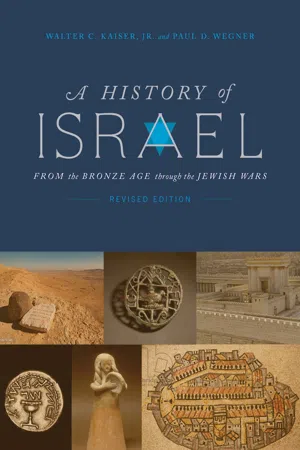
A History of Israel
From the Bronze Age through the Jewish Wars
- 728 pages
- English
- ePUB (mobile friendly)
- Available on iOS & Android
eBook - ePub
About this book
This volume provides a comprehensive introduction to the history of ancient Israel—from the creation account to setting the stage for the New Testament era. This edition has been thoroughly revised, but maintains its focus on Old Testament texts as well as ancient Near Eastern literary and archeological sources to highlight the important modern controversies surrounding this part of Scripture. The work provides an up-to-date, conservative, evangelical position on matters relating to ancient Israel’s history and is illustrated with over 600 figures, charts, and maps.
Trusted by 375,005 students
Access to over 1 million titles for a fair monthly price.
Study more efficiently using our study tools.
Information
Part I
The Patriarchs and Their Residence in Egypt
4THE EARLY BRONZE AGE (3300–2200 BC)
During the last centuries of the fourth millennium BCE, far-reaching changes occurred throughout the ancient Near East. In both pharaonic Egypt and Sumerian Mesopotamia literary civilizations developed, characterized by complex systems of government and by religious, administrative, and social hierarchies.1
THE EARLY BRONZE PERIOD (3300–2200 BC)
The traumatic circumstances that ended the Chalcolithic period were short-lived. Mazar describes the amazing changes that burst forth from the ANE at the beginning of the next time period:

These two great civilizations [Egypt and Sumer] succeeded, for the first time in the history of mankind, in organizing masses of people to carry out large-scale public works exploiting for irrigation the Nile, Tigris, and Euphrates rivers. Both civilizations developed a system of writing, as well as monumental architecture and art . . . [D]uring the third millennium BCE., Palestine and Syria felt the impact of the two great civilizations which emerged at either end of the Fertile Crescent.2
WRITING
Probably the most important innovation was writing, which developed about the same time in both Mesopotamia3 and Egypt; but soon both areas were literate (Fig. 4.1). Bright says, “Early in the third millennium, history, properly speaking, begins. That is to say, one enters for the first time an age that is documented by contemporary inscriptions that can, unlike the earlier texts of which we have spoken, be read.”4

FIG. 4.1 EARLY PICTOGRAMS
Writing forever changed the way humans intereact with each other. Societies could record their histories, business transactions, accounts of offerings to their gods, and hosts of other things (Fig. 4.2). Coogan states,
Both [writing] systems [i.e., Egypt and Mesopotamia] originally use a pictographic system in which a picture or icon represented a single object, action or concept. These pictures rapidly became stylized, and soon some were also used as phonograms, to represent a sound or syllable. Because of the necessity of learning hundreds of symbols in order to represent even a limited vocabulary, literacy was for the most part restricted to a specially trained class known as scribes.
In Sumer, as subsequently in its successors Babylonia and Assyria, the principle medium of writing was clay. Before the moistened clay had fully hardened, the symbols were inscribed on it with the sharpened point of a reed, resulting in wedge shapes; each wedge or combination of wedges represented a symbol or syllable. . . .
In Egypt, a locally available reed, papyrus, was processed to become a cheap and durable writing surface. . . .5

FIG. 4.2 SUMERIAN CUNEIFORM TABLET FROM SHURUPPAK, IRAQ (CA. 2500 BC)
URBANIZATION
The Early Bronze (henceforth EB) period saw significantly increased urbanization, with a growing number of settlements and more complex social organizations. The presence of a military with increasingly sophisticated weaponry was another major innovation. Some of the earliest fortifications in Israel were constructed during this period (Fig. 4.3).
International trade routes crossed Canaan, bringing goods from both Mesopotamia and Egypt. Coogan describes the economic shift of this period:

FIG. 4.3 EB AGE GATE AT MEGIDDO
As populations increased, agriculture also became a specialized activity. No longer could each family or domestic unit supply its own food. Many of its members might pursue other occupations—soldiers, builders, priests, potters, metallurgists, administrators—and their needs would have been met by others—farmers, herders, traders.6
EARLY BRONZE I (3300–2900 BC)
The EB I period is not as sharply defined or agreed on by scholars. For example, some of the pottery (particularly the “gray burnished ware”) labeled “Late Chalcolithic” by some scholars was contemporary with what others designated as “EB I.” Perhaps the best solution is to employ the label EB I to apply to all pre-urban settlements of the EB Age.

MESOPOTAMIA
Near the beginning of the third millennium BC, the Sumerian civilization (Classic Sumerian [Early Dynastic] Age, ca. 2850–2360 BC) was organized around approximately twelve mostly small city-states. Each city-state was a theocracy controlled by a particular god; the land was his estate and the temple his manor. Kings ruled at the behest of the gods who allowed them to reign as long as they maintained law and order. A Semitic population known as the Akkadians also lived in Mesopotamia. Bright describes them:
No doubt they had been seminomads in the areas to the northwest of Sumer since earliest times, and had pressed in, in increasing numbers, since the fourth millennium. By the mid-third millennium they constituted an appreciable portion of the population, in northern Sumer the predominant portion. These Semites took over Sumerian culture in all its essentials and adapted it to themselves. Though they spoke a Semitic language (Akkadian) entirely different from Sumerian, they borrowed the cuneiform syllabic script to write it; texts in Akkadian reach back to the mid-third millennium.7
In time these Semites seized power (the Empire of Akkad, ca. 2360–2180 BC; Fig. 4.4) and founded the first true empire under Sargon, who captured Sumer and expanded his territory all the way to the Persian Gulf (Fig. 4.5).

FIG. 4.4 THE EMPIRE OF AKKAD

FIG. 4.5 SARGON OF AKKAD
EGYPT
About the same time, the First Dynasty (ca. 3000–2840 BC) was being established in Egypt under Narmer, who unified both Upper and Lower Egypt into a united kingdom. Shortly after this, with the rise of the Third Dynasty began one of the most foundational times in Egyptian history, known as The Old Kingdom period (ca. 2686–2181 BC) or the Age of the Pyramids. Cheops, Chefren, Mycerinus, and the Step Pyramid of Memphis were all constructed during this time (Fig. 4.6).

FIG. 4.6 THE STEP PYRAMID
The strength of this kingdom also allowed for important trade interaction with the rest of the ANE, particularly with the land of Palestine.
PALESTINE
Palestine did not develop a material culture as sophisticated as Mesopotamia’s, but it did see a significant increase in population, in the number and quality of cities, fortifications, pottery, and especially in the establishment of city-states. They appear to have had a common language, which Bright describes:
Their language was presumably the ancestor to that spoken by the Canaanites in Israelite times, of which Biblical Hebrew...
Table of contents
- Preface
- Abbreviations
- List of Maps
- INTRODUCTORY MATTERS
- PART I: THE PATRIARCHS AND THEIR RESIDENCE IN EGYPT
- PART II: THE SOJOURN IN EGYPT, THE EXODUS, AND SINAI
- PART III: THE ISRAELITE OCCUPATION OF THE LAND
- PART IV: THE PERIOD OF THE JUDGES
- PART V: THE MONARCHY
- PART VI: THE DIVIDED MONARCHY: THE INDEPENDENT KINGDOMS OF ISRAEL AND JUDAH
- PART VII: THE BABYLONIAN EXILE (605–536 BC)
- PART VIII: THE PERSIAN HEGEMONY (539–332 BC)
- PART IX: THE INTERTESTAMENTAL PERIOD
- Epilogue
- Photo Credits
- Name Index
- Subject Index
Frequently asked questions
Yes, you can cancel anytime from the Subscription tab in your account settings on the Perlego website. Your subscription will stay active until the end of your current billing period. Learn how to cancel your subscription
No, books cannot be downloaded as external files, such as PDFs, for use outside of Perlego. However, you can download books within the Perlego app for offline reading on mobile or tablet. Learn how to download books offline
Perlego offers two plans: Essential and Complete
- Essential is ideal for learners and professionals who enjoy exploring a wide range of subjects. Access the Essential Library with 800,000+ trusted titles and best-sellers across business, personal growth, and the humanities. Includes unlimited reading time and Standard Read Aloud voice.
- Complete: Perfect for advanced learners and researchers needing full, unrestricted access. Unlock 1.4M+ books across hundreds of subjects, including academic and specialized titles. The Complete Plan also includes advanced features like Premium Read Aloud and Research Assistant.
We are an online textbook subscription service, where you can get access to an entire online library for less than the price of a single book per month. With over 1 million books across 990+ topics, we’ve got you covered! Learn about our mission
Look out for the read-aloud symbol on your next book to see if you can listen to it. The read-aloud tool reads text aloud for you, highlighting the text as it is being read. You can pause it, speed it up and slow it down. Learn more about Read Aloud
Yes! You can use the Perlego app on both iOS and Android devices to read anytime, anywhere — even offline. Perfect for commutes or when you’re on the go.
Please note we cannot support devices running on iOS 13 and Android 7 or earlier. Learn more about using the app
Please note we cannot support devices running on iOS 13 and Android 7 or earlier. Learn more about using the app
Yes, you can access A History of Israel by Walter C. Kaiser, Jr.,Paul D Wegner in PDF and/or ePUB format, as well as other popular books in Theology & Religion & Biblical Studies. We have over one million books available in our catalogue for you to explore.