Servant leadership has been broadly and enthusiastically embraced by Christians as a model of leadership marked by humility and modeled by Jesus. But behind that attractive veneer is an approach to leadership that is problematic theologically and anemic biblically with humanistic goals and assumptions that are derived more from secular theory than biblical research. Careful examination of the servant metaphor in Scripture reveals that a leader is not primarily called to be a servant after all, but rather a slave who is obedient and ultimately accountable to God as his or her Master. This provocative picture conveys a much richer and more demanding model of leadership than servanthood when understood within its cultural context. Slaves of the Most High God provides a rigorous exegetical, historical, and theological analysis of the slave metaphor in Luke-Acts. The pattern of Christ's slave leadership in Luke and the practice of slave leadership in the early church in Acts outline a paradigm of a leader who is in authority and under authority, redeemed by God to serve his people. The author proposes a countercultural model of slave leadership outlining seven practical principles drawn from the metaphor of slavery and shaped by personal pastoral experience.
eBook - ePub
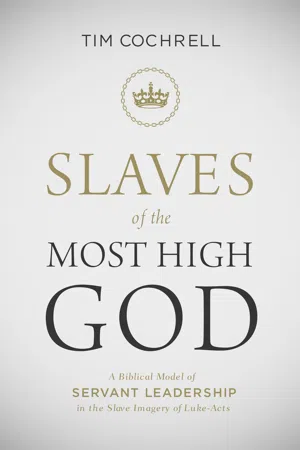
Slaves of the Most High God
A Biblical Model of Servant Leadership in the Slave Imagery of Luke-Acts
- 288 pages
- English
- ePUB (mobile friendly)
- Available on iOS & Android
eBook - ePub
Slaves of the Most High God
A Biblical Model of Servant Leadership in the Slave Imagery of Luke-Acts
About this book
Information
Topic
Theology & ReligionSubtopic
Biblical StudiesChapter 1Servant Leadership: A Flawed Foundation
Servant leadership presents a counterintuitive paradigm of power in leadership in which the leader gives up control to empower others to reach their fullest potential for the good of the organization and society as a whole.[1] The lofty rhetoric, compelling stories, and bottom-line success of servant leadership theory have made it an attractive leadership model in business and religious organizations over the past 40 years. The late Bernard M. Bass, a researcher and leadership expert, optimistically predicts that “the strength of the servant leadership movement and its many links to encouraging follower learning, growth, and autonomy, suggests that the untested theory will play a role in the future leadership of the learning organization.”[2] Many Christian writers have enthusiastically embraced this countercultural leadership model, which reflects certain biblical themes, such as selflessness, service, and humility.[3] While management consultant Keshavan Nair is certainly correct that the connection between service and leadership goes back thousands of years,[4] the distinctive model of servant leadership extant in contemporary theory has its origins in the philosophical presuppositions and altruistic principles of Robert Greenleaf that were proposed by him only 40 years ago. While the practical value of Greenleaf’s theory was quickly recognized and endorsed by popular leadership writers, only recently has servant leadership been developed into a cohesive theory including antecedent conditions, servant leader behaviors, and leadership outcomes.[5] These developments of the theory, in addition to the thousands of books and articles published on the topic of servant leadership from Christian and secular perspectives, suggest that servant leadership is arguably one of the prevailing leadership theories for the current generation.[6]
As servant leadership has grown in popularity, many Christian leaders have broadly adopted the presuppositions and methodology of secular servant leadership uncritically, correlating them to the example of Christ without careful attention to the anthropological and teleological underpinnings of this theory. This book will argue that contemporary servant leadership is problematic theologically and anemic biblically, offering a humanistic paradigm that is rooted in secular theory and incompatible with a Christian worldview. In recent years several Christian theorists have begun to critique some of the underlying assumptions of a secular servant leadership model and called for a more biblically-based paradigm of selfless leadership.[7] Dr. Jack Niewold warns, “Servant leadership in its secular form is based on non -Christian secular and religious ideas. But even in its Christianized form it is reflective of a heterodox and distorted Christology, which it in turn helps perpetuate.”[8] Some, such as Regent University’s Dr. Kathleen Patterson, have attempted to correct the prevailing model of servant leadership by augmenting it with Christian principles, such as agapao love.[9] Even these attempts to ameliorate the flaws of servant leadership have drawn mostly from other secular theories or superficial study of Scripture, leading Patterson herself to concede, “There is a gap in servant leadership literature connecting the theory to its proper Christological and biblical origins. . . . If the theory is to be complete, research needs to be conducted to fill this apparent lack.”[10] Servant leadership theory has been appropriately criticized for its humanistic anthropology, eclectic spirituality, and insufficient teleology. However, attempts to construct a distinctively biblical model of servant leadership have failed to develop a comprehensive viable alternative.[11]
A careful exegetical examination of servanthood as a metaphor in Scripture reveals a surprising paradigm, which provides a corrective to the flawed model developed in secular servant leadership and offers a distinctively Christian model of leadership that is decidedly countercultural. A servant leader in Scripture is not called to be a servant after all, but rather a slave who is obedient and ultimately accountable to God as his or her Master. Terms that are frequently translated “servant” in the Old Testament (עֶבֶד) and the New Testament (δούλος) denote slavery rather than mere servanthood, describing a “slave (whether literal or figurative) whose person and service belong wholly to another.”[12] This provocative image conveys a much richer and more demanding metaphor than servanthood when understood within its cultural context. One cannot responsibly exegete passages that repeatedly describe leaders and even Christ Himself with slave language without considering the distinctive paradigm of Christian leadership that this metaphor implies. While there has been a surge of popular and scholarly interest in the metaphor of slavery in Scripture as a model for Christian discipleship, to date the slave metaphor’s relation to leadership, in contradistinction from secular models, has received very little focused attention.[13]
Many Christian leaders and theorists have developed a paradigm of servant leadership based on secular servant leadership theory and selective exegesis of biblical passages that use servant terminology. In so doing they have generally overlooked a foundational exegetical detail concerning the lexical and cultural referent of slavery rather than servanthood. This book will argue that the slave imagery used in Scripture as a whole and in Luke-Acts in particular offers a distinctively Christian paradigm of leadership in contradistinction to the follower-oriented servant leadership paradigms that have gained popularity in secular and Christian literature alike. Rather than attempt to provide a comprehensive canonical treatment of the slave theme as it relates to leadership, this study will focus specifically on how the metaphor is used in Luke-Acts to evaluate the importance of the metaphor in the exemplary and didactic ministry of Christ and then how the metaphor was used in Luke’s narrative account of the early church and its leaders. This study will argue that slave leadership in Luke-Acts was rooted in both Hebrew and Greco- Roman understandings of slavery, in which Christians generally and leaders particularly were to understand that salvation placed them in subordination to God as Master, with clear ethical implications for the way leadership was to be carried out. A model of slave leadership encompasses the leader’s identity and behavior comprehensively. The metaphor of slavery suggests a markedly different paradigm of leadership than contemporary models of servant leadership have offered, and this study will investigate the lexical, sociocultural, and exegetical implications of this metaphor for Christian leadership.
Problems in the Servant Leadership Paradigm
This book will argue that the deficiencies of secular servant leadership reveal the need for a biblically based, distinctively Christian model that is theologically coherent and theoretically consistent, which can serve as a corrective for secular paradigms and a foundation for Christian models of servant leadership. This section will outline the primary deficiencies of the modern servant leadership model to highlight the need for a biblically based model. While this overview will offer a theological critique of the servant leadership model at points, I acknowledge that servant leadership has shifted the leadership landscape toward a more biblical model of leadership that eschews self-interest, expresses concern for others, and considers the broad implications of the leader’s actions. Despite these contributions, humanistic servant leadership theory is built on a flawed foundation, reflecting secular presuppositions regarding humanity and the ultimate aim of leadership. Even most Chr...
Table of contents
- Dedication
- Endorsements
- Acknowledgments
- Chapter 1: Servant Leadership: A Flawed Foundation
- Chapter 2: Slavery in Pre-Christian Hebrew Life and Thought
- Chapter 3: Slavery in Greco-Roman Life and Thought
- Chapter 4: “Good and Faithful Slave”: Slave Imagery in the Gospel Luke
- Chapter 5: “Your Holy Slave Jesus”: Slave Imagery in the Book of Acts
- Chapter 6: Slave Leadership: A Practical Paradigm
- Bibliography
Trusted by 375,005 students
Access to over 1.5 million titles for a fair monthly price.
Study more efficiently using our study tools.
Frequently asked questions
Yes, you can cancel anytime from the Subscription tab in your account settings on the Perlego website. Your subscription will stay active until the end of your current billing period. Learn how to cancel your subscription
No, books cannot be downloaded as external files, such as PDFs, for use outside of Perlego. However, you can download books within the Perlego app for offline reading on mobile or tablet. Learn how to download books offline
Perlego offers two plans: Essential and Complete
- Essential is ideal for learners and professionals who enjoy exploring a wide range of subjects. Access the Essential Library with 800,000+ trusted titles and best-sellers across business, personal growth, and the humanities. Includes unlimited reading time and Standard Read Aloud voice.
- Complete: Perfect for advanced learners and researchers needing full, unrestricted access. Unlock 1.5M+ books across hundreds of subjects, including academic and specialized titles. The Complete Plan also includes advanced features like Premium Read Aloud and Research Assistant.
We are an online textbook subscription service, where you can get access to an entire online library for less than the price of a single book per month. With over 1.5 million books across 990+ topics, we’ve got you covered! Learn about our mission
Look out for the read-aloud symbol on your next book to see if you can listen to it. The read-aloud tool reads text aloud for you, highlighting the text as it is being read. You can pause it, speed it up and slow it down. Learn more about Read Aloud
Yes! You can use the Perlego app on both iOS and Android devices to read anytime, anywhere — even offline. Perfect for commutes or when you’re on the go.
Please note we cannot support devices running on iOS 13 and Android 7 or earlier. Learn more about using the app
Please note we cannot support devices running on iOS 13 and Android 7 or earlier. Learn more about using the app
Yes, you can access Slaves of the Most High God by Timothy Cochrell in PDF and/or ePUB format, as well as other popular books in Theology & Religion & Biblical Studies. We have over 1.5 million books available in our catalogue for you to explore.